From the January 2026 issue of Apollo. Preview and subscribe here.
‘About suffering they were never wrong, / The Old Masters’, claims Auden in his poem ‘Musée des Beaux Arts’ (1938), before going on to describe some of the paintings that show ordinary people ignoring the extraordinary things happening around them, such as Mary and Joseph riding into Bethlehem or the Massacre of the Innocents. The only work he names directly is The Fall of Icarus, an oil painting in the Oldmasters Museum, Brussels, that was probably produced in the 1560s as a copy of a work by Pieter Bruegel the Elder and still has the power to make our eyes pop.
Usually we admire works of art that make us look more closely at aspects of the world our attention would otherwise merely slide over. This painting works rather differently. At first it appears to be a conventional pastoral scene. In the foreground a farmer is daintily ploughing a field and closely inspecting the earth he has just carved open; behind him a shepherd and his dog are gazing into the middle distance while a flock of sheep concentrate on the grass they are steadily chomping; in the distance there are ships dotted around on the sea like children’s toys, all sailing in different directions. Everywhere we see the regular rhythms of life working in a form of visual counterpoint.
Then we suddenly notice a pair of human legs sticking out of the waves, like an artistic swimmer performing their routine in an Olympic swimming pool, as the water froths around them and one pink hand breaks the surface in a mute appeal. This is Icarus, whose wax and feather wings melted after he flew too close to the sun, and now is drowning, but apparently we are the only ones to have noticed. A nearby fisherman seems unbothered; even a bird of prey has its eyes fixed beadily on something beyond the frame of the painting. As Auden describes the scene:
[…] the ploughman may
Have heard the splash, the forsaken cry,
But for him it was not an important failure; the sun shone
As it had to on the white legs disappearing into the green
Water; and the expensive delicate
ship that must have seen
Something amazing, a boy falling
out of the sky,
Had somewhere to get to and sailed calmly on.
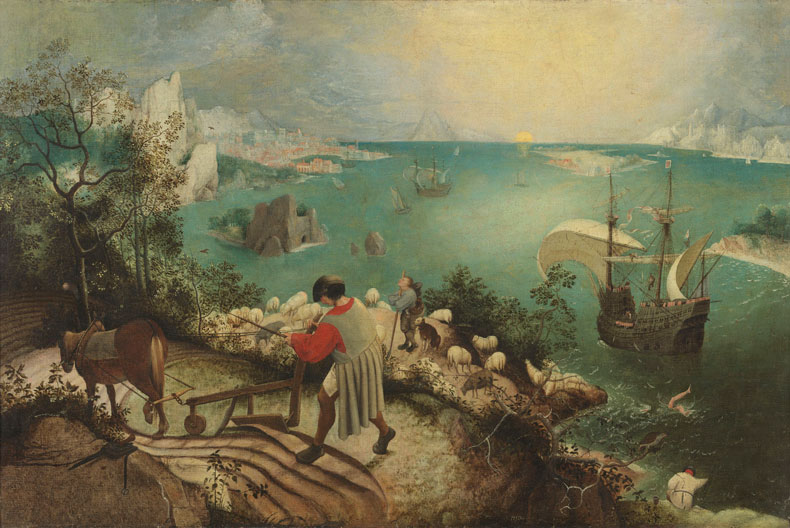
For Auden the painting depicts ‘how everything turns away / Quite leisurely from the disaster’, but his own poem works rather differently. The English word ‘verse’ comes from the Latin vertere, meaning ‘to turn’, and therefore reminds us how a sentence like the one above loops and curves as it proceeds down the page, like a plough moving in a straight line before turning when it reaches the edge of a field. Yet Auden’s poem doesn’t turn away from Icarus; instead it forces us to turn our attention towards him and keep it there.
When we look again at The Fall of Icarus, we realise that the painter is doing something similar with his own composition. The curve of Icarus’s flailing leg is echoed in the swell of the sail just behind him, warning us that it isn’t only airborne travellers who risk drowning; the hand that can only grasp water is contrasted by the firm grip of the ploughman, another figure whose life depends on the caprices of the natural world. Even though we don’t immediately spot Icarus, whose smallness represents how little he means to anyone else in this scene, the painting reminds us how closely connected our lives are and how easily we can forget.
Perhaps that’s why The Fall of Icarus has attracted several later poets, including William Carlos Williams and Michael Hamburger, both of whom have responded to a depiction of isolation by creating a poem that is designed to make us feel less alone in the world. Perhaps it’s also why this is the painting that comes into my head whenever I hear of another migrant drowning after a failed attempt to cross the Channel, reminding me that even a death that is ‘not an important failure’ for some people is the end of the world for someone else.
From the January 2026 issue of Apollo. Preview and subscribe here.