From the July/August 2026 issue of Apollo.
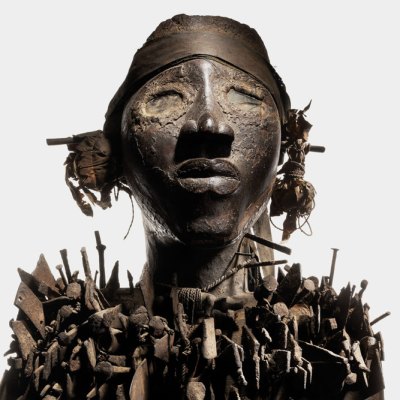
In March 2024 a Fang reliquary head – one of an extremely rare group of heads from the Southern Fang (Fang Betsi) regions of Gabon – achieved a new record for a work of African classical art. From the renowned Barbier-Mueller collection, it achieved €14.8m, with reports suggesting that the sale as a whole drew bidders from 25 different nationalities. Following a succession of rising Fang prices over the last 10 years, it confirmed the place of Fang sculpture at the very top of a hierarchy of value that has been in place since the early 20th century.
In 1906 the painter Maurice de Vlaminck, part of the group of Fauvists who had recently scandalised Paris with their shocking colours, sold his friend André Derain a white-painted Fang Ngontang mask he had recently acquired. Derain showed it to Picasso and Matisse, and a revolution was ignited. If Fang masks – including the Fang Ngil mask said to have inspired Picasso’s Les Demoiselles d’Avignon, a similar example of which sold for €2.4m at Christie’s Paris in 2018 – represent one strand of inspiration, the other, equally strong, is comprised of Fang figurative sculptures or Bieri, produced for the ancestor cult of the same name, created to watch over bark reliquary containers.
In a story retold in the exhibition ‘1913–1923: The Spirit of the Times – Paris Celebrates the Arts of Africa and Oceania’ at the Musée du quai Branly (until 20 September), before the First World War these objects became the primary focus of the influential gallerist and dealer Paul Guillaume, among others. Through him, in 1914, they reached 291, Alfred Stieglitz’s gallery in New York, and, by the 1930s, when Mueller bought his Fang head, these objects had shifted from a niche obsession of the avant-garde to much-celebrated cultural artefacts and works of art. Largely brought to Europe in the late 19th and early 20th century, with production in a ceremonial context having died out by 1930, a distinct corpus of important Fang objects was established, reinforced by starry provenance, scholarly documentation and museum exhibitions.
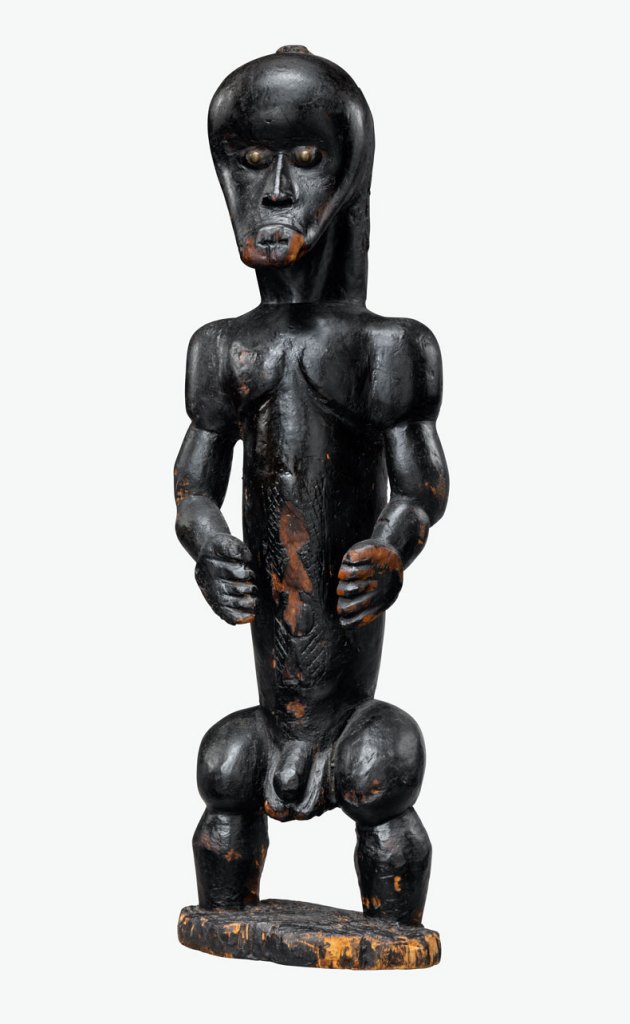
If the primary quality of the Fang mask that inspired Derain was its vivid geometric simplification of the human face, the reliquary guardian figures – both the rarer heads and the entire figures – were valued by sculptors such as Jacob Epstein for their strong rounded forms. The succinct, symbolic force (as mediators between ancestors, the present and the future) of their combination of childlike and adult characteristics, and the deep black weeping patina achieved through the repeated ritual use of oils in the ceremonies of which these objects were an essential part, added to their allure. The styles vary between the more elongated Northern Fang (Ntumu, Okak, Ngumba, Mabea groups) and compact Southern Fang (Betsi, Nzamam-Betsi groups) but share a spiritual intensity and formal beauty that has outlasted changing fashions.
The 21st century has brought new perspectives. Scholars have researched intensively the contexts in which these objects were produced – the Ngontang masks, for instance, were a direct response to the first incursions of white colonisers. Since the early 2000s, Brussels-based dealer Bernard de Grunne’s research into distinct masters has identified the Master(s) of Ntem, responsible for around seven particularly exquisite Fang objects. And while many hail the elevation of these objects from ethnography to fine art objects of the highest order, the Milan-based dealership Dalton Somaré says that ‘the works must not be reduced to their impact on Western art: their primary meaning lies in Central African systems of memory, descent and ritual protection.’ This was the argument behind the protests in 2023 by the Gabonese community in southern France about the sale of a rediscovered Fang mask in Montpellier in March 2022 for €4.2m. Yet this small corpus of works continues to dazzle collectors. It is notable that among the 14 lots chosen by Christie’s to celebrate 50 years of its African and Oceanic sales on 3 June, a Fang guardian figure once owned by Paris dealer and friend of Derain, Maurice Renou, achieved €3.8m, an auction record for a statuette.
Victor Teodorescu, head of African and Oceanic Art at Christie’s Paris, notes that today’s market is focused on exceptional pieces: ‘There is a large number of Fang masks, but important Fang masks are extremely rare, especially the large ones of the Ngil type, which are among the most iconic and sought-after. Similarly, while there is a relatively large number of reliquary figures, only those that are aesthetically among the most accomplished are highly prized.’ Teodorescu also notes ‘more selective behaviour among collectors’ with prices steady for top pieces and dropping slightly for ‘pieces of only moderate aesthetic quality’.
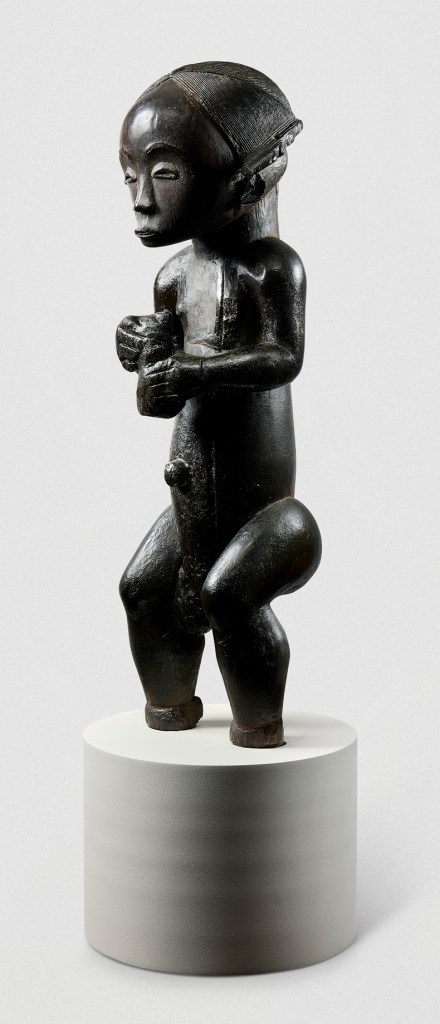
Tim Teuten, an advisor to Bonhams London, warns collectors: ‘Provenance is extremely important. We are sent photos of Fang figures and masks just about every week, the majority being copies made for sale. In the case of Fang figures, copies are easier to identify from a photo than is the case with masks, and for Fang masks provenance is essential. Without a reliable early history, or the association with a reputable dealer or collector, they are almost unsaleable as the market is so sceptical.’ In September Bonhams Paris will offer in its African and Oceanic Art sale a reliquary figure on a base created by the celebrated Kichizō Inagaki (1876–1951), who produced bases for some of the leading dealers of the early 20th century, including Paul Guillaume, Charles Ratton and Louis Carré.
De Grunne says that the best objects, with good provenance, are ‘the blue chip of the blue chip’. He has available a Fang figure that, unusually, stands on its feet without a support. According to him, the market goes in waves. There has been a cluster of high prices in the last 10 years, from the Fang reliquary figure sold at Christie’s Paris in December 2015 for €3.8m, to a Fang-Mvaï ancestor statue by the Master of Ntem, which sold at Sotheby’s New York in May 2018 for $3.5m. A rare head once in the collection of Vlaminck before being acquired in 1983 by Michel Périnet sold in June 2021 from the latter’s collection at Christie’s Paris for €7.7m against an estimate of €3m. Another beautiful head from the Al Thani collection sold in Paris in December 2025 for €5.2m.
Didier Claes will open the exhibition ‘African Legacy – Cradle of Art’ in Brussels on 4 September, just days before Parcours des Mondes (8–13 September). The show will include 165 classical pieces sourced from institutional and private collections alongside 100 modern and contemporary works by painters, sculptors and photographers from Africa. Claes’s intent is to underline the continuous vitality of African art and reinforce Africa’s status as a cradle of global artistic creation. He notes the impact on the market in the past of the exhibition ‘Primitivism in 20th-Century Art: Affinity of the Tribal and the Modern’ (1984) at MoMA in New York and, in 2000, the opening of the Musée du quai Branly.
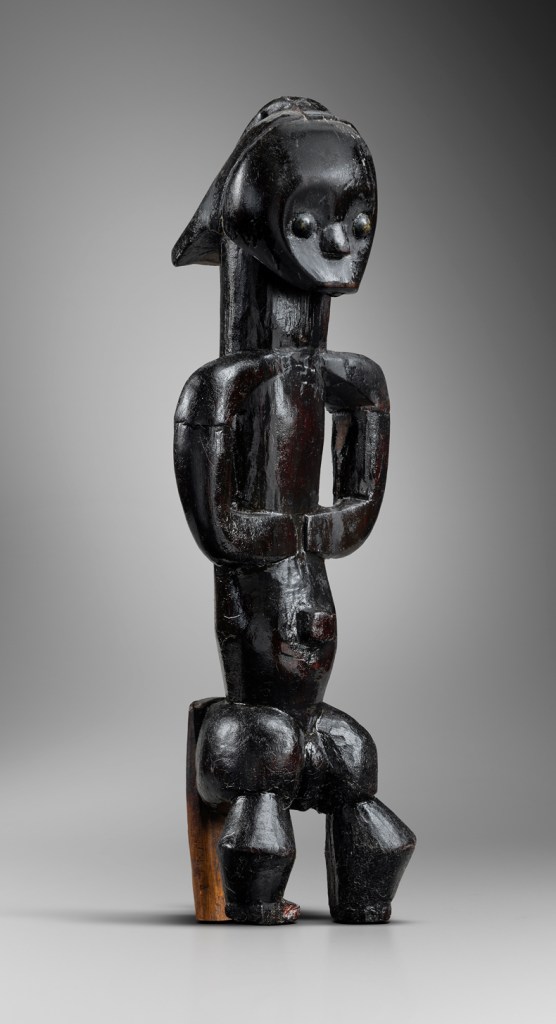
David Serra, director of his eponymous gallery in Barcelona, suggests there has been a shift among collectors from specialists to those seeking one or two pieces for a decorative display. They are drawn rather to the iconic masks than the hieratic statues. While Serra’s clients are mostly based in Europe and the United States, he has had enquiries from younger Gabonese people interested in these objects. Theodor Fröhlich of Zurich dealership Patrik Fröhlich, who will bring a range of African masks to Parcours, says that his collectors are mostly based in Switzerland and elsewhere in Europe and the United States.
Fröhlich notes that provenance and quality are hard to disentangle – given that no new objects can appear on the market, the most beautiful pieces were once owned by the most discerning collectors. Since many collectors of African classical art are also collectors of early 20th century art, he supposes that so long as a Brâncuși can continue to rise in value to the latest $108m record, Fang pieces will continue to rise in value too.
From the July/August 2026 issue of Apollo.