From the December 2026 issue of Apollo.
I remember first standing in front of this picture, more than 40 years ago, transfixed by its atmosphere, yet unable to work out what exactly I was looking at, and being asked to understand. I’d been under the spell of Symbolist art since my schooldays, and here was a consummate example – painted in 1891, exhibited the next year in Brussels, London, Liverpool, Paris and then Munich, where it was snapped up by the Bavarian state. I was in Munich on my way to see my first Ring in Bayreuth, a time of heady immersion in myth expressed through means beyond words. So it may seem perversely prosaic to have tried so often since then to make sense of what Fernand Khnopff’s masterpiece actually depicts.
Its title is a line from a poem by Christina Rossetti, but it feels more like a trigger than a solution to the painting. Perhaps the world of Rossetti is reflected in the red-haired woman, cousin of countless Pre-Raphaelite females, her washed-out gaze fixed at once on us and on something beyond us, and unreachably interior. If, as I sometimes believe, the whole picture shows what she sees in a mirror, it is in fact herself that she stares at. She’s an arresting figure, but to me less compelling than the complicated space Khnopff places her in, which it’s worth trying to describe.
The nearest thing to us, and easily missed, is a small semi-circular ornament of gilded leaves, suspended on a slender chain, a token perhaps of all in the picture that will go unexplained. Slightly further back are three saffron-coloured daylilies, probably standing on the cloth-covered surface which occupies the whole lower third of the painting and which could be a table or possibly a grand piano, the forward hinge of its lid visible on the left. The woman’s elbows rest on its very edge, where the border of a richer blue cloth is glimpsed – perhaps a dress she is putting away? We note that she wears a ring with a gemstone on her wedding finger.
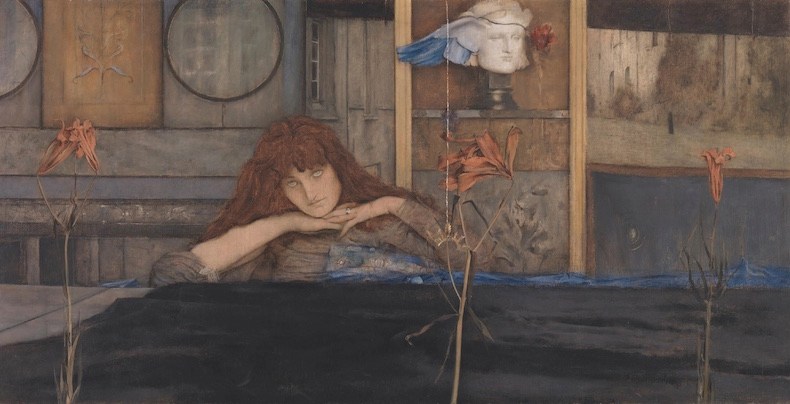
The rear wall of the room is divided into four unequal sections; the woman’s head is echoed across the central gilt axis by a head of Hypnos, god of sleep and father of dreams, perched on a ledge beside a red poppy in a glass vase. Khnopff had recently bought a plaster cast of the British Museum’s bronze Hypnos and, with its single wing painted blue, it was to recur as a tutelary presence in a number of his pictures. On the far left is a broad unaccountable feature – a section of wall with figured panelling above a heavy dado? A cabinet with closed doors? A chimney breast? The two roundels, conceivably old mirrors, foggily reflect a window towards which the woman must be gazing.
But what, then, are the two nearly monochrome sections of the background? The narrower one seems to be a view through a window of an external wing of the house. Above it a dark shape at an angle, like a raised blind, continues to the right of Hypnos, as if he stood in front of one broad plate-glass window, though the right-hand view of steeply rising ground isn’t easily reconciled, in spatial terms, with the left-hand one. Halfway up the slope is a vertical black mark, which might be a post, or a tall hooded figure, perhaps an image of the woman as widow, but could simply be a tassel on the string of the blind. Like Virginia Woolf’s mark on the wall, which might be a nail or a rose leaf or a crack in the plaster, it’s a challenge to interpretation. Or is what we’re looking at in fact an unframed drawing, with a large blue portfolio perhaps, propped up beneath? Is the room thus simply the painter’s studio, with Hypnos at home among other works of his, actual or conjectural? If so, the woman matters in a new way, as a projection of the artist’s quest for solitude and silence, her back turned on the outside world.
At times I think the whole picture is a dream conjured by Hypnos, all its elements mere mental phenomena, surreally coexisting. These puzzles are now a significant part of the painting’s larger mystery for me, its way of embodying mystery itself. It begs us to speculate, while silently insisting that its meanings can never be known.
From the December 2026 issue of Apollo.