From the June 2026 issue of Apollo.
In 1869 the Austrian-born Hungarian writer Karl Maria Kertbeny coined the words ‘homosexual’ and ‘heterosexual’, creating a generally accepted binary that has persisted until comparatively recently. Before this there was no real notion of sexual identity, merely sexual acts that did not necessarily define those enjoying them. ‘The First Homosexuals’, an intriguing exhibition ‘examining the origin of the homosexual identity through art’, was first mounted at Wrightwood 659 in Chicago in 2022, and its second and considerably augmented iteration, containing some 300 artworks, was shown there last year. It now arrives in Basel in a much reduced but still very impressive form, with more than 80 paintings, works on paper, sculptures, photographs and other items, including material from Swiss collections not shown in Chicago. These are arranged thematically in six rooms, the walls of which have been painted in a dusty violet, a colour that is not only associated by long tradition with gay men and lesbians but also shows off the artworks beautifully.
The first section features work from what might be termed the ‘pre-homosexual’ period, from Dürer’s cheerfully homosocial The Bath House from the 15th century to Francisco Fierro’s watercolour of ‘men dressed as women’ in 19th-century Lima. Classical subjects such as Zeus and Ganymede allowed artists the freedom to depict same-sex encounters through a mythological framework, while a languishing though well-developed Saint Sebastian (1848) by Heinrich Beltz from the Kunstmuseum’s own collection introduces another figure who has over the centuries found favour among homosexual artists and audiences.
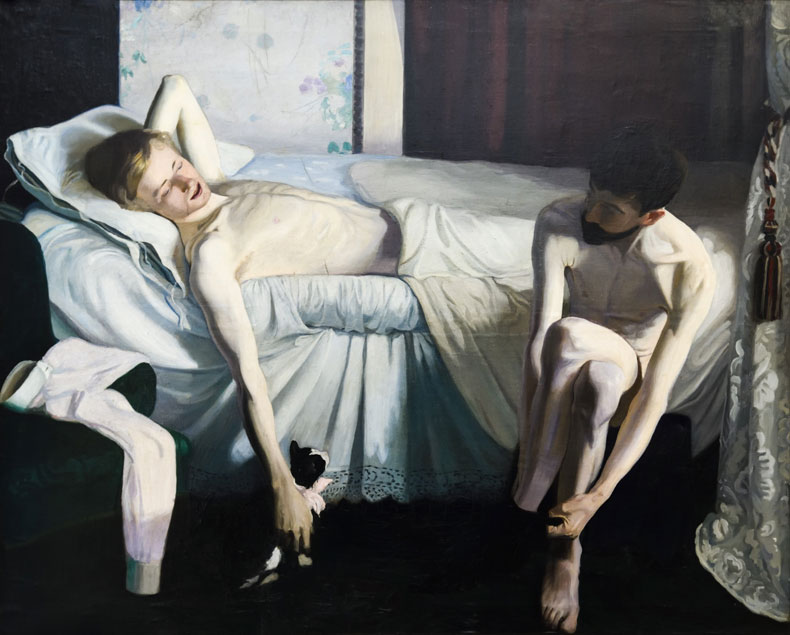
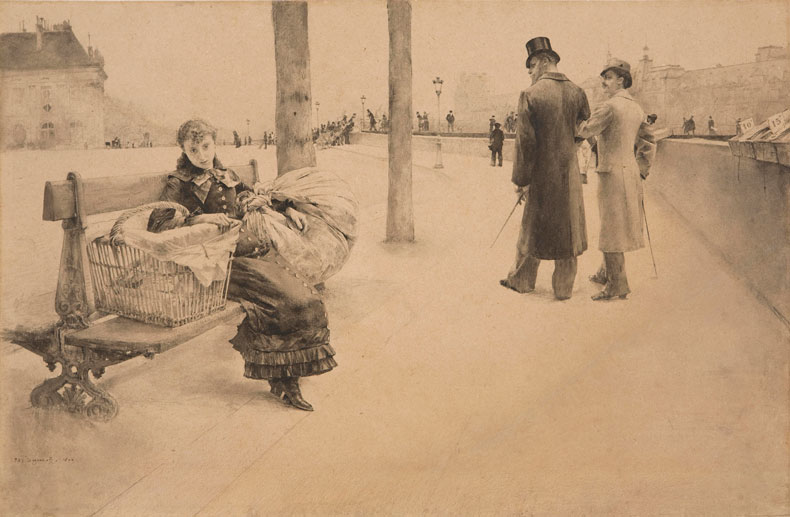
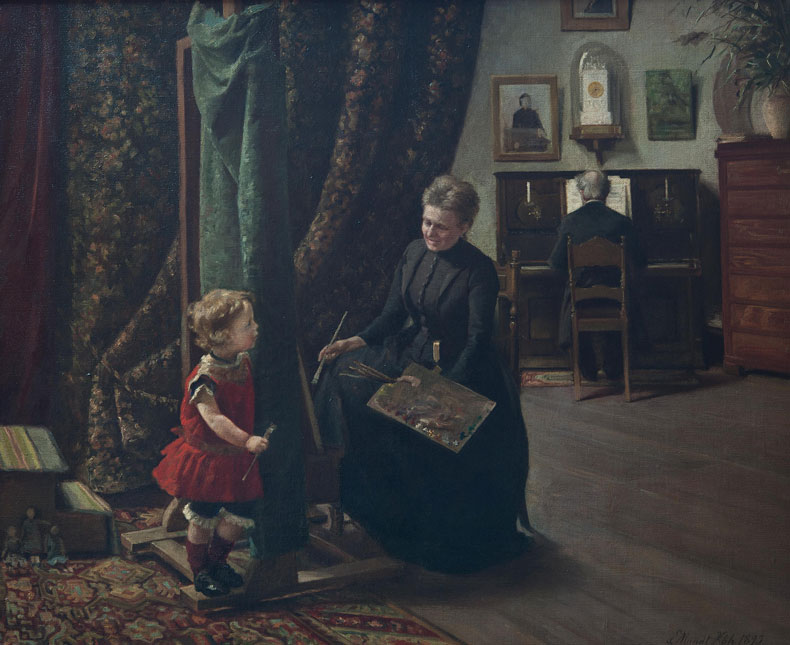
A second section shows how gay and lesbian artists of the 19th and early 20th centuries depicted themselves and how they were seen by others. Variety in queer self-presentation is nicely illustrated by R.G. Harper Pennington’s portrait of an immaculately tailored Oscar Wilde (c. 1884) hung alongside Herbert Gilchrist’s depiction of a hirsute and rugged Walt Whitman (c. 1887). A characterful portrait from c. 1930 by the Czech painter Emil Orlik of Claire Waldoff, the great and gravel-voiced lesbian cabaret star, is particularly welcome since such Neue Sachlichkeit recorders of Weimar Berlin’s queer nightlife as Jeanne Mammen and Christian Schad are not represented. Some paintings here are more direct than others. We may be fairly sure what has been going on in Andreas Andersen’s ravishing painting from 1894 of his brother Hendrik lounging in bed and drawing the gaze of the equally naked John Briggs Potter, who has evidently just got out of it. One needs insider knowledge, however, to realise that the apparently conventional domestic interior of Emilie Mundt’s Painter and Child in the Studio (1893) features her lover, Marie Luplau, and their adopted daughter, or that Pascal Dagnan-Bouveret’s Laundress (1879), featuring in the background two men strolling companionably arm in arm, is ‘arguably the first work in the history of European art to depict a same-sex couple as romantic life partners’.
Among the most interesting artworks that the Kunstmuseum has added to the exhibition is Aristide Maillol’s Racing cyclist (1907–08). This bronze sculpture of the 18-year-old racing cyclist and jockey Gaston Colin naked is a highly unusual work for Maillol, who is chiefly known for sculptures of hulking female forms. The real story here, however, is of the man who commissioned it, Harry von Kessler, the diplomat, diarist and patron of the arts, who was Colin’s lover. It is placed alongside other works depicting unclothed young males in a section titled ‘Changing Bodies’. Gustave Courtois’s unusually pubescent Narcissus (1872), in which the genitals are decorously obscured, provides a striking contrast to Carlos Baca-Flor’s unapologetically full frontal Dead Abel (1886) or Sascha Schneider’s Growing Strength (1904), in which a youth wearing nothing but a laurel wreath has his biceps tested by an older, bearded man. The adolescent male form was widely regarded as a physical ideal at this period, which made such paintings less controversial than they might be considered today. A shift, however, took place soon after this, in which mature men became the focus of the queer artistic gaze. This is exemplified by Courtois, who relinquished the soft limbs of his Narcissus for the well-defined musculature in his 1907 portrait of Maurice Dériaz, a famous athlete and bodybuilder he frequently used as a model later in his career.
The variety of works included in sections devoted to ‘Gender Diversity’ and ‘Colonial Images and Counter-Images’ dispel suspicions of mere box-ticking. Marguerite Peltzer’s extraordinary sculpture Hermaphrodite (1928) depicts an apparently female subject lifting her skirts to reveal male genitals, while an enchanting film by the Lumière brothers (1902–03) shows two Black performers, one in drag, doing the cakewalk. The lounging semi-clad men in Gabriel Morcillo’s glossy Orientalist fantasy Fructidor (c. 1932) were modelled from local rent boys, which is rather what they look like (if a little past it), and in an exhibition such as this representation can sometimes seem more important than high aesthetic merit. Elisàr von Kupffer, for example, built a temple near Lake Maggiore devoted to Clarism, the religion he devised that held that separating people into two genders was ‘a violation of divine will’. The panels he painted for this building, depicting largely naked androgynous figures involved in quasi-religious ceremonies, are borderline kitsch but of considerable social and historical interest. Visitors will be inspired to explore further the works of the less familiar artists on show.
The sheer geographical and stylistic range of the exhibition, even in this condensed form, is extraordinary, and the story it tells is both coherent and compelling. The stupendous catalogue, in which all the items in the Chicago iterations are illustrated, additionally contains 21 essays that broaden the scope even further.
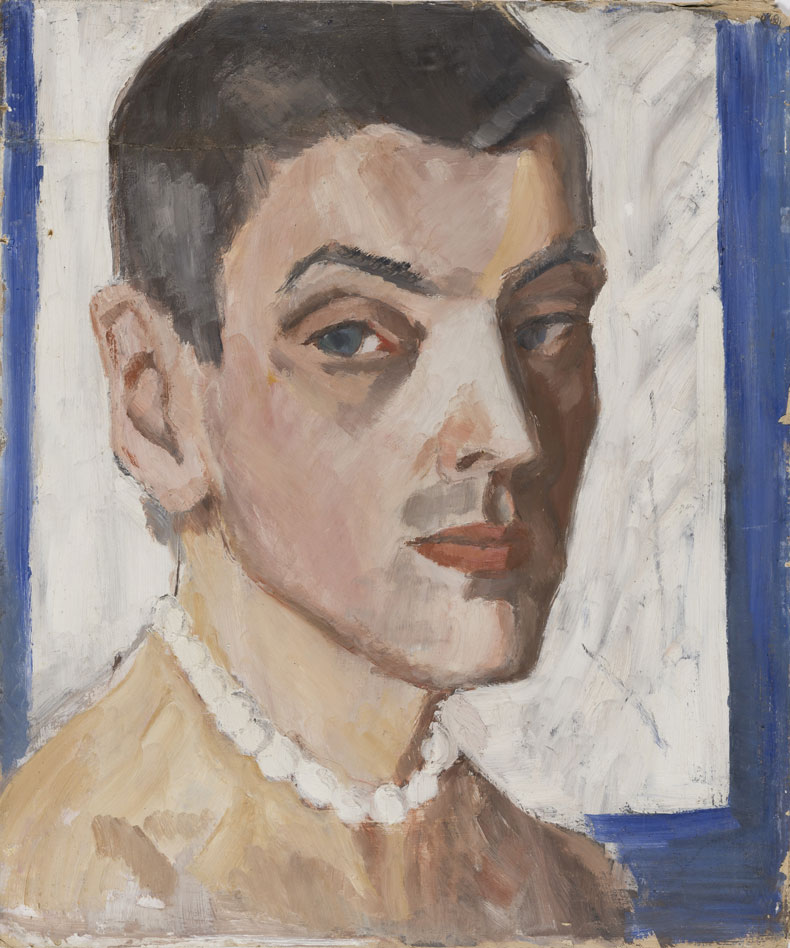
‘The First Homosexuals: The Birth of New Identities, 1869–1939’ is at the Kunstmuseum Basel until 2 August.
From the June 2026 issue of Apollo.