
Gazelles (1913/14; detail), Franz Marc. Permanent loan from a private collection. Courtesy Franz Marc Museum, Kochel am See

‘Four things to see’ is sponsored by Bloomberg Connects, a free arts and culture platform that provides access to museums, galleries and cultural spaces around the world on demand. Explore now.
Each week we bring you four of the most interesting objects from the world’s museums, galleries and art institutions, hand-picked to mark significant moments in the calendar.
Franz Marc was killed at the age of 36 at the Battle of Verdun, on 4 March 1916 – 110 years ago this week. In his brief career, the German Expressionist painter sought what he called the ‘animalisation’ of art: he wanted not only to depict the physicality of animals but also to convey a sense of their spirit. Marc believed animals possessed a certain purity and a connection to cosmic forces that modern humanity had lost, and his luminous paintings of blue horses and abstract gazelles were attempts to perceive the world through animals’ eyes.
Across cultures and centuries, animals have served as subjects for realistic representation and as symbols of forces beyond human comprehension – guardians of sacred knowledge, embodiments of divine attributes, bridges between earthly and celestial realms. Many artists have seen animals as embodiments of certain qualities – wildness, innocence, instinct, vitality – and have often turned to animals to express what human forms cannot, finding primal energies and spiritual dimensions in their presence. Other artists have delighted in observing animals closely and depicting them in detail with scrupulous care. This week we examine four works that explore animals as conduits to the sacred or the cosmic.
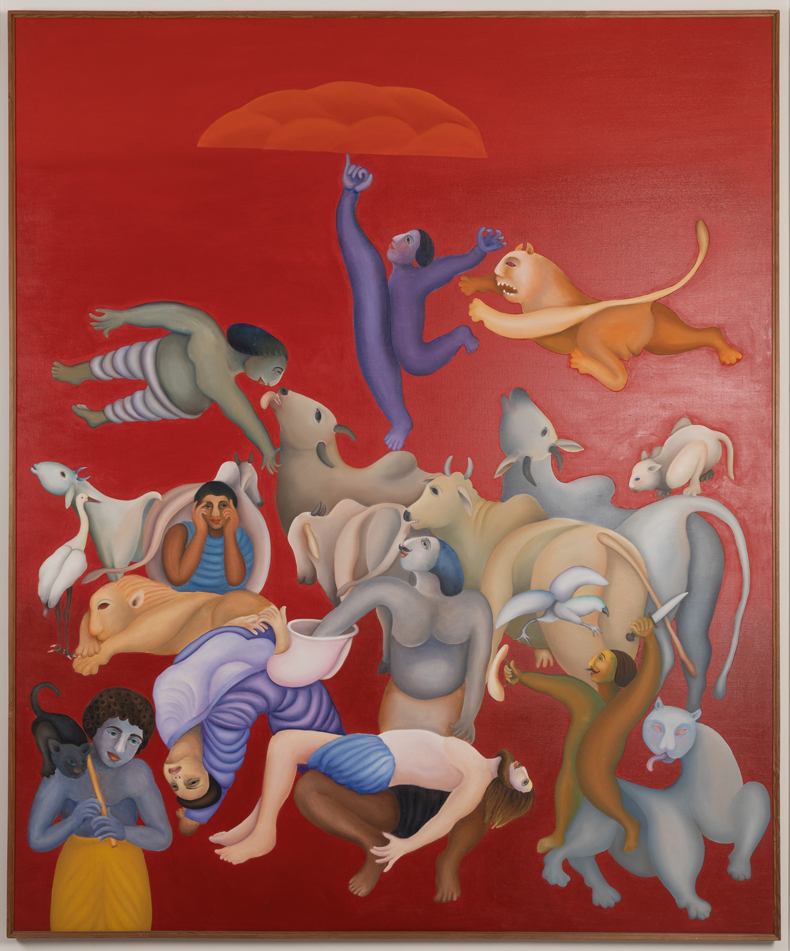
India Today (n.d.), Manjit Bawa
Kiran Nadar Museum of Art, New Delhi
Manjit Bawa’s vivid painting teems with life. Against a deep red background, the artist weaves together Hindu mythology and Sufi mysticism into a single dense composition where animals and humans coexist, sometimes peacefully, sometimes violently. Bawa grew up among cattle and other farm animals in Punjab, approaching bulls fearlessly and incorporating them into his art as symbols of harmony between humanity, nature and the divine – though here that harmony appears precarious. Click here to learn more.
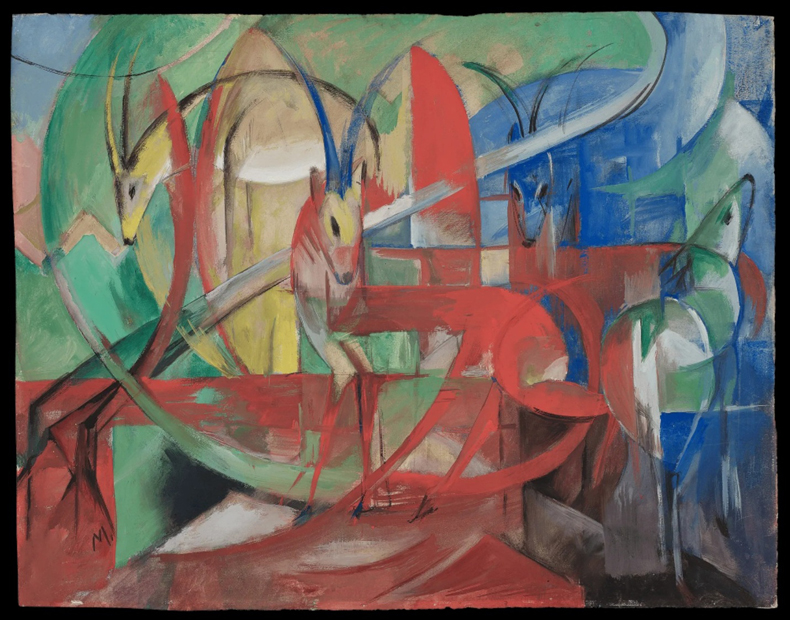
Gazelles (1913/14), Franz Marc
Franz Marc Museum, Kochel am See
Franz Marc dissolves four gazelles into luminous fields of red, blue, green and yellow, their bodies barely distinguishable from the abstract forms around them. Working with colour contrasts developed by Robert Delaunay, who used such dynamism to evoke modern Paris, Marc redirected the technique towards spiritual ends, making the gazelles seem like embodiments of energy itself. Click here to read more.
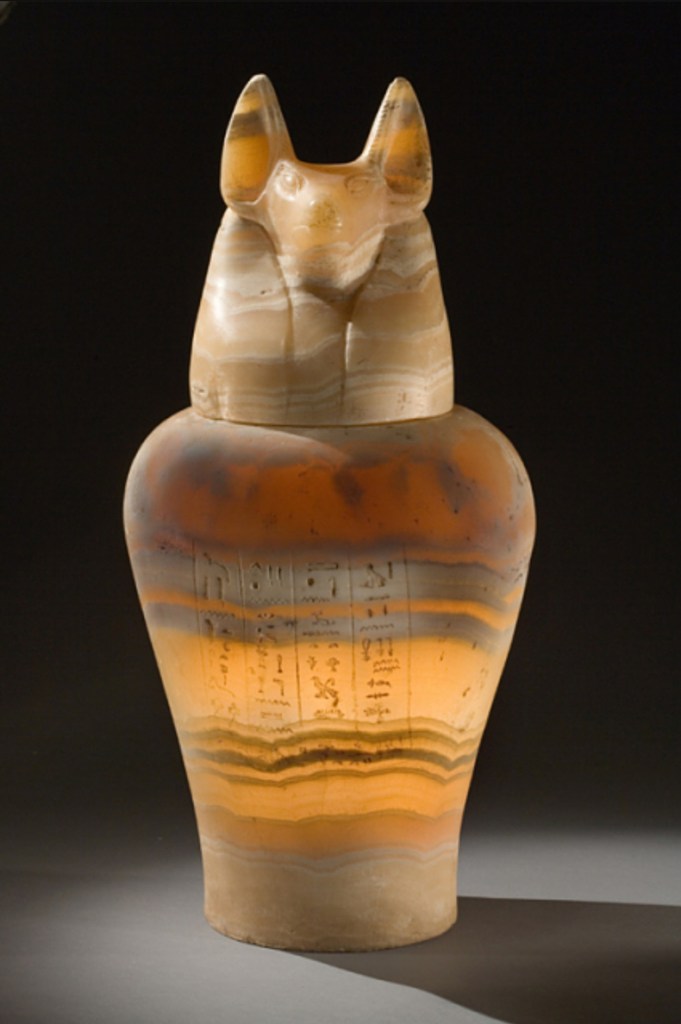
Jackal-headed alabaster canopic jar (Egyptian, Late Period, Dynasty XXVI)
National Museum of Natural History, Washington, D.C.
The jackal Duamutef crowns this alabaster jar like a sentinel guarding the mummified stomach sealed within. Duamutef, one of four sons of Horus, was charged with protecting the preserved stomach, which was deemed necessary for resurrection in the afterlife. Ancient Egyptians saw the jackal as a creature that dwelt between worlds, making it the perfect protector of bodies in transit from death to eternal life. The smooth stone and watchful gaze show how ancient Egyptians believed animal forms could carry divine power, protecting people even after death. Click here to discover more.
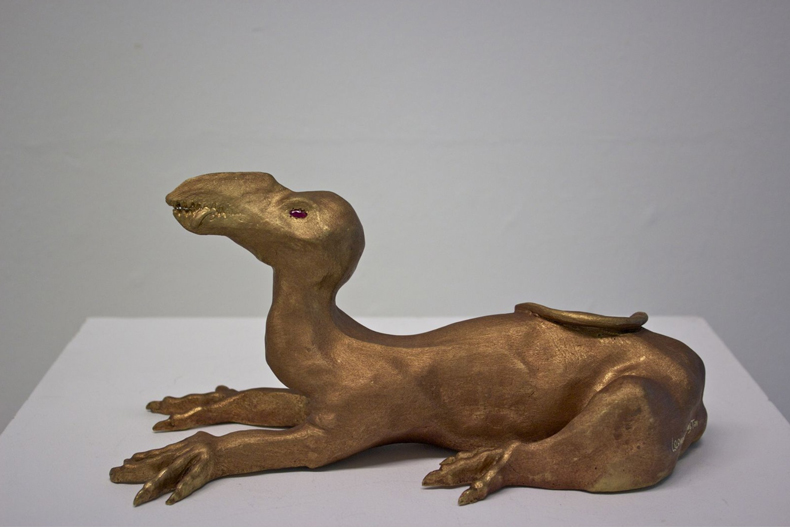
Vulture (Dragon) (2010), Leonora Carrington
Irish Museum of Modern Art, Dublin
Leonora Carrington’s bronze sculpture merges vulture and dragon into a hybrid creature: predatory bird fused with mythical beast, with wings, scales and elongated neck. Created a year before the Surrealist artist’s death, it distils her lifelong fascination with animals as avatars of the subconscious, or guardians patrolling the borders between known and unknown realms. Her paintings and stories teem with horses, hyenas, wolves and cats, blurring the line between human and animal, celebrating interspecies connection and acknowledging the wild instincts and rebellious energy that civilisation often suppresses. Click here to find out more.

‘Four things to see’ is sponsored by Bloomberg Connects, a free arts and culture platform that provides access to museums, galleries and cultural spaces around the world on demand. Explore now.