Detail of a wood carving of a bear carrying salmon (1986) by Takiji Mogi. Yakumo Bear Woodcarving Museum, Yakumo, Hokkaido

‘Four things to see’ is sponsored by Bloomberg Connects, a free arts and culture platform that provides access to museums, galleries and cultural spaces around the world on demand. Explore now.
Each week we bring you four of the most interesting objects from the world’s museums, galleries and art institutions, hand-picked to mark significant moments in the calendar.
On 14 October 1926, 100 years ago this week, A.A. Milne’s Winnie-the-Pooh was published in London. Milne, a playwright and long-serving contributor to Punch, had built the stories around his son Christopher Robin and the boy’s nursery toys, with illustrations by E.H. Shepard. The book was an immediate success and was followed two years later by The House at Pooh Corner.
Pooh joined a long line of bears in human imagination. The animal has been admired and hunted, worshipped as a deity, featured in myths and folk tales, adopted as a civic emblem and, from 1902 – when Theodore Roosevelt inspired the first ‘teddy bears’ – manufactured by the million as a children’s companion. This week we celebrate the bear.
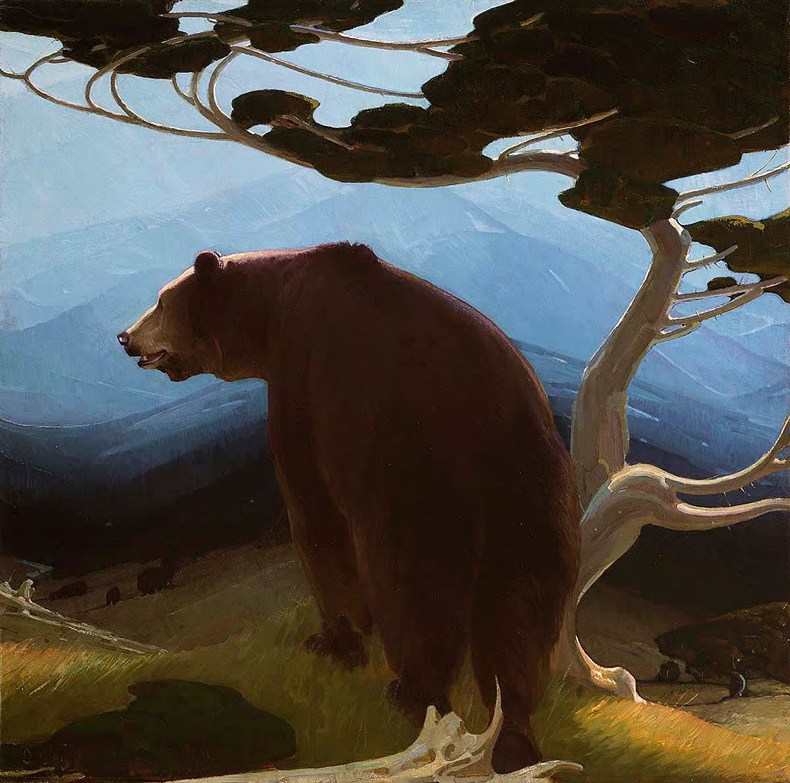
Timberline (1932), William Herbert Dunton
Whitney Western Art Museum, Cody, Wyoming
A grizzly bear stands beneath a gnarled tree, the curve of its back repeating the ridgelines of the mountains behind it. William Herbert Dunton, who had spent much of his life hunting and roaming the area around Taos, New Mexico, returned to bears again and again in his final years of easel painting. Here he abandons the naturalistic detail of his earlier illustration in favour of rich, simplified colour and undulating lines borrowed from art nouveau. Dunton’s grizzly is more gentle, even ornamental, than formidable. Click here to learn more.
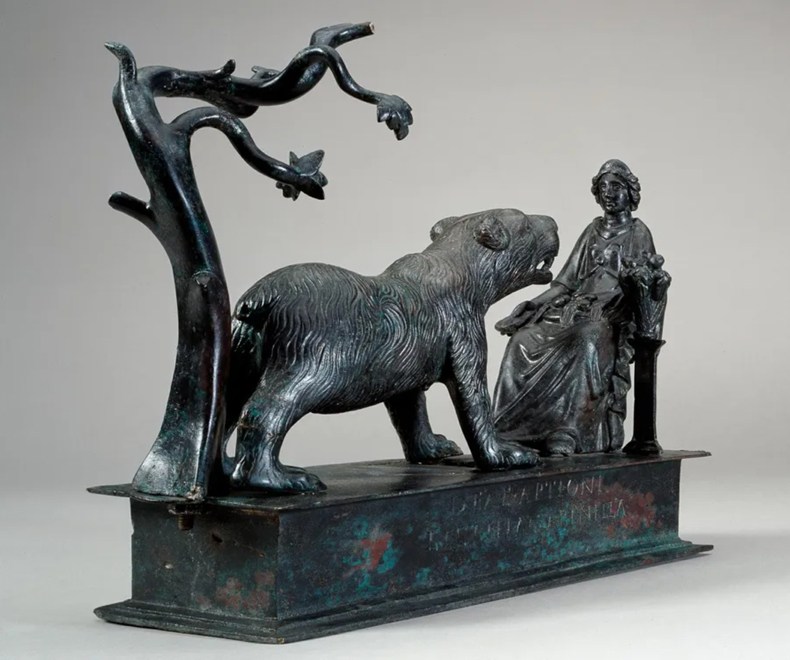
Goddess Artio (c. 200 AD)
Bernisches Historisches Museum, Bern
This bronze statuette depicts a large bear advancing from beneath a tree towards a seated woman, who holds a bowl of fruit in her lap. Both represent the goddess Artio, in her bear and human form. The Latin inscription on the base records its dedication to the goddess by a woman called Licinia Sabinilla. Discovered in 1832 at Muri in Aargau, Switzerland, the statuette attests to a bear cult in the region long before the nearby city of Bern took the animal as its emblem. Click here to learn more.
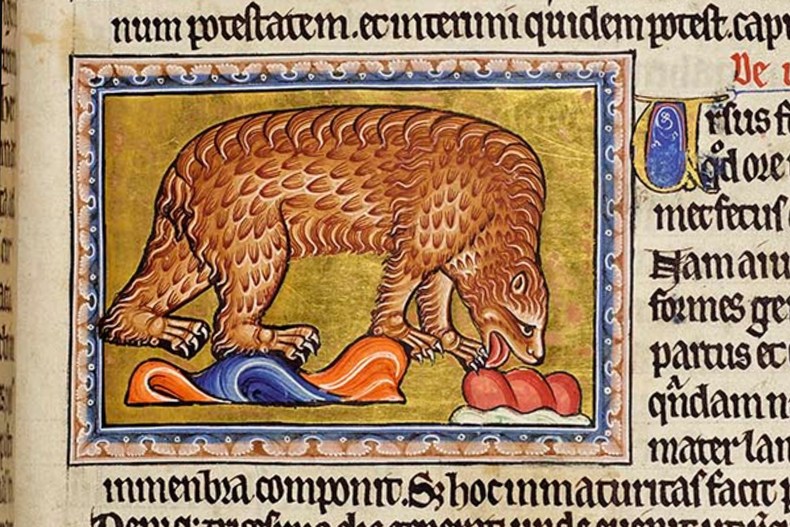
Bear from the Aberdeen Bestiary (c. 1200)
University of Aberdeen
In this illumination a bear bends over her newborn cub, depicting a belief recorded since antiquity and repeated in many medieval bestiaries: that bear cubs were born as formless lumps of flesh, and that the mother sculpted them into bear form with her tongue – the origin of the phrase ‘licked into shape’. The accompanying text adds that bears heal their own wounds with mullein and eat ants when sick. Written and illuminated in England around 1200, the Aberdeen Bestiary is among the most lavish of its kind. Click here to find out more.
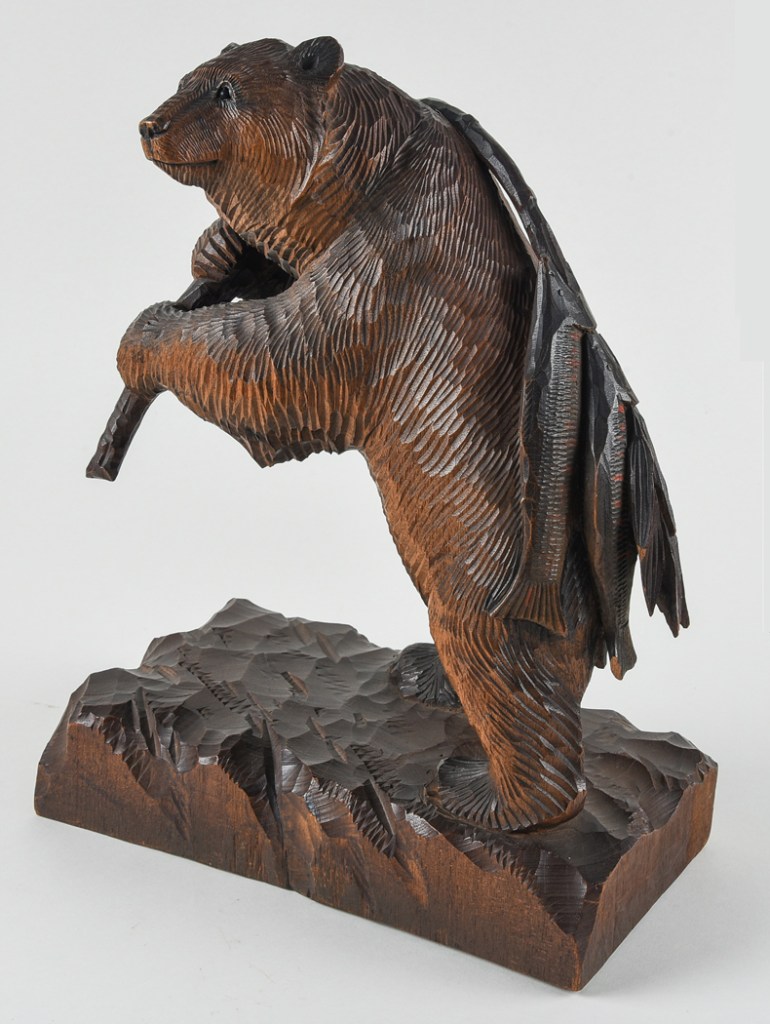
Wood carving bear carrying salmon (1986), Takiji Mogi
Yakumo Bear Woodcarving Museum, Yakumo, Hokkaido
A bear pads forwards with salmon slung across its back, its coat and the fish scales carved in elaborate detail. The reverse bears the sculptor’s pseudonym, Hokusetsu. The kibori kuma, or carved wooden bear, is Hokkaido’s most familiar souvenir. Its story began in 1922, when the aristocrat Yoshichika Tokugawa returned from Switzerland with carved bears from the village of Brienz and encouraged the farmers of Yakumo to copy them. The first examples were shown at a rural crafts exhibition in 1924, and the carvings spread across Japan – a folk tradition born, coincidentally, around the same time as Winnie-the-Pooh. Click here to discover more.

‘Four things to see’ is sponsored by Bloomberg Connects, a free arts and culture platform that provides access to museums, galleries and cultural spaces around the world on demand. Explore now.