Girl in a Chemise (c. 1905; detail), Pablo Picasso. Tate Collection. © Succession Picasso/DACS 2026

‘Four things to see’ is supported by Bloomberg Connects, a free arts and culture platform that provides access to museums, galleries and cultural spaces around the world on demand. Explore now.
Each week we bring you four of the most interesting objects from the world’s museums, galleries and art institutions, hand-picked to mark significant moments in the calendar.
On 25 October 1881, 145 years ago this week, Pablo Picasso was born in Málaga. In 1901, at the age of 19, shaken by the suicide of his close friend Carles Casagemas, he began to paint almost exclusively in shades of blue. For the next three years his subjects were the poor, the ill and the solitary, rendered in a chilly palette that gave the Blue Period its name.
It is not a given, however, that blue should signify sorrow. Ancient Britons used to stain themselves blue before battle and, much later, the colour gained standing in western Europe when the kings of France adopted a blue shield strewn with gold fleurs-de-lis and the nobles followed the fashion. In the eastern Mediterranean, blue beads are often worn to ward off the evil eye. What has been a constant throughout much of art history is the trouble taken to obtain the colour: the finest blue was ground from lapis lazuli quarried in the mountains of Afghanistan and carried thousands of miles by land, and indigo, fermented from plants, was traded across continents for millennia. This week we explore four works that use blue in very different ways.
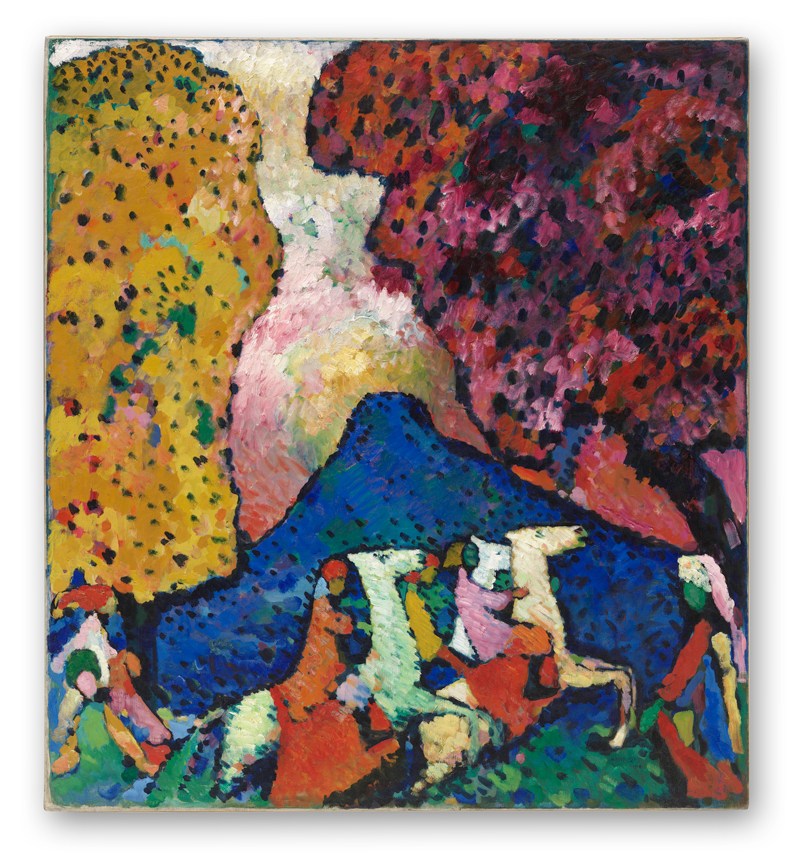
Blue Mountain (Der blaue Berg) (1908–09), Wassily Kandinsky
Solomon R. Guggenheim Museum, New York
A blue mountain dominates the middle of this landscape. Kandinsky painted it at a time when his landscapes were loosening towards abstraction and he was focusing more on the possibilities of colour. Blue, he later wrote in Concerning the Spiritual in Art (1911), was the ‘typical heavenly colour’ that draws the viewer towards the infinite. Set against the reds and yellows around it, the mountain acts as a calm, even reassuring centre. The colour would soon give its name to the Blue Rider group, which Kandinsky founded with Franz Marc in Munich in 1911. Click here to find out more.
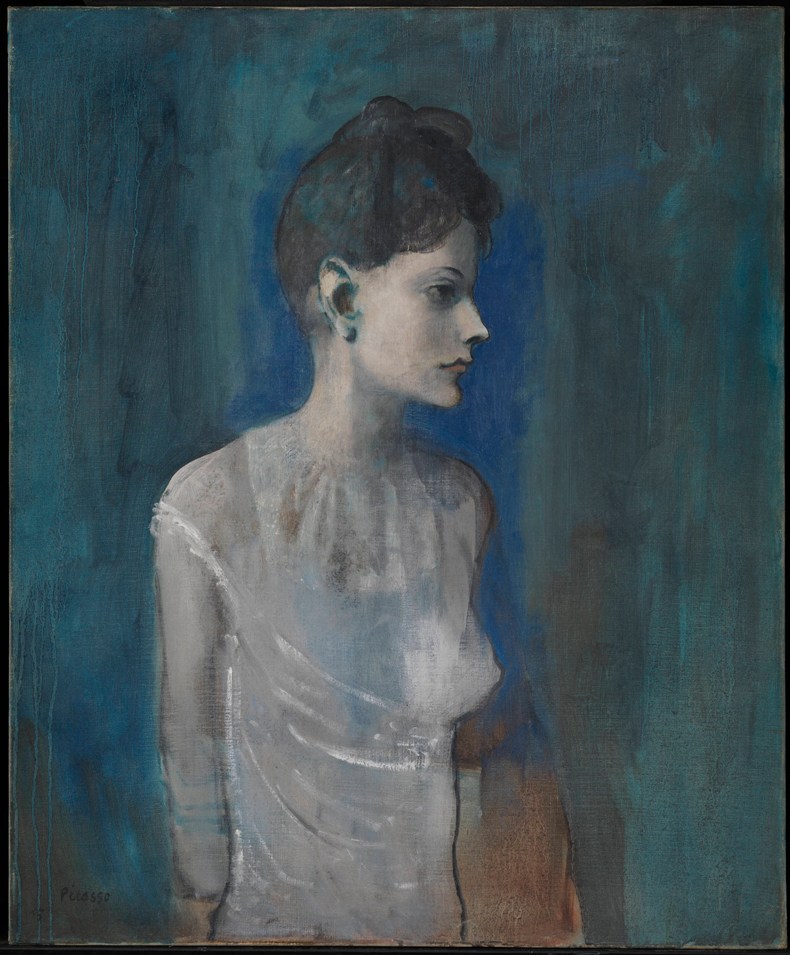
Girl in a Chemise (c. 1905), Pablo Picasso
Tate Modern, London
Picasso painted this young woman as he was easing out of his Blue Period, the years of mourning in which blue, in his hands, was the colour of cold, isolation and sorrow. Her slight, ghostly body seems to melt into a wash of dark blue, matching the shadows under her hooded eyes, which gaze numbly into the distance. The mood has not lifted, but there are hints of change: a pinkish brown towards the bottom of the canvas and a touch of red on her lips anticipate the warmer Rose Period, while a brighter ultramarine behind her makes her profile glow. Click here to read more.
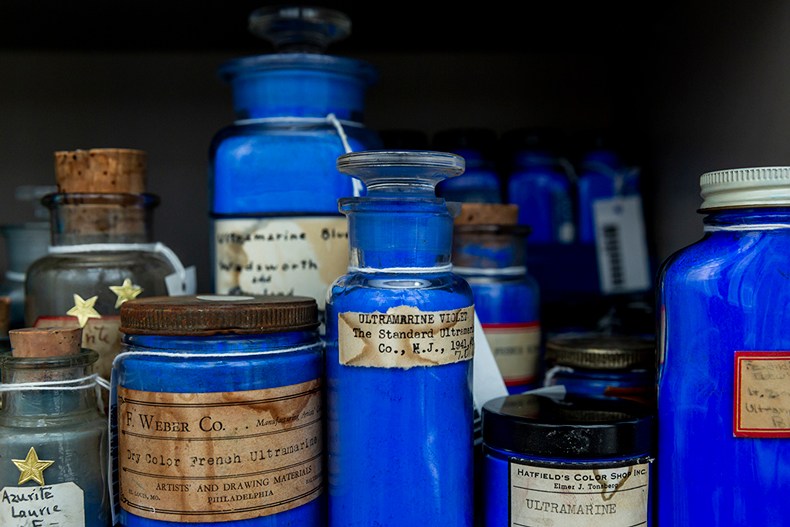
Ultramarine pigment from the Forbes Pigment Collection
Straus Center for Conservation and Technical Studies, Cambridge, Massachusetts
Weight for weight, the powder in these jars was once worth more than gold. Ultramarine was originally ground from lapis lazuli, and its name comes from the Latin for ‘beyond the sea’, referring to its journey to reach Europe. Renaissance contracts specified how much a painter was to use and where, which is why the colour so often appears only in the robes of the Virgin. The price of the pigment collapsed in the 1820s after French chemists figured out how to synthesise it and the colour became available by the tube. These jars stand among more than 2,700 samples in the Forbes Pigment Collection, which began in the early 20th century as a reference tool for studying and conserving paintings and is still referred to daily. Click here to learn more.
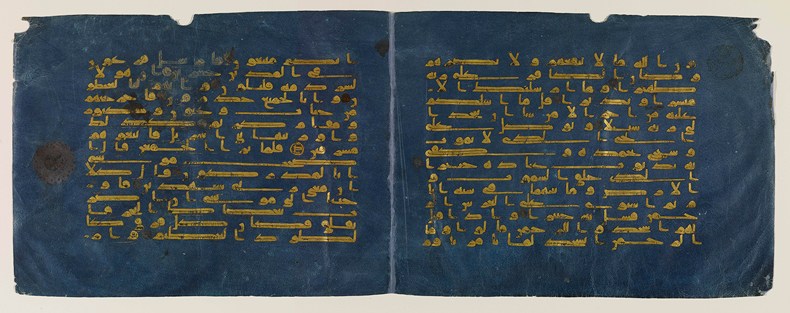
Two folios from a manuscript known as the ‘Blue Qurʾan’ (c. 950 CE)
Aga Khan Museum, Toronto
The Blue Qurʾan originally ran to seven 90-page volumes, requiring the slaughter of some 300 sheep to create enough parchment. Every sheet was dyed deep indigo; 15 lines of angular Kufic script cross each page in gold. The calligraphers wrote each letter in adhesive, laid gold leaf over it, brushed away the excess and outlined every character in ink. It was most likely made in the 10th century at Kairouan, a centre of trade and scholarship in what is now Tunisia, and the scheme of gold on blue may have been meant to rival the purple-dyed manuscripts of the Byzantine emperors – one dyed colour set against another as a claim to power and authority. Click here to discover more.

‘Four things to see’ is sponsored by Bloomberg Connects, a free arts and culture platform that provides access to museums, galleries and cultural spaces around the world on demand. Explore now.