Luncheon of the Boating Party (1880–81; detail), Pierre-Auguste Renoir. The Phillips Collection, Washington, D.C.

‘Four things to see’ is sponsored by Bloomberg Connects, a free arts and culture platform that provides access to museums, galleries and cultural spaces around the world on demand. Explore now.
Each week we bring you four of the most interesting objects from the world’s museums, galleries and art institutions, hand-picked to mark significant moments in the calendar.
Sunlight dappled by plane trees, glasses raised on café terraces, bodies leaning in easy intimacy – this was the Paris Pierre-Auguste Renoir captured again and again. Born on 25 February 1841, 185 years ago this week, Renoir would devote himself to translating his adoptive city’s new boulevards, riverside restaurants and garden promenades into luminous paintings. In his hands Paris is convivial, sensuous and enlivened by light.
For centuries Paris has functioned for artists as both subject and sanctuary. The city’s transformation under Georges-Eugène Haussmann in the 1860s created the wide boulevards and café culture that became synonymous with modern urban life in France, attracting artists from across Europe and the United States who sought to capture the pace and textures of life in the capital. From Impressionist painters documenting the play of light on the Seine to contemporary photographers chronicling Paris’s diverse banlieues, artists have found the city to accommodate both romantic idealisation and clear-eyed social observation. Paris has served as artistic capital, bohemian refuge, site of revolutionary ferment and symbol of cultural sophistication. This week we examine four works that depict Paris in its various guises, revealing how the city has continued to inspire artists whether they’re capturing its most iconic monuments or its less well-known suburbs.
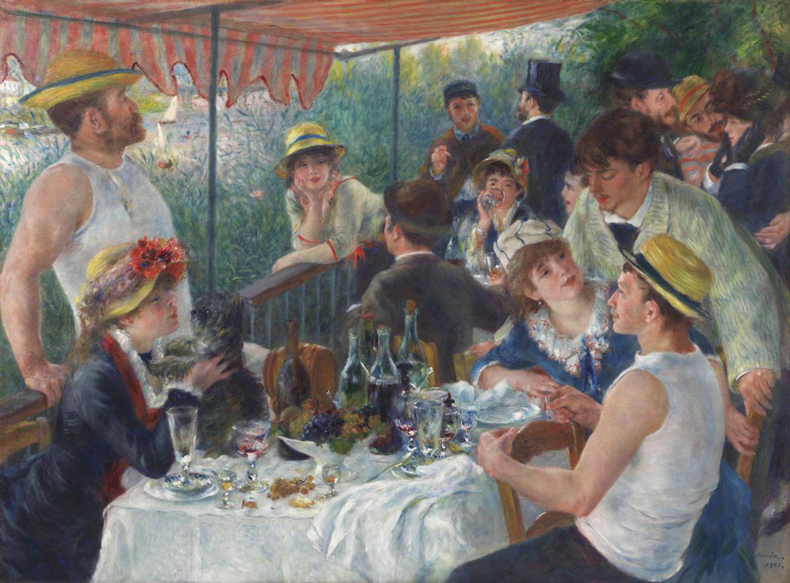
Luncheon of the Boating Party (1880–81), Pierre-Auguste Renoir
Phillips Collection, Washington, D.C.
Renoir’s sun-soaked painting captures exactly the kind of suburban reprieve that would tempt any city dweller. The painting shows the artist’s Parisian friends gathered on the terrace of Maison Fournaise, a riverside restaurant in Chatou, reachable by the new railway lines that made day trips from the city centre convenient. These are unmistakably Parisians at leisure – the social world, the fashions, the joie de vivre – with the setting offering temporary refuge from the intensity of inner-city life. Click here to find out more.
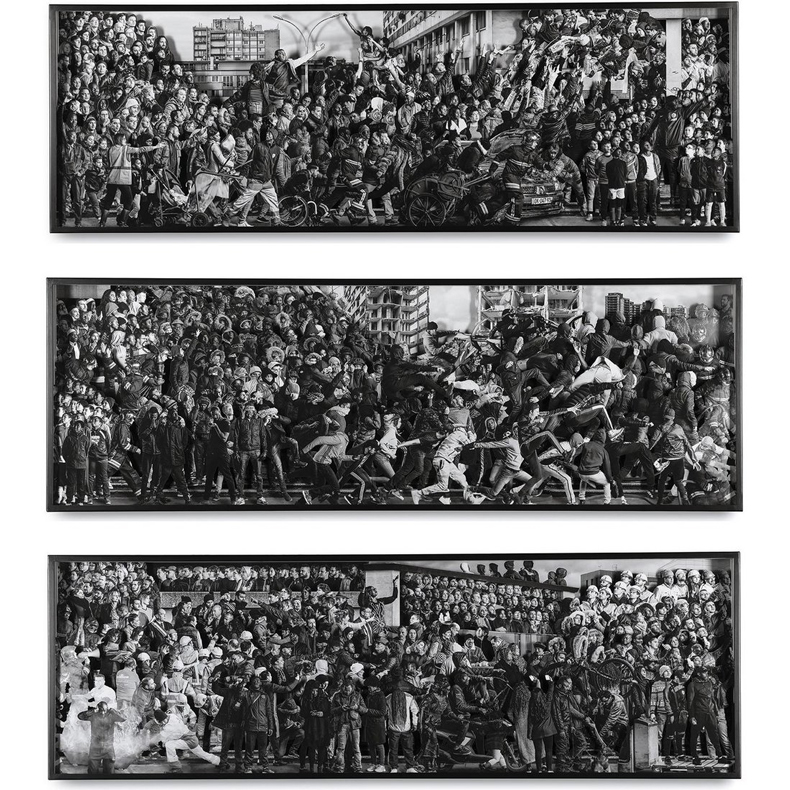
Chroniques de Clichy-Montfermeil, Work in Progress, France (2017), JR
Centre Pompidou, Paris
JR’s monumental photographic triptych assembles some 800 portraits of residents from the Paris suburbs of Clichy-sous-Bois and Montfermeil, creating an epic 36-metre mural that lends street photography the grandeur of history painting. The work chronicles neighbourhoods marked by the 2005 riots that followed the deaths of two teenagers during a police chase, giving personality and dignity to communities typically represented through statistics and stereotypes. JR’s project insists that there is far more to Paris than picture-postcard monuments. Click here to read more.
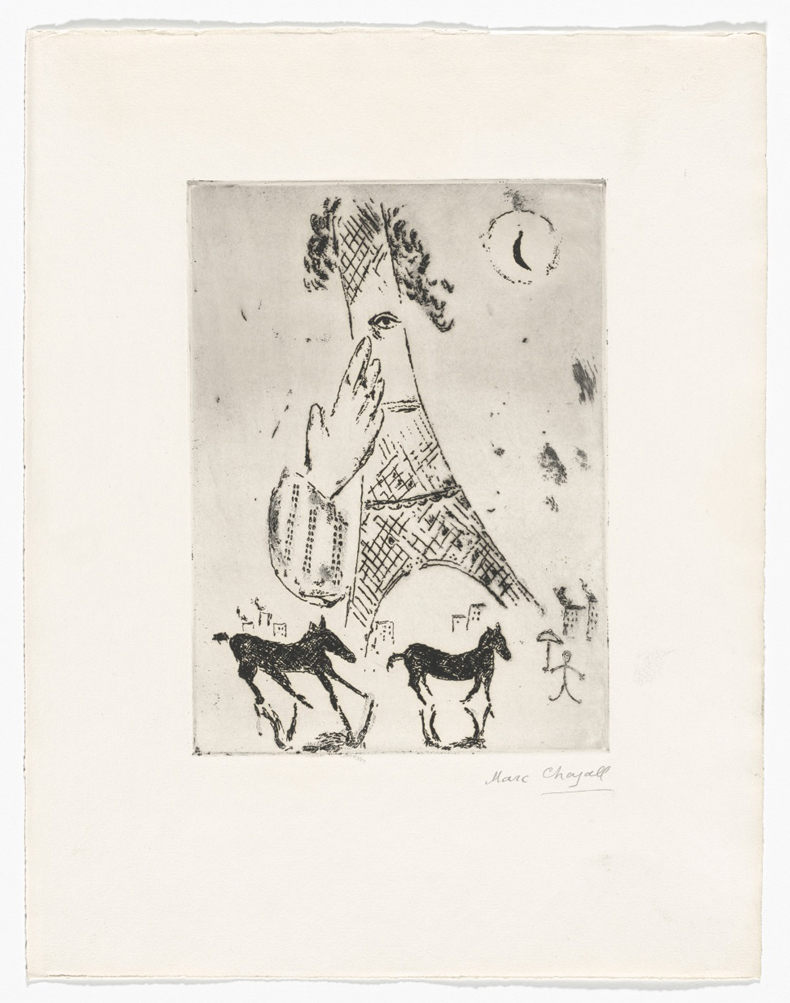
Eiffel Tower, from VVV Portfolio (1942, published 1943) by Marc Chagall
Museum of Modern Art (MoMA), New York
Chagall made this dreamlike image of the Eiffel Tower while living in wartime exile in New York. The edifice drifts through a scene filled with his trademark floating figures and surreal motifs. Created for the Surrealist magazine VVV, edited by André Breton, the print shows how Paris had become, for Chagall, less a real place than a symbol of everything he had lost. The city had welcomed the Jewish painter from Vitebsk and become central to his artistic identity. Here, the Eiffel Tower blends with folk imagery and personal memory, reshaped by longing into a sign of the cultural life that war had temporarily put out of reach. Click here to discover more.
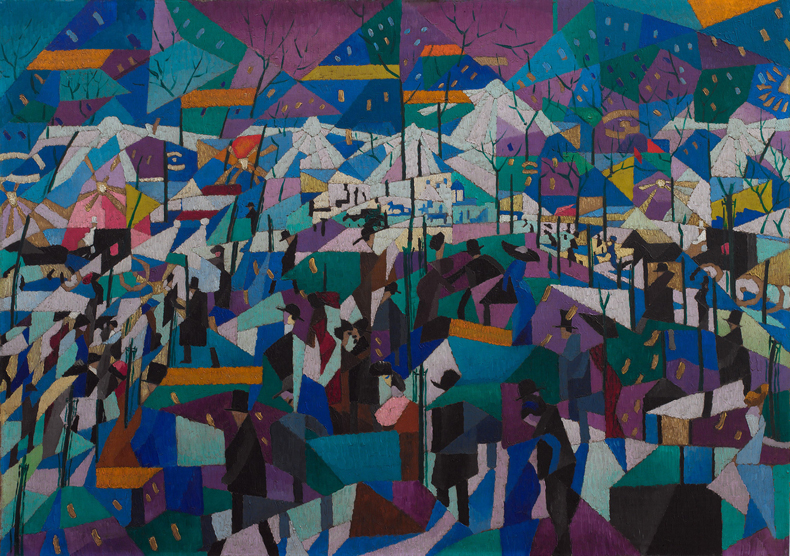
The Boulevard (1910–11), Gino Severini
Estorick Collection, London
Gino Severini fragments a wintry Parisian boulevard into shards of light, movement and colour – red automobile headlights pierce the darkness, electric lamps glow, bowler-hatted figures hurry through snow-dusted streets where horse carts collide with motorcars. Painted in Montmartre where the Italian Futurist lived near Cubists such as Braque and Picasso, the work captures Paris as the centre of modernity, a city where old and new technologies jostle for space and human activity has its own frenetic rhythm. Click here to learn more.

‘Four things to see’ is sponsored by Bloomberg Connects, a free arts and culture platform that provides access to museums, galleries and cultural spaces around the world on demand. Explore now.