From the January 2026 issue of Apollo. Preview and subscribe here.
Rumour has it that the Vatican is considering the Florentine painter and Dominican friar Fra Giovanni da Fiesole for another promotion. Shortly after his death in 1455, he was dubbed the pictor angelicus, comparing his accomplishments in the field of painting with the intellectual contributions of Saint Thomas Aquinas (the doctor angelicus). In 1982, the Catholic Church beatified him, one step away from sainthood. If that requires at least one posthumous miracle, it need look no further than the exhibition on view at Palazzo Strozzi and the Museo di San Marco in Florence. Curated by Carl Brandon Strehlke, Stefano Casciu and Angelo Tartuferi, the show brings together nearly 150 works by the painter and comparative material from 70 lenders, making it the biggest ever monographic exhibition on the artist.
Fra Angelico’s pictures belong to a brave and exciting time. Europe’s first public library – at the friar’s convent of San Marco – brought the world to Florence. While the manuscripts displayed in its former reading room hint at the breadth of knowledge that underpinned all of the painter’s work, the famous frescoes decorating the friars’ cells are a testament to the emotional depth of his art. Yet Angelico’s reputation – as shaped after his death by Vasari’s pious narrative and the dismantling of landmark works into fragments during the Napoleonic suppressions – left the friar’s accomplishments difficult to see, let alone articulate in scholarly monographs.
This exhibition brings back together seven altarpieces: five in full (for the churches of San Domenico in Perugia, Sant’Egidio, Santa Croce, San Pier Maggiore, and Santa Trinità) and two more nearly so (for San Domenico in Fiesole, for which the predella could not travel, and for San Marco minus one pilaster panel). It also reassembles dispersed groups, including four painted reliquaries for the sacristy of Santa Maria Novella.
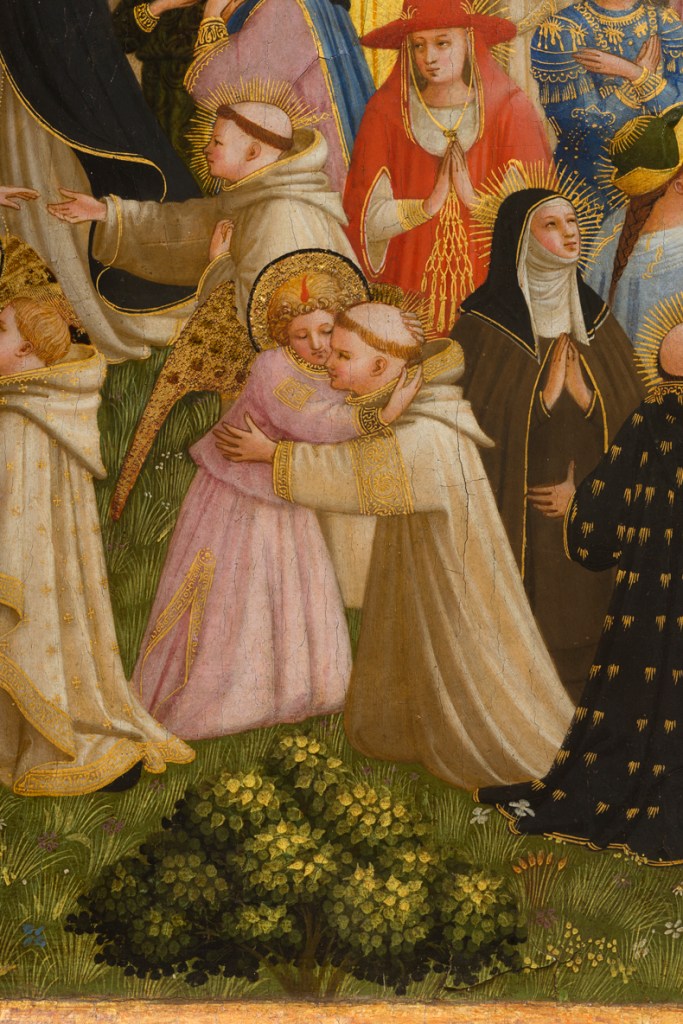
The restoration of many paintings created an exceptional opportunity for new technical research. For instance, imaging of the Fiesole pala has revealed the throne’s canopy to be octagonal, like that of the roughly contemporaneous Virgin and Child Enthroned, with Twelve Angels now in Frankfurt. The catalogue explores how Fra Angelico adhered to tradition, for instance in his choice of pigments, and broke new ground, such as in the use of preparatory cartoons or in sophisticated perspectival constructions. Like many leading artists, he was in great demand. The friar was hired to complete the unfinished projects of other painters and paused his own work to take on new commissions, leading to prolonged gestation periods. However, as Marco Mozzo points out in the catalogue, the fact that he rarely left his own incomplete points to his expert management of complex projects.
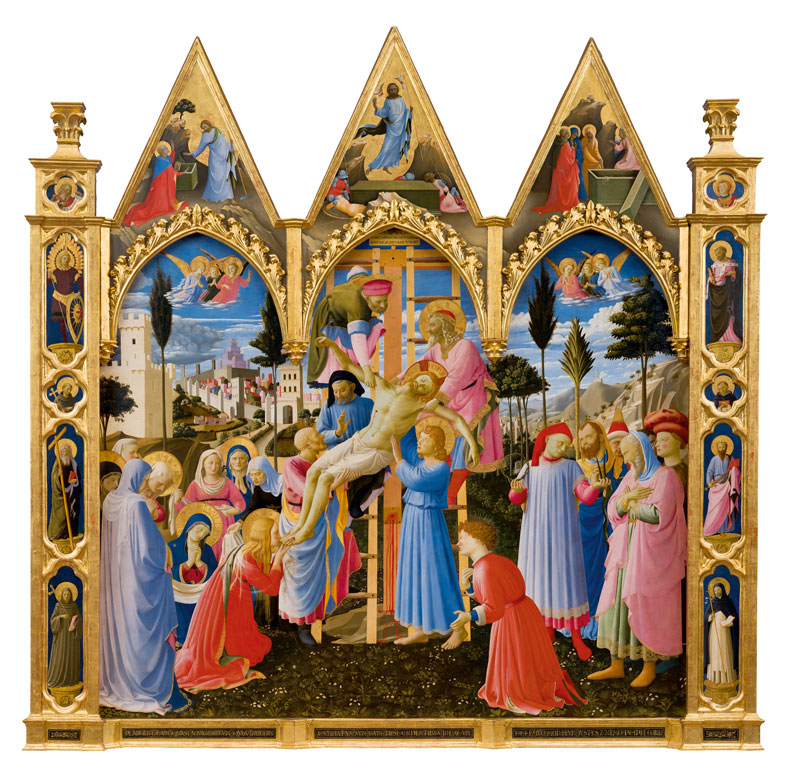
The installation at Palazzo Strozzi focuses on issues of patronage and compositional and technical innovation. It opens with the story of Santa Trinità, underscoring to visitors that they are standing in the Renaissance clan’s family compound and on the doorstep of their parish church. The Strozzi family had previously employed Lorenzo Ghiberti to transform its sacristy into a Strozzi burial chapel and adorned it with altarpieces including Fra Angelico’s Deposition and Gentile da Fabriano’s more famous Adoration of the Magi (represented here by a predella scene).
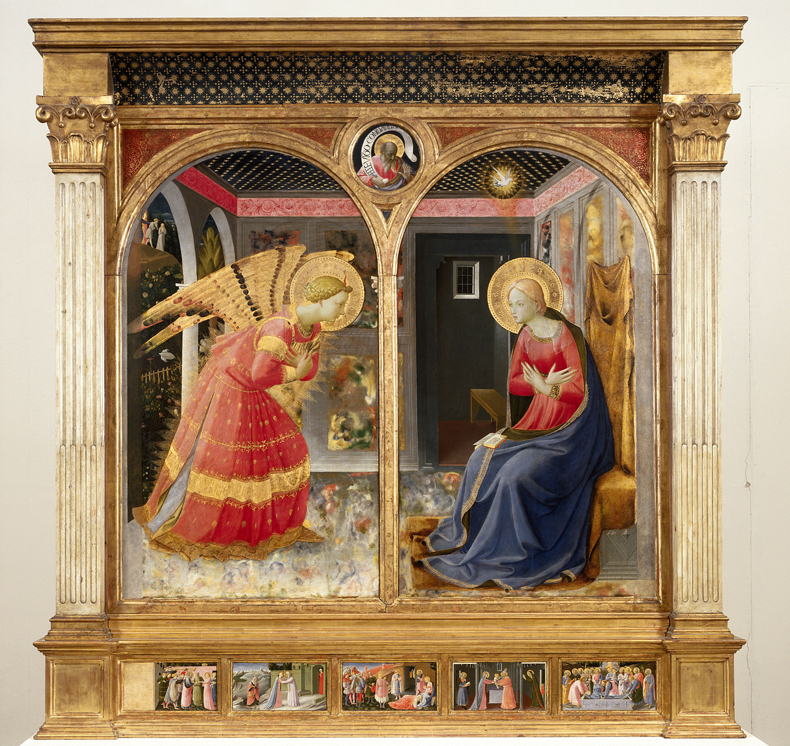
It opens with the beautifully restored Deposition, a painting begun by Lorenzo Monaco – who delivered only predella and pinnacles – and finished by Fra Angelico. The curators foreground his reimagining of the triptych into a single pictorial field. The friar seized opportunities for spatial exploration that Lorenzo Monaco did not pursue in the Annunciation for the Bartolini family chapel for the same church. The comparison also reminds visitors that Lorenzo Monaco modelled the career of a painter who embraced the religious life and successfully leveraged the connections and independence of the orders, which operated outside the guild system. Another approach to carving out a modern vision within the antiquated triptych format surfaces in the next room. Here the triptych for the chapel of the Compagnia di San Francesco del Martello at Santa Croce stands out. With laser cleaning technology, conservators at the Opificio delle Pietre Dure have made the side panels, long thought to be damaged beyond repair and consigned to a storage depot, shine again. Reunited with its central panel and predella, the main tier of images reveals Fra Angelico’s careful use of landscape already introduced by the Deposition. The same spare desert beneath the saints’ feet that underscores the Franciscan commitment to a penitent life creates plausibly three-dimensional space in front of the gold background, transforming the four ascetics into figures in the round. In the predella, Fra Angelico took those spatial experiments further, opening a bird’s-eye view behind The Meeting of Saints Dominic and Francis of Assisi and plotting a tightly framed and choreographed crowd scene in the central panel depicting the funeral of Saint Francis.
What follows is a reconstitution of the San Marco altarpiece. Angelico borrowed from an Ilkhanid animal carpet to anchor the sacred space. The radicality of this gesture is revealed by its multi-decade cleaning and the installation here opposite a 14th-century rug. The newly conserved treasures continue: three monumental sagomata crucifixes (including the extraordinary Pesellino, whose connection to the boys’ confraternity of San Giorgio – once hypothesised by Luciano Bellosi – is now confirmed in the catalogue by Andrea Staderini), his highly original variations on the Madonna of Humility, a room dedicated to his career in Rome that raises fascinating questions of his curial patronage beyond that of Cardinal Torquemada, a gallery of altarpieces that offer comparisons between Fra Angelico and his contemporaries as well as across media, and a conclusion focusing on his relationship with the Medici. The artist who emerges from these galleries is possessed of an exacting artistic skill and an omnivorous mind, who continued to refine pictorial solutions across media, location, and workshop structure throughout a 40-year career. Among all this splendour, it’s hard to find room for improvement.
‘Fra Angelico’ is at the Palazzo Strozzi and the Museo di San Marco, Florence, until 25 January.
From the January 2026 issue of Apollo. Preview and subscribe here.