From the January 2026 issue of Apollo. Preview and subscribe here.
Frances Anne Vane, Marchioness of Londonderry, was a formidable force in 19th-century European politics; when she died in 1865 she left behind an impressive collection of jewellery. Emma Edwards, project curator at the Victoria and Albert Museum, explores the intricacies and the symbolism of one emerald-studded ensemble.
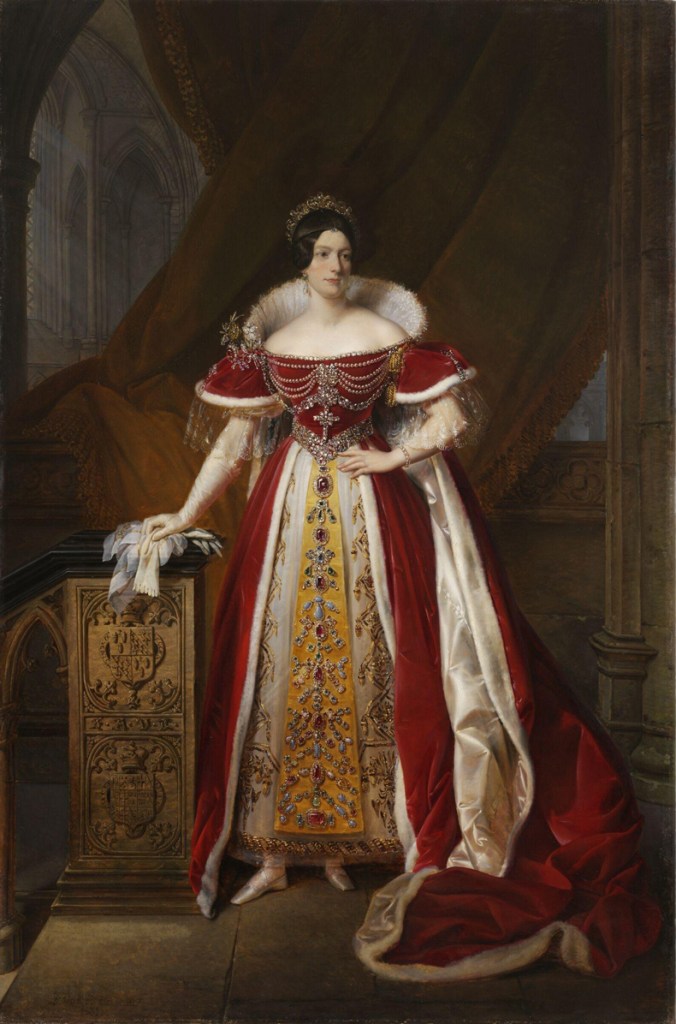
At the coronation of the 20-year-old Queen Victoria, in Westminster Abbey in 1838, an older woman caught the eye of Benjamin Disraeli. Clad in ermine-trimmed scarlet robes and bedizened with jewels, she looked, he wrote, ‘like an empress’ as she ‘blazed among the peeresses’. This imposing figure was Frances Anne Vane, the Marchioness of Londonderry (1800–65), who left rather an impression on the future prime minister. ‘She was a tyrant in her way,’ he wrote in 1874, after assuming office for the second time, ‘but one remembers only the good in her.’
Much of what we know about Frances Anne is from a handful of contemporary accounts and a biography by one of her successors as marchioness. But we can also get a flavour of her personality from some of her possessions. At the Victoria and Albert Museum, on long-term loan from a private collection, is a demi-parure – a matching set of jewellery, in this case an emerald-studded necklace and earrings – from one of the UK’s most significant aristocratic jewellery collections. Given how much jewellery belonging to the great and the good has been broken up, reset or sold off over the years, it’s remarkable that the marchioness’s collection has survived at all. It gives us a sense of one of the most imperious women in 19th-century Britain.
The marchioness was born Frances Anne Vane-Tempest to Henry Vane-Tempest and Anne, Countess of Antrim. Vane-Tempest, a major landowner in the north of England, died when Frances Anne was 13 and her guardianship was held by her mother and her aunt, with whom she had – perhaps fittingly, given her maiden name – a stormy relationship. But she was one of the great heiresses of her generation and in 1819 she married Charles William Stewart, who was 22 years her senior and who took her name in order to access her fortune.
Frances Anne’s mother did not agree with the marriage and deemed Charles William a fortune hunter, even though he had a significant income of his own. He was also the half-brother of Robert Stewart, commonly known as Lord Castlereagh – one of the most influential diplomats of his generation. Thanks to Castlereagh’s influence, Charles William became an ambassador, first to Berlin in 1813 and shortly afterwards to Vienna.
He didn’t comport himself with much decorum: his boorishness, belligerence and fondness for vice earned him such nicknames as ‘Lord Pumpernickel’ and ‘Fighting Charlie’. But he held his post for nine years, from 1814–23, and when in 1822 Lord Castlereagh had a nervous breakdown and took his own life, Charles William became the 3rd Marquess of Londonderry.
By this point he was three years into his marriage to Frances Anne, who at the tender age of 19 had been thrust into the heart of European politics. The 1810s and early 1820s were quite a time to be a diplomat in Europe: many of the continent’s rulers were meeting regularly in Paris and Vienna to discuss peace and how it might be maintained after the Napoleonic wars. Amid the politicking, Frances Anne was responsible for hosting strategically important social and political functions.
A year or so into her career as a diplomatic hostess, Tsar Alexander I saw a half-length portrait of Frances Anne in the studio of Thomas Lawrence in Aachen and was instantly intrigued. In 1820 the two met in Vienna and the tsar quickly grew besotted, calling on the couple and engaging them in conversation for hours. For many years the tsar had been a recluse; it was Frances Anne who brought him out of his shell. They met several times over the next two years.
Around the time of the Congress of Verona in 1822, the tsar began to grow wary of spies watching him and recording his movements. The lovers parted in Venice and Frances Anne anointed him godfather to her daughter – whom she went on to name Alexandrina in his honour. In her memoirs, she wrote that their romance was ‘innocent from guilt’, which suggests that their affair, though passionate, was never consummated.
The tsar had written her many letters, which she kept in a leather portfolio embossed with the tsar’s crest. But he also gave her several jewels, which a later marchioness described as ‘barbaric’ on account of their monstrous size. They included topaz and enormous amethysts, visibly sewn on to her clothing in several portraits, including one by Lawrence that hangs in Mount Stewart in Northern Ireland. These jewels were tokens of the tsar’s infatuation, his devotion and his phenomenal riches, underwritten by Russia’s vast mineral wealth.

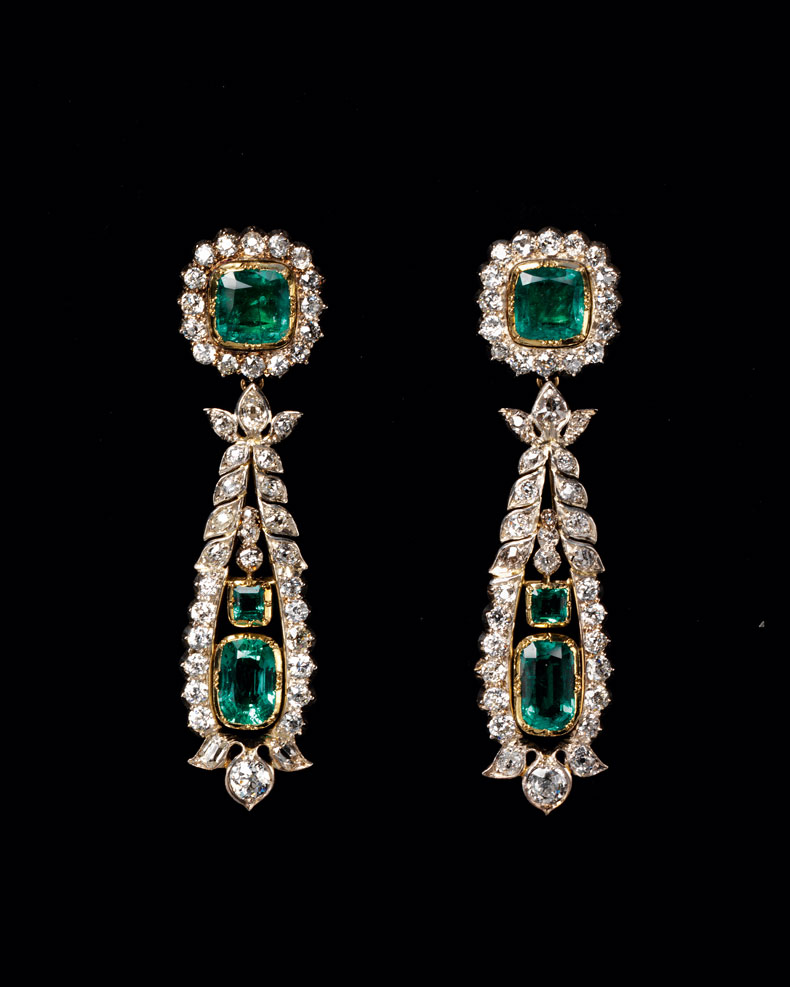
Though there’s no doubt she cherished these gifts, the marchioness owned many suites of jewels with the most lustrous of gems. Her husband gave her a set of enormous pear-shaped pearls after the birth of their first child in Vienna; at one point she purchased a turquoise parure from Count Ferdinánd Pálffy in Vienna when he was a little hard-up. We don’t know how she acquired this emerald demi-parure, though she inherited the emeralds themselves – the ‘Antrim emeralds’ – from her mother; neither do we know where in England it was made, though London seems most likely, since that’s where the court jewellers were based. In any case, even by the standards of the marchioness’s collection, this item is something special. Formed of six clusters of diamonds and emeralds on the necklace, with a pear-shaped emerald suspended in a pendant, it’s set in gold, heightening the contrast between the green of the emeralds and the lustre of the diamonds. The clusters themselves are arranged almost like fireworks, while the earrings hang like glimmering elongated teardrops.
The grand scale of this jewellery was typical of the time. Jewels made in the early 19th century and before tended to be more neoclassical in style, but as the 19th century waltzed on, layers of diamonds and coloured stones began to make an appearance. The sophisticated setting of the gemstones in this demi-parure reflects developments in jewellery-setting techniques, which allowed for the open-work layering of diamonds and precious gems – that is, a setting full of interstices that bring out the decorative patterns in which the stones have been set.
The constituent pieces were adaptable and flexible so that, like most jewellery of the time, it could be worn in different ways. (In one portrait painted in 1832 after the coronation of William IV, the emeralds can be seen on her dress.) In general the process went something like this: the jeweller and the client would agree on a design, usually based on drawings that the client would approve. Then the emeralds and diamonds would be sourced – easy enough for this demi-parure, since the marchioness already had the emeralds. The client would take the jewels that they wanted to be set or reset to the jeweller, who would work up the design, sourcing any additional stones that were needed and, if necessary, recutting some of the stones.
The gold and silver would be sourced, melted down, alloyed and rolled out on to a thin sheet with wire to make the structure and the settings. Then the goldsmith would make a little collet and decorative elements by hand, soldering everything together and adding hinges and links so that the piece would hang properly, or screws so the pieces could be taken apart and worn in different ways. A specialist setter would prepare the seats for each of the stones and then carefully set the diamond and, in this case, the emeralds. Once set, the whole piece would be polished and cleaned, and a box created for the jewels, velvet-lined and furnished with a mount so that they sat in the case perfectly.
Thus did the jewels begin their life as signifiers of rank and lineage. Worn at all manner of formal occasions, from coronations to ambassadorial functions, the best examples of mid 19th-century jewellery reflected Britain’s industrial and imperial prowess. Gem-cutting and metalworking techniques had improved significantly and global trade networks were expanding apace. Though we don’t know where Frances Anne’s mother got her emeralds, the diamonds likely came through Charles William from his grandmother, the daughter of the governor of Bombay, who had unparalleled access to the South Asian gem market. There was also a certain culture of display in Britain, typified by the Great Exhibition in 1851, at which, alongside all the technical innovation, plenty of jewellery was on show.
The Illustrated London News took pains to record and illustrate these jewels. At the time, society columns described at length what aristocrats wore. Given that evening events would have been lit only by candle or gaslight, diamonds would have glinted and shimmered in the dimness while coloured gems captivated the eye.
The marchioness and her husband enjoyed a lavish lifestyle, of which a number of their rivalrous contemporaries disapproved – sometimes committing their scorn to paper. In these sources she is often described as haughty, but a more generous interpretation is that she was simply very determined. Whether marrying Charles William against her mother’s will or outshining the other aristocratic women at Queen Victoria’s coronation, Frances Anne knew and often got what she wanted. Charles William had, by his first wife, a son who was set to inherit the Marquessate of Londonderry, but Frances Anne insisted that a new title was created for her children to inherit. And so the marquessate continued through Frances Anne’s line, along with her estate – and her jewels.
As told to Arjun Saijp.
Emma Edwards is a project curator at the Victoria and Albert Museum, London, and the curator of ‘Dynastic Jewels: Power, prestige and passion, 1700–1950’, which is at the Hôtel de la Marine, Paris, until 6 April.
From the January 2026 issue of Apollo. Preview and subscribe here.