
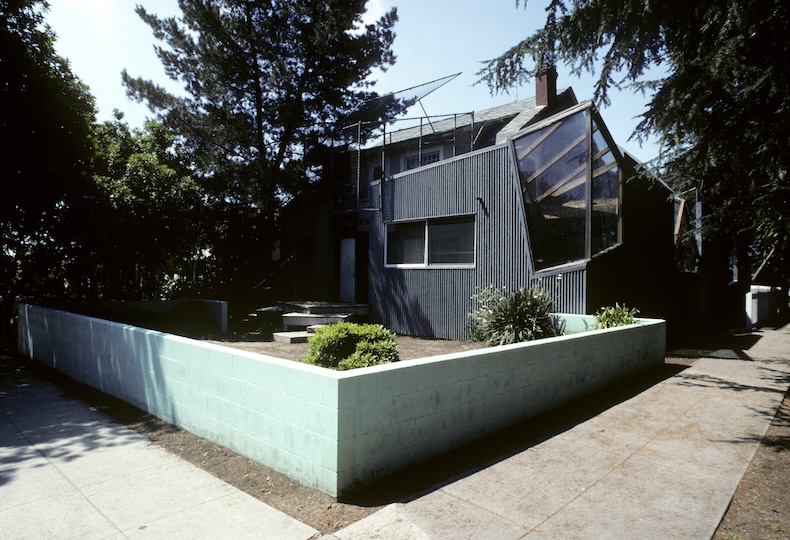
The Canadian-born architect Frank Gehry, who has died at the age of 96, lived in a pink bungalow in Santa Monica around which, in 1978, he built another house, cocooning the original building in plywood, chain-link fencing and corrugated iron. It was a fragmented, deconstructed style that suited what he described as the ‘brash, raucous, frontier’ spirit of his adopted Los Angeles and it soon attracted attention. It was, the architectural historian Beatriz Colomina has written, ‘The house that built Frank Gehry’. The architect was a friend and collaborator of Pop artists Jasper Johns and Robert Rauschenberg, and his raw, bricolaged aesthetic was the architectural equivalent of their Combines and assemblage works, which fused found objects with painting.
The artist’s architect, Gehry designed LA studio-homes for Ron Davis and Lou Danziger. With Claes Oldenberg he came up with scaled-up binoculars that served as the entranceway to a 1990s commercial building near Venice Beach. However, the artist with whom he shares the greatest affinity is Richard Serra, whose The Matter of Time (1994–2005) fills the main gallery of Gehry’s masterpiece, the Guggenheim Bilbao (1997). The gutsy, titanium form of that building, with its Serra-like torques and large-scale curves, was supposedly inspired by a fish; indeed, it resembles a time-motion study of a muscular tuna flapping about on the dock. Made possible by the computer programmes used in aeronautics, it also looks like the swoosh of warplanes engaged in a dogfight (Gehry’s first public building, Aerospace Hall in Los Angeles, 1984, has a fighter jet collaged on to its facade). Gehry’s urban installation blurred the boundaries between art and architecture: he sought to emulate the way in which Serra’s sculptures make you feel space as a dramatic force-field.
‘I was an outsider from the beginning,’ Gehry recalled. ‘I was different from the architects, who called me an artist, which was their way of marginalising me. And then the artists got competitive and said, No, you’re still an architect, because you’re putting toilets in your buildings, in your art. Richard Serra dismissed me as a plumber.’ Serra made this remark on the Charlie Rose show in 2001, initiating a spectacular falling out (he later sought to make amends by clarifying that he had said only that Gehry ‘thinks like a plumber’). In response to Serra’s high-minded comments about the ‘purity of art’, Gehry noted that Michelangelo and Bernini were artist-architects.
The Guggenheim Bilbao made Gehry, at 68, the most famous architect in the world – the personification of the Starchitect. Its success was followed by the Walt Disney Concert Hall in Los Angeles, designed before Bilbao but completed in 2003. Its festive, flowing, rhythmic design in shimmering steel, resembled ‘frozen music’. A huge ship in dry dock, its wooden interior was intended as a ceremonial barge, with convex sails to soften the space and diffuse orchestral sound. Gehry designed a set there for Don Juan made of clouds of scrunched paper, which inspired a cameo on The Simpsons. When Gehry, ‘the bestest architect in the world’, receives an invitation from Marge to design a similar concert hall in Springfield, he scrunches up her Snoopy letterhead and casts it aside. However, the crumpled form catches his eye: ‘Frank Gehry, you’re a genius!’ Wrecking balls are soon seen smashing a steel grid into a signature buckled state.

When I interviewed him in 2012, Gehry was keen to assert that he did not design in this throwaway fashion. He carefully familiarised himself with the site and worked first with coloured blocks that defined each project’s different programmes and how they might jigsaw together, allowing him to experiment with space, volume, scale and massing. He then approached the design much as a painter would approach the blank canvas, beginning to sketch the skin of the building with spontaneous, gestural sketches that look like an energetic bird’s nest of squiggles. ‘I just trust my intuition and draw,’ he explained. ‘I don’t take my pen off the paper, I just keep going and I do lots of them and the design evolves over twenty drawings, you start to get the beginnings of an idea of how to do it.’
Though his firm pioneered the use of architectural computer software, the hands-on, haptic process was important to him and he was keen to emphasise the human scale. ‘The problem with the computer is it dries out all of the humanity and it takes away all the feeling,’ he said, ‘I haven’t seen anything that excited me coming out of the computer stuff – it sort of looks repetitive.’ Through an iteration of tangible models and sketches, Gehry could intuit a resolved design. ‘I don’t build it unless it clicks – you know, when you get the combination on the safe and you hear it click, that’s what I look for. The crazy thing is, over the years when you see the buildings finished and when you look at the first sketches, a lot of it’s there.’
Critics, such as Hal Foster, saw in such architecture the decadent urban branding of late capitalism, with its addiction to spectacle. In response to such accusations of showmanship, in 2014 Gehry famously flipped the bird at a Spanish news conference. He said 98 per cent of what was currently built was ‘pure shit’. He had a great sense of civic responsibility and wanted to distance his unique architecture from the corporate homogenisation that was blighting our cities. ‘I see so many inhuman, heartless buildings being built,’ he told me, ‘and it’s stupid. The most important thing in every building is to create the place for human interaction – it’s magical if you get it right and I love that. Man, I try to make that happen! If I go down in history, I want to be known for doing that!’
Christopher Turner is Keeper of Art, Architecture, Photography and Design at the Victoria and Albert Museum, London.