From the March 2026 issue of Apollo.
Don’t expect any mannequins: the only frock coats and fichus in this fashion show are those the virtuoso artist ingeniously and dazzlingly translated into pigment on canvas. To our eyes, the bizarre as well as spectacular aspect of the costume and maquillage of Gainsborough’s sitters – ‘fancied’ or fancy dress, preposterously piled and powdered hair, patches, vivid rouge – are compelling enough for consideration, but this exhibition and accompanying catalogue also explore the all-encompassing concept of fashion in 18th-century Britain.
Fashion determined how and where (as well as in what) a sitter should be painted and by whom. Occasionally, it also determined who was depicted. The word came to describe a growing and aspirational social class, ‘people of fashion’ as they were known. ‘Gentility running away from vulgarity’ is how the painter James Northcote described it. Even for the aristocratic sitter, presentation of self was a tool of dynastic ambition. This small but representative show brings together a lively company of the great and the decidedly not so good, friends and family, children and dogs – in intimate portraits and bravura full-lengths.
Gainsborough grew up surrounded by the raw materials of fashion. He was the son of a Suffolk cloth merchant; his cousin had a tailoring business in London and one sister a millinery shop in Sudbury, plus another in Bath. The artist’s attention to the particularity of stuffs and how to depict them is apparent in the early ‘conversation pieces’ here. Such small-scale group portraits were already going out of fashion around 1750 when he recorded the stiffly posed Mr and Mrs Andrews and their no less carefully observed rural acres. It was the artist’s fate to rely on the ‘curs’d face business’ to make a living rather than his beloved, but less lucrative, landscape painting.
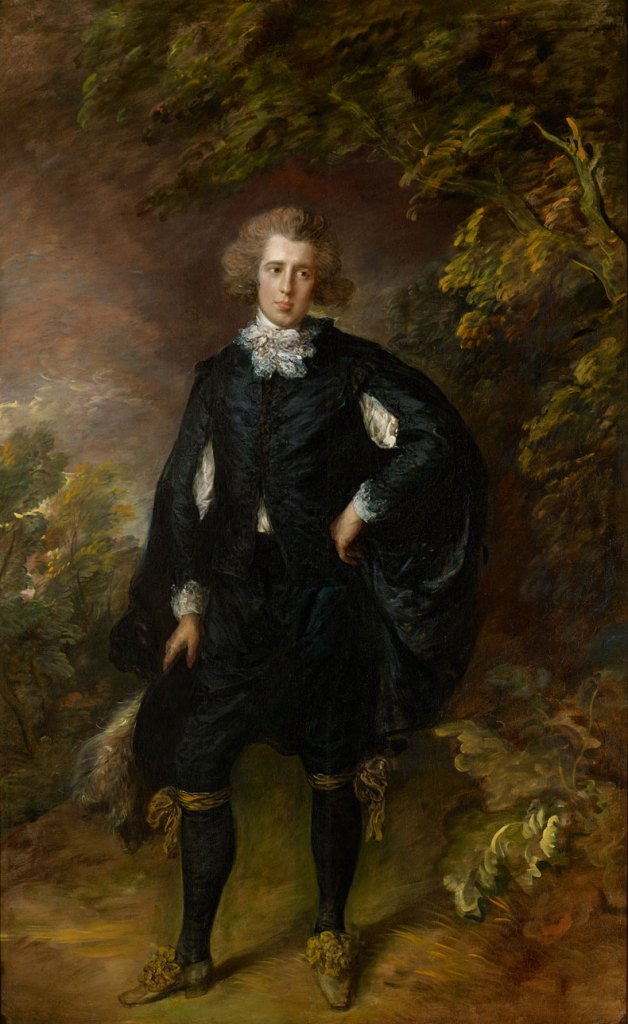
The provincialism of Gainsborough’s Suffolk pictures soon dissolved after his move to the fashionable spa resort of Bath in 1759. The artist quickly developed his widely acknowledged skill not only in capturing a likeness but also in conjuring the shimmering, seductive surfaces of silks, the sheen of pearls and the delicacy of gauzy, diaphanous lace. Such signifiers of a sitter’s wealth and status are resplendent in Mary, Countess Howe of 1763–64, one of Gainsborough’s earliest ‘whole-length’ society portraits.
Gainsborough may have borrowed the conceit of the gloved left hand holding the glove from the right from Van Dyck’s Lord John Stuart and His Brother, Lord Bernard Stuart, his copy of which takes centre-stage in the main gallery, flanked by Countess Howe and The Hon. Frances Duncombe. That the artist was able to endow his sitters with a patrician air of ease and occasional hauteur, whatever their position in the social hierarchy, is largely due to his study of the 17th-century Flemish master, one well represented in British aristocratic collections. Gainsborough modified Van Dyck’s technique to a freer, looser brushwork more suited to capturing the rippling surfaces of his sitters’ attire. Frances Duncombe herself is presented in blue Van Dyck dress, perhaps to accord with existing portraits at Longford Castle, just as Bernard Howard, Later 12th Duke of Norfolk – out on loan for the first time from Arundel Castle – visualises Bernard as the legitimate heir to the 11th Duke, his third cousin.
Despite his not infrequent recourse to historic court dress, real and imagined, Gainsborough preferred the contemporary. He felt it propitious for a truer likeness, unlike his great rival Joshua Reynolds, who favoured the classical grand manner. Even so, he was acutely aware that fashion dated a portrait, and he would amend accordingly. Technical examination of his soulful, romantic portrait of the talented singer Elizabeth Linley, Mrs Sheridan, for instance, reveals that he subsequently removed her no longer modish bergère hat, basket, shepherd’s crook and lamb.
Mrs Sheridan’s scandalous private life paled in comparison to that of Grace Dalrymple Elliott. Gainsborough submitted his first portrait of Mrs Elliott to the Royal Academy exhibition of 1778 after his sitter’s highly public liaison with one married aristocrat and during her relationship with a second. Referring to a poem by Alexander Pope, critics alluded to her ‘errors’, but – overwhelmed by her beauty – were inclined to ‘forget them all’. All bets were off by 1782 after Elliott had just given birth to a child, reportedly fathered by the Prince of Wales, when Gainsborough painted her once more, perhaps at the prince’s behest. In an era before photography, notoriety of sitter drew visitors to Gainsborough’s studio, relocated to London in 1774, as well as to the Academy.
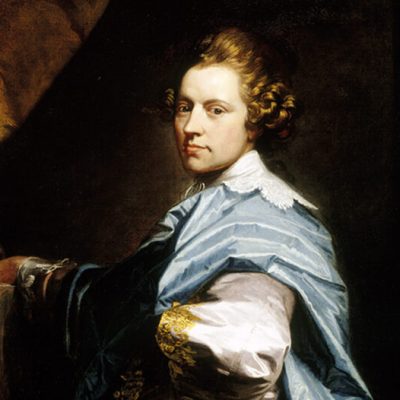
It seems likely that Gainsborough used portraits of his family hung in his showroom to represent portrait types. These often experimental, intimate images are perhaps the most compelling of the show, not least the bravura study of the artist’s handsome nephew and studio assistant, Gainsborough Dupont, and the direct, sympathetic portrait of the artist’s long-suffering wife, Margaret. By the late 1770s he had evolved a gestural technique, almost a shorthand, which lent even greater immediacy and life to his subjects. That the artist gave dignity to what curator Aimee Ng nicely describes as the ‘topography of the aged face’ is evident, too, in Mary, Duchess of Montagu.
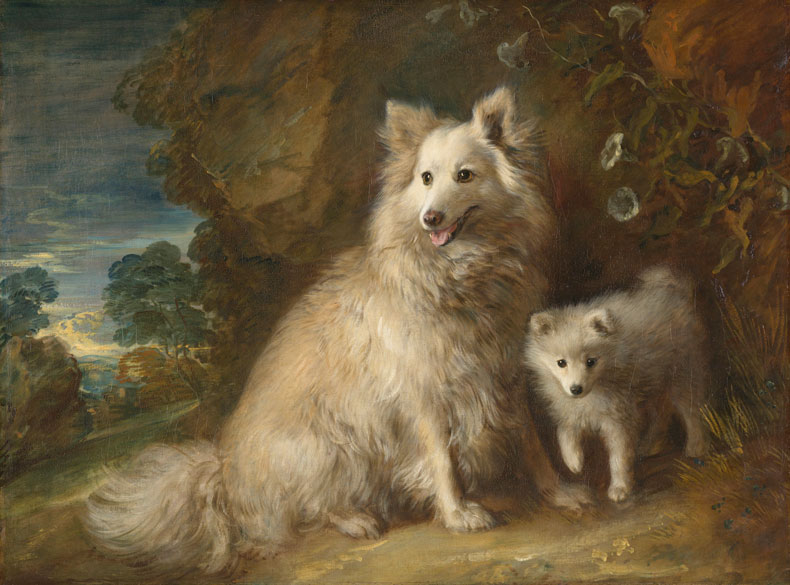
Alongside the duchess is the portrait of her husband’s then valet, the remarkable Ignatius Sancho, born on a slave ship (the catalogue does not shy away from commenting on the questionable fortunes that brought wealth to many of Gainsborough’s sitters). Sancho was already publishing his musical compositions and gaining a reputation as a man of letters at the time of the work’s creation in 1768. Gainsborough depicted his only Black subject in the clothes and pose of a gentleman – hand tucked into his waistcoat. The commission may have come from the Montagus, but it is perhaps more likely that the artist chose to depict Sancho, along with other musical and professional friends, as a mark of respect. A show-stopper is the Pomeranian and Puppy painted in exchange for lessons on the viola da gamba from their probable owner, Carl Friedrich Abel. Who would have realised that the composer was so portly that his waistcoat might easily have ‘buttoned twin brothers’? Gainsborough really was Van Dyck’s true heir.
Gainsborough: The Fashion of Portraiture is at the Frick Collection, New York, until 25 May.
From the March 2026 issue of Apollo.