From the January 2026 issue of Apollo. Preview and subscribe here.
If you live into your 90s, you’ll find yourself inhabiting a radically different world to the one you grew up in – and, just possibly, one that’s also the same in disturbing ways. You might, say, have been born in Dresden in 1932, narrowly escaped being caught up in the firebombing of that city in 1945 and later devoted decades to making art constituted as being after fascism, only to see said ideology roar back in your sunset years. You might have begun your exhibiting career as a participant in the short-lived, consumerism-critiquing Capitalist Realist movement of the 1960s yet become, six decades later and to your chagrin, the most expensive living artist in a world of rampant inequality. And also, the subject of a massive, darkly celebratory retrospective in the €800m Frank Gehry-designed private museum of a French luxury-goods brand owned by Bernard Arnault, one of the world’s wealthiest men.
‘Gerhard Richter’, at the Fondation Louis Vuitton in Paris, is a 275-work survey that surely won’t be equalled for scale and wealth of loans in its subject’s lifetime. It is exhaustive and, as its five ascending floors progress (and as Richter, after a certain point, mostly does not), somewhat exhausting. Arranged chronologically, it includes rooms of great intensity, traverses eras displaying an almost omnidirectional virtuosity and features long late passages of wheel-spinning aesthetic finessing. As a titanic summation of Richter’s practice – much more so than the touring ‘Panorama’ retrospective of 2011–12, since it’s almost twice the size and includes work dating to 2024 – it demands we gauge his achievement. It is, furthermore, an exploration of what happens when you set out to make paintings that are full of doubt about the purpose of art after Auschwitz, but often so loaded with complicated affect and verve that a viewer may well enter them and be moved anyway. Arguably, it’s a comparative study in good emptiness and bad emptiness.
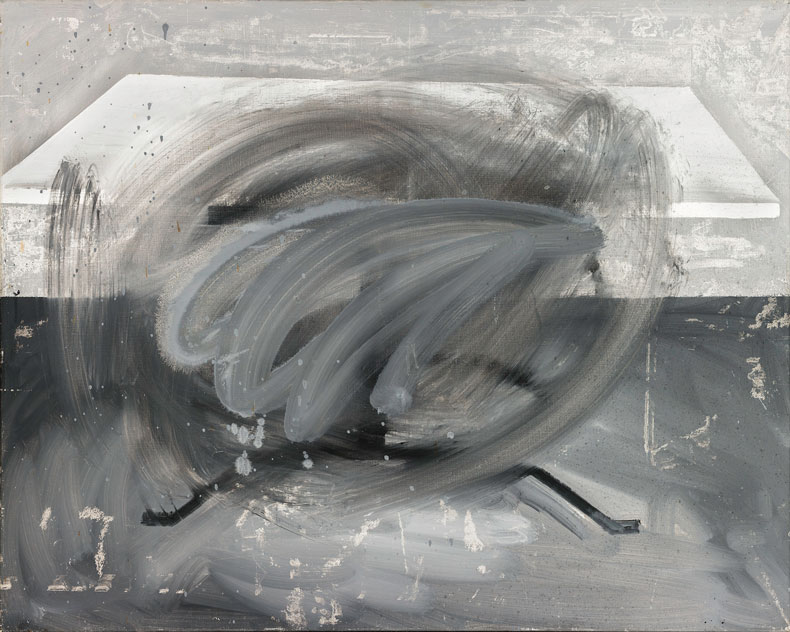
Symbolic erasure is built into Richter’s art from early on. Table (1962), in the show’s opening room, is nothingness as form. Having made a black-and-white realist painting of a piece of furniture, the artist has scrubbed out the central part, leaving a hovering grey cloud. Painterly destruction and voiding, we’re forewarned, are going to sit in counterpoint with the wider social context: an increasingly prosperous but unhealed West Germany of the 1960s, whose citizens were determinedly not talking about the war and where many former Nazis were still in positions of power. Transcendence was henceforth not painting’s goal; a poetics of negation and downfall might be. Richter’s artworks, he has suggested in interviews, are no more than what they are: a figurative image is only a reflection of the corner of reality it depicts. If choice of subject suggests an editorialising opinion, one might get around that by painting everything, from a toilet roll to a hanged woman.
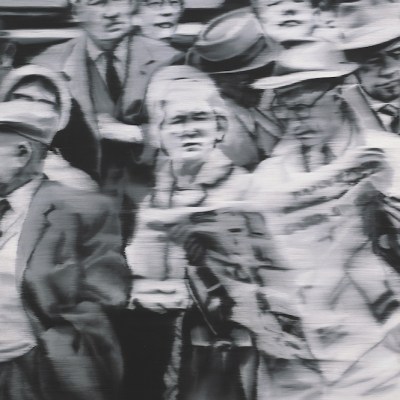
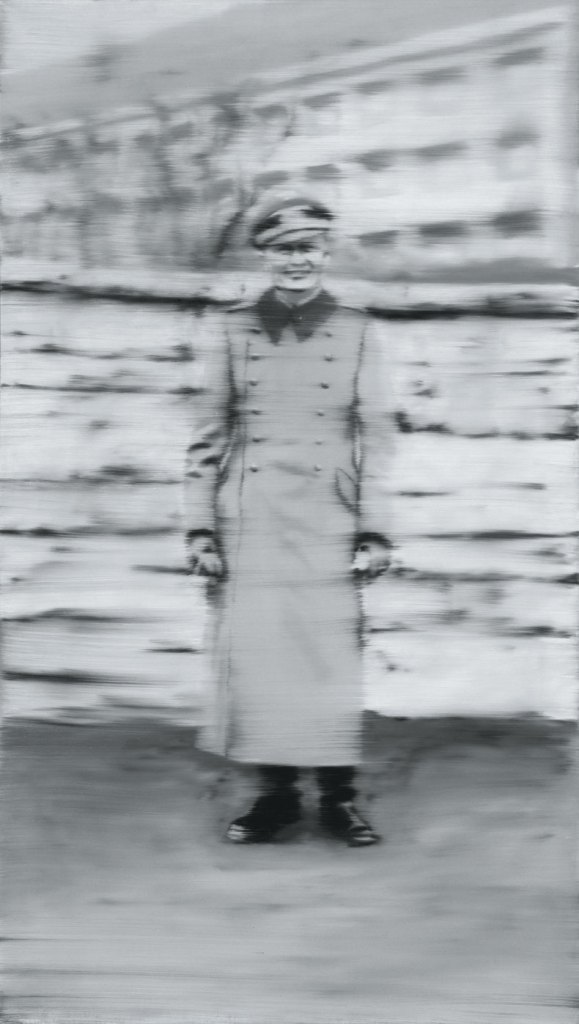
Context creeps in, nevertheless. Much of Richter’s early figurative work, based on black-and-white historical photographs subjected to his signature blurring, is ghosted by hindsight, by implicit reminders of what happened after the original image was made. Here, in Uncle Rudi (1965), is the smiling face of uniformed fascism and its horrific proximity within one’s own family line; here, in Aunt Marianne (1965), is Richter’s schizophrenic aunt, happily holding the artist as a baby in the mid 1930s, unaware that soon enough she will be euthanised by the Nazis. Here, in the Warholian Eight Student Nurses (1966), are the young women, mostly smiling, who will become victims of a mass murderer in Chicago. The power of these works derives from a multivalent shimmer: the images feel inaccessible and the narratives they point to certainly irreversible; the blur creates a sense of remove and of the artworks unavoidably, melancholically arriving too late. At the same time, the blur points to loss and the paintings also present an artist locating pictorial and conceptual space where none appeared to be – moving on somehow.
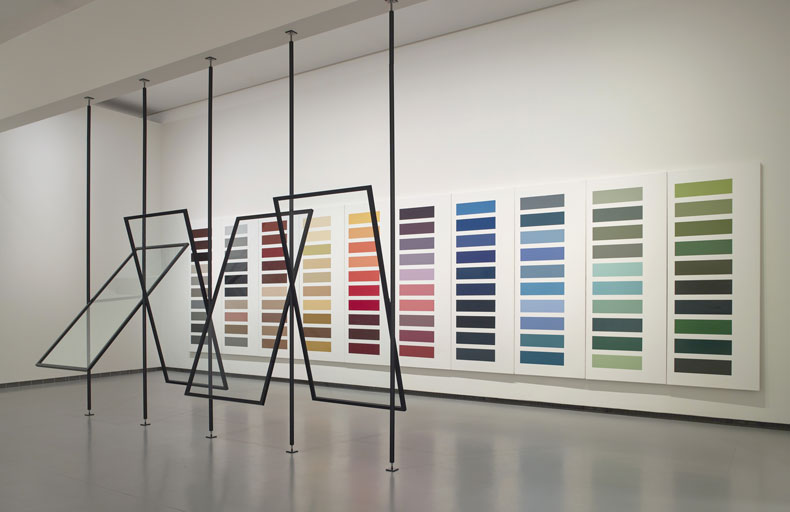
How Richter does that without espousing progress, from here and for decades, is to face in many formal directions at once – somewhat jettisoning the outdated heroism of a specific artistic identity – and to revisit pre-existing painterly forms without appearing to venerate them. Rather, he treats them like a shuffled deck of cards, or mere scaffolds. From the mid 1960s to the ’90s he finds persuasive ways to avoid a fixed position, first by pledging himself equally and simultaneously to figuration and abstraction. Ten Large Colour Charts (1966/71/72), a coldly zinging work driven by chance processes, wrangles colourful geometric abstraction from decorators’ design tools, as do scintillating successors such as 1024 Colours from 1973. When Richter returned to paintings based on black-and-white photos, he made a sharp turn into superficially ‘expressive’ but fundamentally mechanical rough-edged handling – in, for example, the aerial views of the Townscape paintings (1968–70) that survey German conurbations as if from the gimlet-eyed viewpoint of an aerial bomber.
At the exhibition, there are full rooms tracking this fecund era that leave one almost breathless at the artist’s Apollonian inventiveness and energy. It is a period in which he rewinds through the history of painterly iconography in the wake of photography’s territorial incursions, Second World War barbarities and the pluralism of nascent postmodernism. The tranquil, unpopulated, photorealist colour landscapes and seascapes and cloudscapes of 1969–70 soon give way in 1971–72 to the production-line monochrome portraits of great men in 48 Portraits (the subjects chosen a bit randomly, with Richter deliberately unaware of some of their achievements) and to abstractions built from rainbow-like, wet-on-wet paint strokes such as the Red-Blue-Yellow series of 1972.
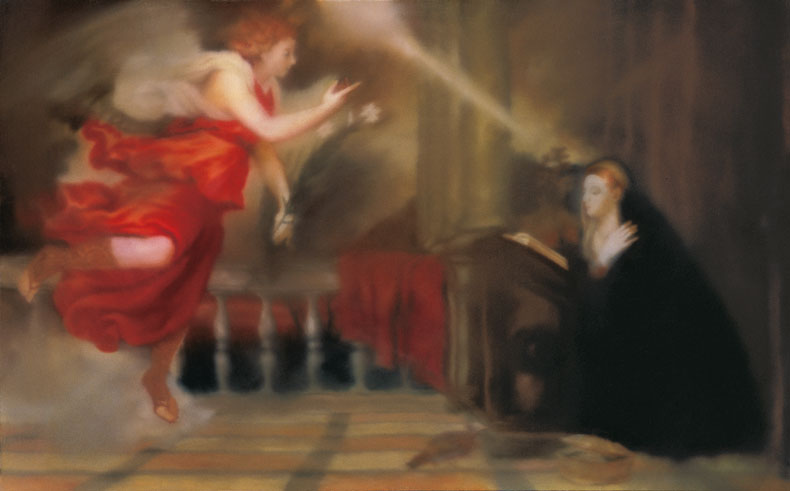
It would be easy for this to feel like dilettantism, yet Richter maintains pictorial authority, fundamental wall-power. In the Annunciation after Titian series (1973), an initially fuzzy but figurative rendition of the Italian painter’s composition is blurred over successive canvases into cloudy reddish-brown nothingness. Take that as a comment on a centuries-long swan-dive from Renaissance glories and the consolations of faith to emptied-out abstraction and process-driven formalism, or as one on the historical ‘inevitability’ of abstraction – the work, not unusually for Richter, teases competing readings into uncertainty. (Either way, it’s hard not to note with amusement that abstract painting with a tantalising whiff of pre-modern art history is what precisely many young painters are currently attempting, with little of Richter’s rigour.)
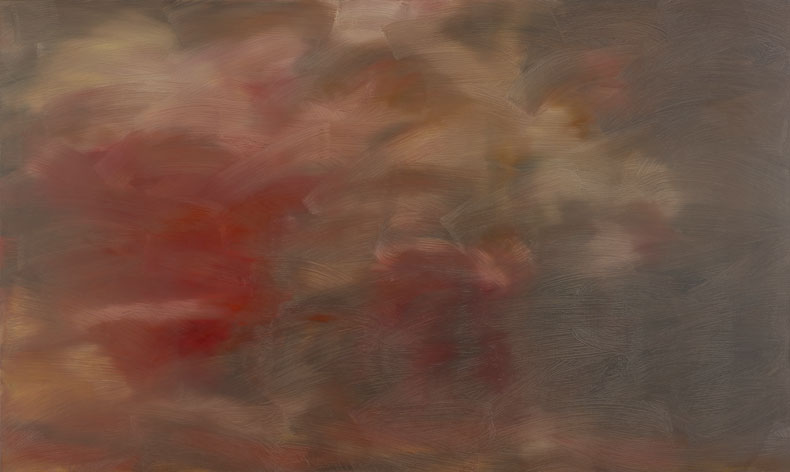
Given Richter’s desire, or at least assertion, that a painting shouldn’t refer to anything outside itself, it seems logical in retrospect that from the mid ’70s onwards, he should have devoted so much time to the autonomous zone of abstraction. It’s also logical, lest he be mistaken for an adherent, that he patiently counterpointed it with more figuration. Richter’s abstracts sometimes speed along in the manner of classic Abstract Expressionism (see the De Kooning-esque whiplash strokes of S.D. from 1985), but they’re closed systems: only in Construction (1976) is there a sense of perspectival depth, otherwise everything is lasering across an ambiguous surface. When Richter begins squeegeeing his paint in the late ’70s, the sense of the Abstract Paintings as halfway mechanical – if often acridly beautiful in their equal-opportunities approach to hot colour – is increasingly pronounced. Abstract painting, Richter suggests, is just another thing a painter can do, along with ethereal portraits of one’s daughter (Betty, 1977), drifting Antarctic ice-floe seascapes (Ice, 1981), or quixotic fusions of memento mori and abstraction (Skull, abstract, 1983).
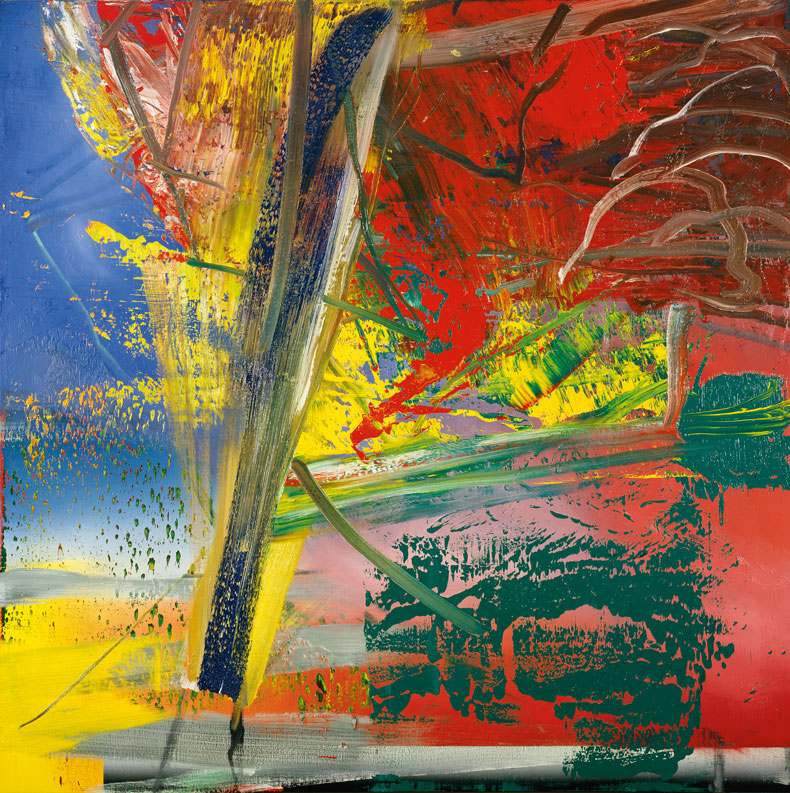
Richter continues energetically spinning plates like this until he reaches, or creates, an impasse with the 15-painting cycle October 18, 1977 (1988). This is focused on Germany’s far-left Baader-Meinhof guerrilla group, which during two periods between 1970–77 jangled the country’s collective nerves with campaigns of bombing and robbery and – to force the release of members imprisoned in 1972 – kidnapping and plane hijacking. The hazy monochrome paintings, based on found imagery, move between shadowy views of interiors and the group’s record player; images of members after arrest; and most indelibly, views of Andreas Baader dead – the same side-on view three times, the artist performatively trying for the truest version and giving up – and Gudrun Ensslin hanged, by whoever, in her cell. The series is at once gut-punching and obscure: it depicts death, but it also wants to question (as Luc Tuymans later would ad nauseum) whether painting is up to depicting history. It refuses to give an opinion on whether either terrorism or the perhaps-murder of terrorists are justified. These paintings are difficult to stay in the room with; they are unresolved and unresolvable, horrifying and philosophically neutral.
This is the darkness-covered summit of Richter’s art. Afterwards he seemed to exhale and start descending the other side. In 1989, he painted the pained-feeling Winter cycle of abstract paintings, with their coruscating, greying drags of white across and down black-blue backgrounds – and from there, halfway through his career, he resisted dramatic innovating. He discovered different ways to squeegee. In 1995, at the age of 63, he married the 26-year-old Sabine Moritz, his former student at Kunstakademie Düsseldorf, made paintings of her breastfeeding (S. with Child, 1995), and perhaps settled into something like pram-in-the-hallway domestic contentment. He intermittently road-tested new subject matters and formats, such as paintings of geometric microscopic closeups of minerals (the Silicate series of 2003), or the horizontally inclined, digital-era Strips (2011–13), based on computerised analyses of his abstract art and done in lacquer on the back of glass. His continuing Abstract Paintings occasionally skewed a little psychedelic. In some ways, Richter now operated more inventively and playfully in other, lesser media, such as his artists’ books (seen at the exhibition in vitrines): War Cut (2004), for example, fuses photographic details of a 1987 painting with newspaper bulletins about the Iraq War from 2003.
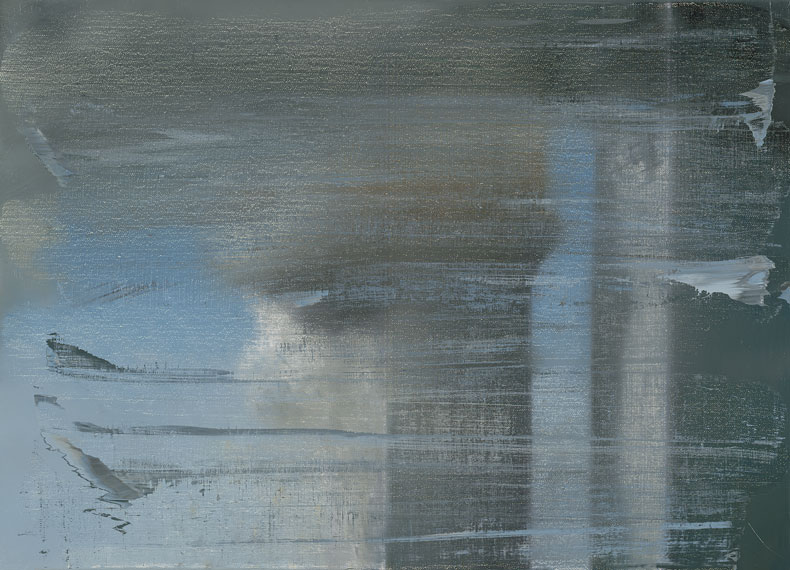
Outside of this, he would now touch on history painting only tentatively: the modestly scaled, 9/11-themed September (2005) doesn’t attempt the gravity of its subject, partly obliterating a view of the Twin Towers via dragging the grey of the buildings horizontally across the canvas. The Birkenau (2014) quartet of canvases augments the rubbed-raw palette of Winter with bloody crimsons and increasing flashes of green, like grass overgrowing the site of the concentration camp. At the exhibition these paintings hang opposite Grey Mirror (2018), four darkly mirrored panels in which coexist yourself and the paintings, yourself and a refraction of the Holocaust – reflected, invited to sombre but open-ended reflection on the once-again-live issue of fascism. Finally, Richter appears to bow out professionally with the small, elegant, lightly masterly drawings of the 2020s, a mixture of smudges and ambiguous featherlight lines, like skeletons of his abstracts, as if winding down the giant, wildly capable orchestra of his practice to a handful of diminuendo strings.
One wonders, still, about the second half of his timeline. If in the first half Richter explicitly raised questions about what it was possible for painting to now do, then since the 1990s, for whatever reason, he seems to have produced a body of painting that is at once grand and weirdly unimportant, unless you’re the kind of art historian who really wants to get into the granularity of his facture and thinking. Does painting matter in the face of history, or – given that his career feels somewhat divided by Germany’s reunification – the end of history? A lot of Richter’s later work, while never less than interesting to look at, doesn’t feel as if it does, even within the artist’s own history. Some of it escapes his control: his art not being post-fascism any more, or the desire of younger audiences to read a political position into art.
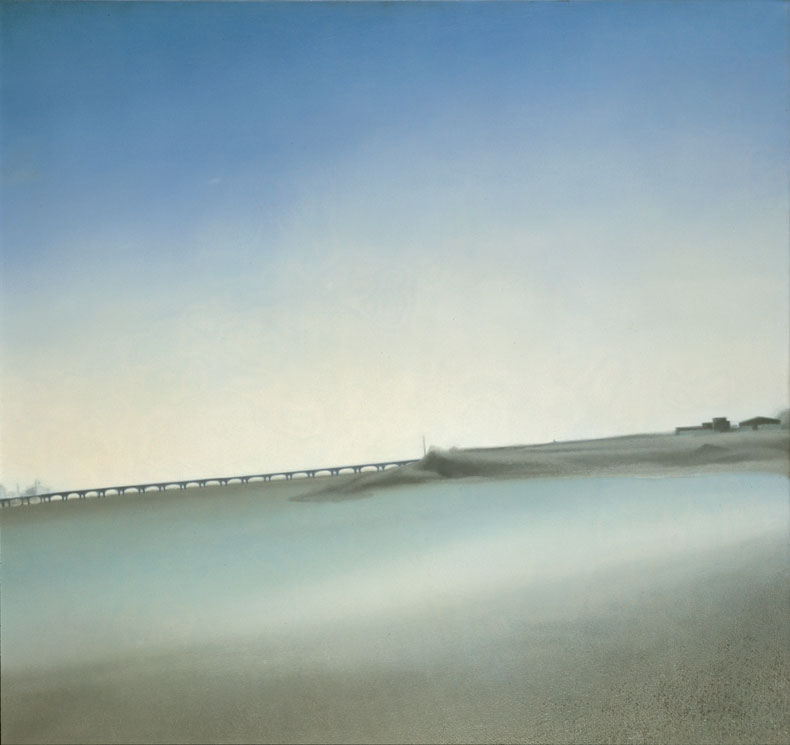
But that doesn’t take away from Richter’s earlier achievement, his life-support sustaining of painting while methodically dissecting it. For three decades, he could increasingly do anything, while coolly suggesting that perhaps none of it mattered in the grand scheme of things, even as his paintings also persistently whispered that maybe it did. Like so much great art, his can be endlessly revisited due to its fathoms-deep ambiguity. Look at an earlyish, unassuming canvas like Bridge (at the Seaside) of 1969: a spit of land and outstretching bridge forming a horizon line under a delicately blueing, star-dotted evening sky, nobody around, the lower half fuzzily ambiguous: maybe it’s water, maybe beach, maybe half of each. Here is a casual, banal, snapshot-style update of the German landscape tradition, a knowingly minor thing. Yet it’s also somehow hushed and beautiful, almost tender – everything and nothing swirling together for you to tease apart or accept, finally, as indivisible.
‘Gerhard Richter’ is at the Fondation Louis Vuitton, Paris, until 3 March.
From the January 2026 issue of Apollo. Preview and subscribe here.