From the November 2026 issue of Apollo.
Sir Thomas Phillipps, born in Manchester in 1792, described himself as a ‘vello-maniac’. No mere bibliomaniac (though he was certainly one of those), his passion ran deep into the very material from which books are made. He exhausted his fortune and, when the money was gone, took on debt to amass a library of some 60,000 manuscripts and 40,000 printed books, possibly the largest private manuscript collection ever built. ‘I am buying Printed Books,’ he wrote in a letter to a friend, ‘because I wish to have one copy of every book in the world!!!’ When he died his collection was sold off and today a chunk of it lines the walls of a room on the fourth floor of the Grolier Club, a private members club for book collectors on the Upper East Side of Manhattan.
The Grolier Club was founded in 1884, when the American businessman Robert Hoe III, a producer of printing presses, invited eight friends to his home on a January evening to talk about books. They weren’t so much interested in what was being published, but how. Hoe proposed a social club dedicated, as their mission statement reads, to fostering ‘the study, collecting, and appreciation of books and works on paper, their art, history, production, and commerce […] through the maintenance of a library devoted to all aspects of the book and graphic arts and especially bibliography […] through exhibitions and educational programs for its members and the general public; and through the maintenance of a Club building’.
They named their endeavour after the 16th-century French bibliophile Jean Grolier. Today approximately 800 members maintain the various branches of this mission. Like books themselves, the club exists at the intersection of the private and the public. All of its members are book collectors, but that requirement has broad parameters. Although private clubs and rare books carry a strong whiff of exclusivity, collecting increasingly has many points of entry as what constitutes an interesting basis for a collection expands. Members might focus on paperbacks from the 1960s, or books published before 1501, or only books with inscriptions, to name just a few examples mentioned by the Grolier Club’s director, Declan Kiely, when I visit in September on the occasion of its one-thousandth public exhibition.
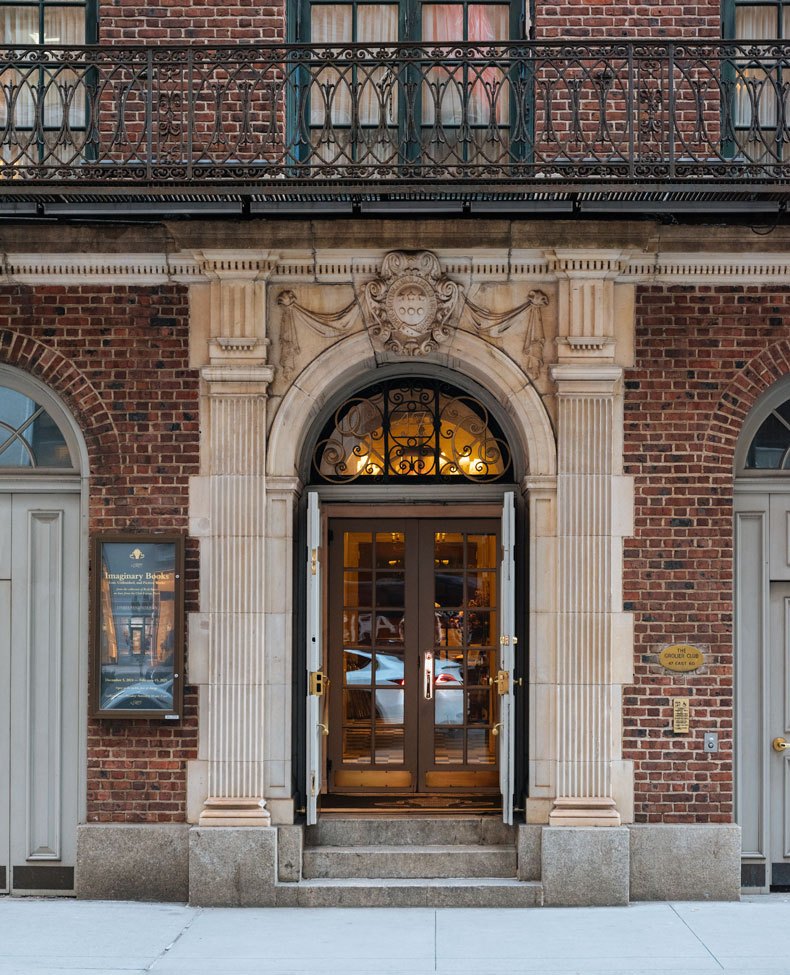
Exhibitions, of which there are currently seven a year, are the most obvious public point of entry. Kiely was previously director of special collections and exhibitions at the New York Public Library and in the two years since his appointment has been able to endow a position for a director of exhibitions and communications, who acts as a curator of sorts. That person oversees the execution of exhibitions, which begin as proposals to a committee of members. Those can come from members as well as non-members who share the club’s interests. (A second-floor space is reserved for members-only exhibitions.) The current show, ‘Pioneers in Hand Papermaking’, came by way of the former, but in collaboration with the arts collective Dieu Donné, which was founded in 1976 as a grassroots effort to develop papermaking beyond craft and as an art in which paper is the medium.
Damp is undoubtedly the enemy of paper. (A mess of Phillipps’s loose papers, for example, was installed in a display closet at the club when they were purchased in 2003 but mould eventually got the better of them and they are being remediated offsite.) But papermaking is wet work. Fibres – from material such as wood, cotton or bamboo – are reduced to soggy pulp that can then be sculpted or pressed flat, dyed or watermarked, then laid out to dry. The exhibition has moments of real interest in the aesthetic virtue of sogginess. ‘Pioneers’ delights in the methods and techniques of papermaking, grounding itself in four: watermarking, colouring and stencils, pulp painting, and blowouts, which involves spraying the paper-in-progress with water. Works on display range from large-format books made of metal sheets, trompe l’æil sculptures of ice cream and kitchen towels and a watermarking device by William Kentridge, and throughout you get an education in methods both playful and profound.
The subject of papermaking is at first glance a bit of a departure for the curatorial arm of the Grolier Club. Previous exhibitions have tended to take on more staid topics such as illuminated Jewish theological manuscripts, Jane Austen or the War of 1812. But behind a stately facade is a healthy strain of forward thinking about works on paper: its show on Japanese prints, hosted in 1889, was the first public display of ukiyo-e prints in the United States.
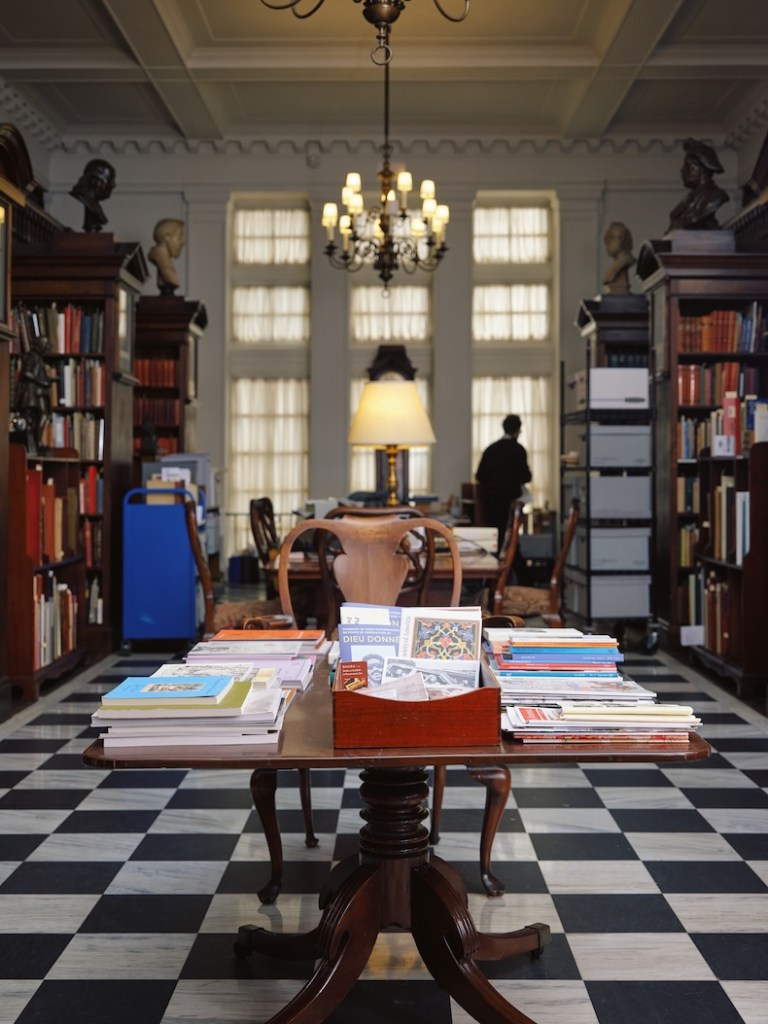
Above the homage to Dieu Donné, the Grolier Club is a five-storey funhouse (not counting a mezzanine level). Wander up the staircase, open a door and there is a library based on the design of Christopher Wren’s at Trinity College, Cambridge, presided over by the busts of several Italian poets – Ariosto, Tasso, Petrarch – and Shakespeare, alongside those of the uncle of the club’s founder and of Theodore Low De Vinne, an American printer and scholar of typography. Open another door and there is the ‘Dutch kitchen’, where on a corner shelf amid comfortably rough stoneware was a jug, about three feet tall, by Thomas Commeraw, the Revolutionary-era freedman potter. Its provenance is lost to time.
‘Provenance’ is a word that comes up again and again during my visit. If you want to make a book-collecting enthusiast really light up, it’s not with first editions, illuminated manuscripts or holy grail finds. It’s through the historic auction catalogues and book logs in which collectors of the past kept track of their holdings. And in the library is a table covered with the latest catalogues from global auction houses and booksellers, from Christie’s and Stuttgarter Antiquariat to Between the Covers in New Jersey, for members to browse. Those same members vote on matters such as the acquisitions of archives coming up for sale and they read the Gazette of the Grolier Club, a handsomely bound journal. The most recent issue, no. 75, is loosely organised around the theme of women collectors and their contributions to the club.
The library’s holdings go back as far as the early efforts of collectors in the 16th century and is open to researchers and scholars who might stumble their way to something. For example, on an unassuming shelf are six volumes that belonged to the Jansenist rebel Claude Pierre Goujet, full of details about heterodox books published under pseudonyms – including the actual names of their writers. This once dangerous information now waits, a piece of the historical record that might otherwise be lost, for a bibliophile to find.
For any institution whose business is the written word, things look uncertain. But though the Grolier Club deals with books, its concern is really with the book as an object, something physical in the world. And there is no sign of pulling away from the real world, with talks and exhibitions to attract the public and new acquisitions of archives on the horizon. Increasingly, these kinds of analogue assets will take on a new meaning and value. By being grounded in the matter of reality, a library full of the past might be able to carry us into the future.
From the November 2026 issue of Apollo.