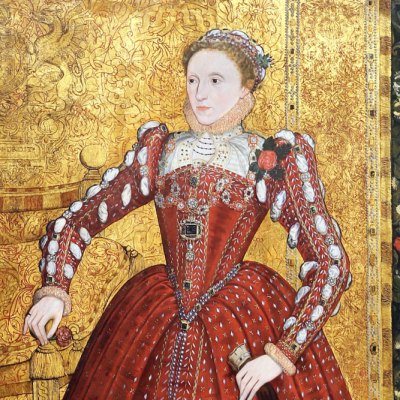
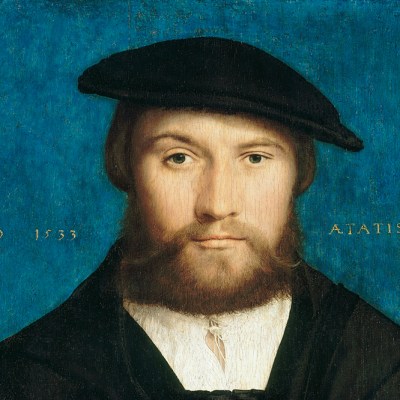
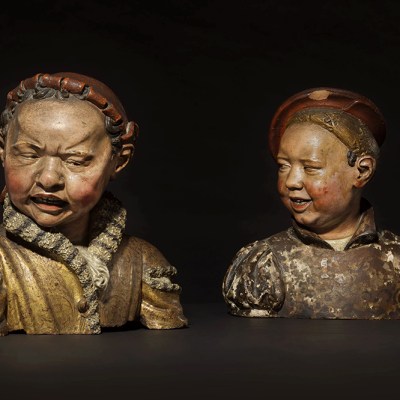
This review of Holbein: Renaissance Master by Elizabeth Goldring is from the February 2026 issue of Apollo. Preview and subscribe here.
It is strange to think that the artist who preserved so many of his contemporaries for posterity was buried anonymously. When Holbein fell victim to the plague in the autumn of 1543, the graveyard of his parish church in Aldgate was full. He may have been lucky enough to make it inside the church itself, but it seems just as likely that his body was tossed into a plague pit among the other indiscriminate dead. ‘If that was his fate,’ notes Elizabeth Goldring in this superb biography, ‘it was an ignominious end for someone who in life had been hailed as a worthy and revolutionary heir to the greatest painters of Antiquity’.
There was nothing predestined about the success that preceded Holbein’s end. Indeed, in the portrait that emerges from Goldring’s book, it seems more than anything else remarkable that Holbein lived so long and that so much of his work has escaped the rigours of time. Born in Augsburg in c. 1497, Holbein entered a world that was simultaneously lucrative and unstable for an artist. His father, Hans the Elder, was a successful religious painter, the head of a workshop known across Swabia, with commissions from as far away as Alsace. Holbein and his older brother Ambrosius – seen together in a beautiful drawing by their father from 1511 – entered the family business just as rampant inflation hit the city. With craftsmen’s wages fixed and fashion shifting to more Italianate models of devotional painting, Hans the Elder soon led a ‘hand to mouth existence’.
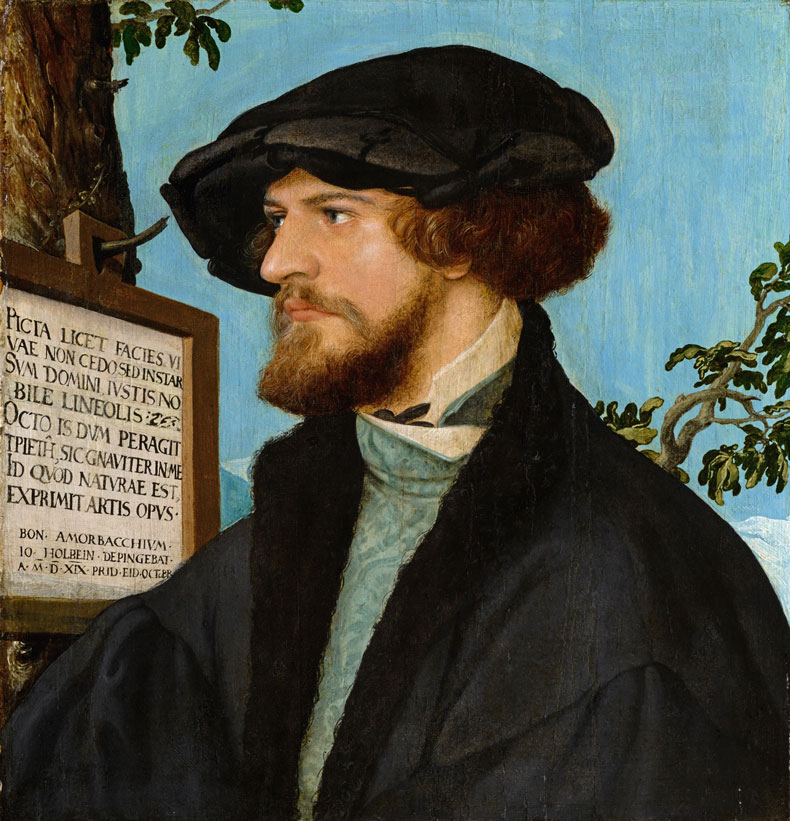
It was a lesson in instability that Holbein seems to have taken to heart. Marked out already by his talent, he emerges here as ‘exceptionally driven, focused and ambitious: a workaholic, in modern terms’. Leaving Augsburg in the 1510s, he and Ambrosius eventually settled in Basel – whether by design or ‘more or less by chance’. Although Basel was only a third the size of their native city, this was a wise move and important to Holbein’s trajectory. The brothers worked together on woodcut designs for the printer Johannes Froben and by the mid 1510s Holbein was in demand as a religious painter and as a designer for printers, goldsmiths and glaziers. His brother’s death from illness in 1519 did not dent Holbein’s output. By the end of that year, he was married and a member of the city’s painters’ guild; by 1523, he had emerged as Basel’s leading painter.
Despite no evidence of humanist leanings on his part, Holbein’s contact with Basel’s intellectuals was his major stroke of good fortune: first Bonifacius Amerbach and then the great Erasmus himself. In 1523, when Dürer failed to produce an agreed portrait of Erasmus, Holbein stepped in to create the images that would become – almost literally – the scholar’s calling card. It was a lucky turn: by the mid 1520s the Reformation was putting Basel’s religious painters out of business, while secular portraits were becoming more fashionable. While he continued to produce sacred works such as The Meyer Madonna (c. 1525–26), the adaptable Holbein capitalised on his new niche and sought fresh pastures. It would be Amerbach, with his links to the Tudor court, who suggested England as a potential market. Equipped with a letter of introduction from Erasmus to Thomas More, Holbein made his first trip there in 1526.
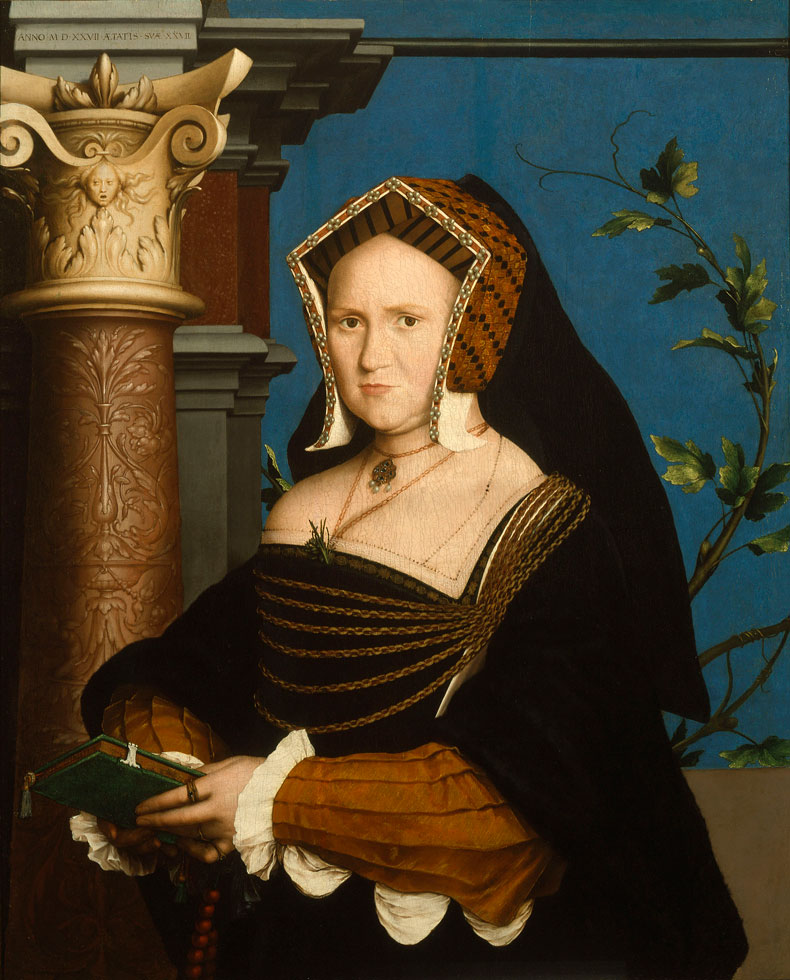
He arrived at the perfect moment. More’s commission of a portrait and family portrait from Holbein in 1527 put him ‘at the forefront of what was a new vogue in England’, where tomb sculptures and heraldry remained the traditional modes of noble representation. Lacking skilled representational painters of their own, the English – as one of Holbein’s sitters put it – ‘resorte[d] unto straungers’. Despite lacking both English and Latin Holbein landed the commission to provide two grand decorative works for the Anglo-French revels at Greenwich in May 1527, as well as portraits for a number of courtiers. Though no direct royal patronage resulted, he had his foot in the door. Despite returning to Basel in 1528, expanding his workshop there and regaining the unofficial post of ‘Town Painter’, he was encouraged by iconoclastic riots, among other factors, to return to England in 1532. He would remain there for the rest of his life, creating the portraits that have fixed the Tudor court in the public imagination ever since.
This is a biography that shuns the temptations of romanticism or novelistic imaginings without ever losing sight of the human at its centre. While specialists will linger on the careful handling of the evidence, the judicious approach to old debates and a welcome emphasis on Holbein’s work beyond portraiture, what is remarkable is the extent to which – despite Goldring’s restraint – Holbein himself emerges as a living figure. The volume of his output combines with evidence of interminable ‘tinkering with and refining his paintings’ to show a restless perfectionist. His position as Stubenmeister at the Basel painters’ guild and a report of a drunken punch-up in the 1510s, meanwhile, suggest that the master was also ‘a sociable man who liked his beer and was not averse to a street brawl’. At court, however, success depended on discretion. The workaholic who liked to let loose was also ‘affable and adept at keeping his nose clean’.
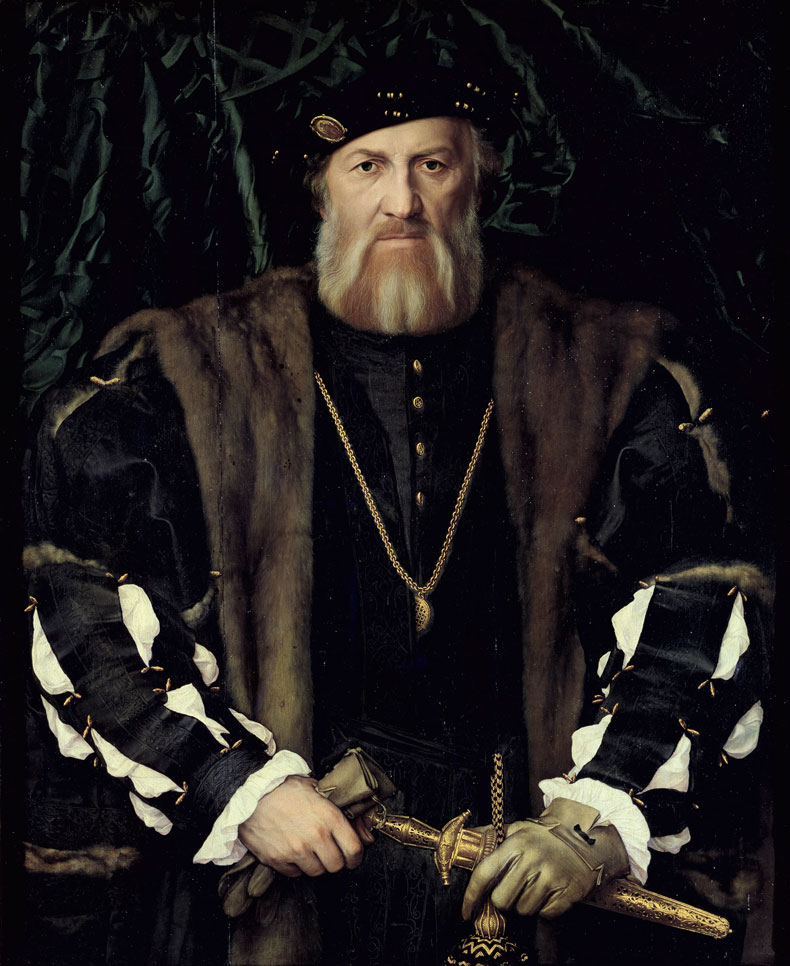
It is hard to see Holbein: Renaissance Master being bettered any time soon. Credit is also due to the Paul Mellon Centre and designer Emily Lees for giving author and subject alike the trappings they deserve. This is a beautiful book and there is almost no image addressed in the text without being reproduced in useful proximity, size and detail.
Death came for Holbein – as it does for many of those in his sequence of woodcuts The Dance of Death (first printed in 1538) – in the midst of work. Despite the assumption some have made about a loss of status after Cromwell’s execution in 1540, the evidence shows trace of neither ‘shrinking horizons nor […] dwindling prospects’. He died prosperous enough to support two families, one in England and one in Basel, in some style. By this time, he was no longer having to traipse across the Continent to depict marital prospects for Henry VIII. What he could have done had his work not been cut short is unknowable; that he would have done much, much more seems certain.
Holbein: Renaissance Master by Elizabeth Goldring is published by Yale University Press/Paul Mellon Centre.
From the February 2026 issue of Apollo. Preview and subscribe here.