From the June 2026 issue of Apollo.
‘Another Matisse exhibition?’, asked a Parisian friend when I told her my plans for the weekend. It was a fair question. The Centre Pompidou put on ‘Pairs and Series’, exploring Henri Matisse’s varied treatments of the same subject, in 2012, and organised a major retrospective of his work in 2020. Now that the Pompidou is closed for renovations, it has collaborated with the Grand Palais on an exhibition dedicated to the artist’s transformative final years.
The general public have clearly had not had their fill of Matisse. On the Sunday I attended, viewing the pictures was a challenge requiring both a dancer’s grace and an understanding of fluid dynamics. I saw a great deal of the late Matisse, but close-up and at an angle. This had some advantages. What stayed with me were not his monumental pieces or bold chunks of colour, but individual lines, faint traces, the marks of a hand at work.
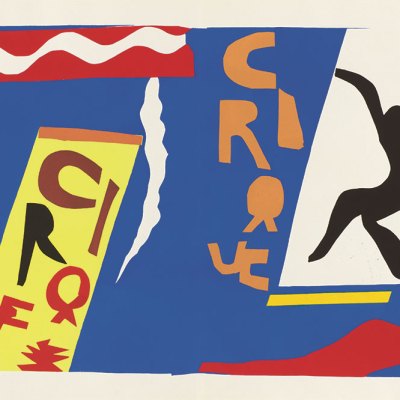
The story of the last 13 years of Matisse’s life has often been told. In 1941, after undergoing a colostomy in Lyon, he came close to dying from a pulmonary embolism and a subsequent infection. He was 71 years old and his unexpected survival felt like a resurrection. Despite the fact that his mobility was increasingly limited, Matisse enjoyed a burst of creativity in the years that followed. He made hundreds of drawings and wrote letters to friends and family. He also turned to cut-outs as a major form of artistic work. His assistants painted bright Linel gouache on Canson paper, out of which he carved fluid shapes with a large pair of scissors. This was a technique he had used in the 1930s in crafting models for other works, but increasingly the cut-outs were the focus of collages and murals.
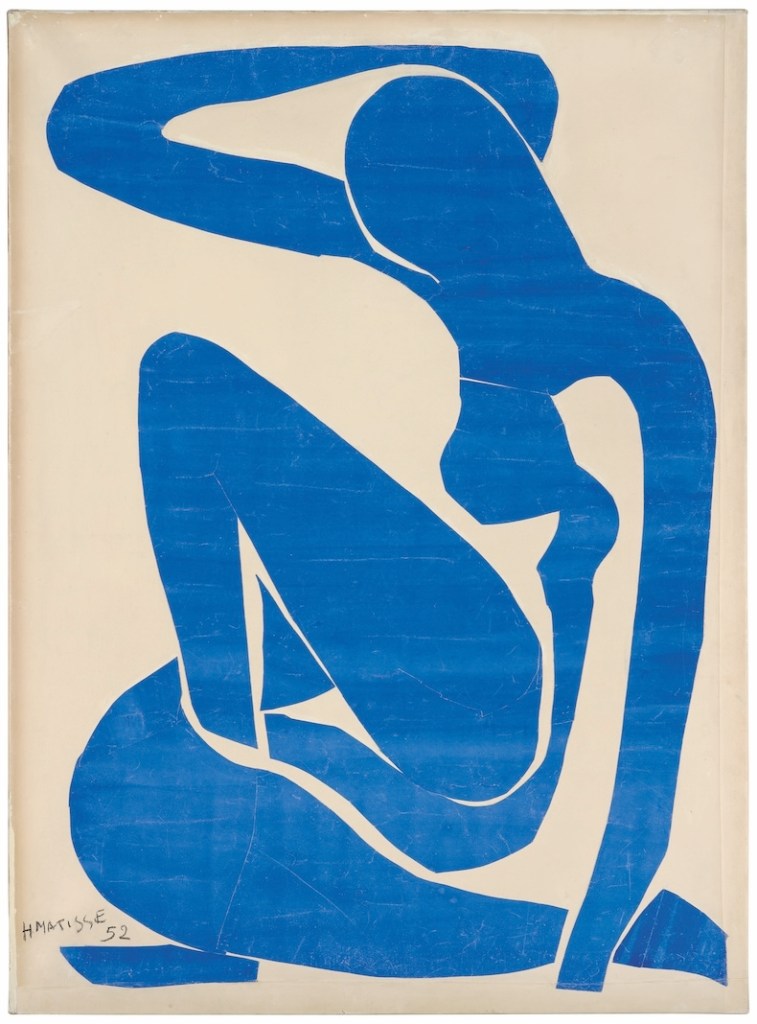
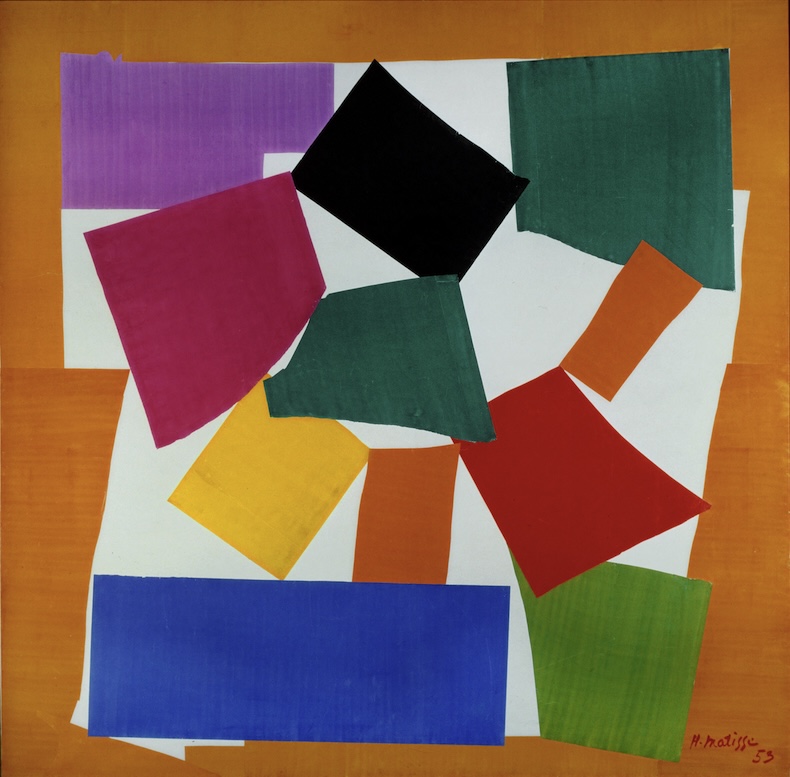
The Grand Palais exhibition aims to give a full sense of Matisse’s production in the last 13 years of his life. Major cut-out works are on display, such as the spectacular Blue Nudes, numbers I through IV (1952) and a frankly enigmatic work, The Snail (1953), a group of squarish colour blocks distantly suggesting a spiral. Two massive collage panels, Polynesia, the Sky and Polynesia, the Sea (both 1946) swarm with vegetal, marine and airborne life, their balanced composition tempered by subtle intermixing: the sky is full of shrimp and coral, while birds swim with fish in the sea. One section of the exhibition presents models of the stained-glass windows Matisse designed for the Chapel of the Rosary in Vence in the late 1940s, along with maquettes for chasubles to be worn during services. They do not seem too far from Polynesia either.
It is energising to see what freedom Matisse’s brush with death afforded him and how unconcerned he was with perfection. In Still Life with a Magnolia (1941), vases, a pitcher and a conch float on a rich vermilion background and a yellow-orange mirror. Even the blues and greens seem to lean warm. Stray lines make the image dance: outlines of leaves peek out over the magnolia’s greenery, sometimes with a touch of transparent colour, as though they were just coming into being. The conch in the lower right corner has an extra mark interrupting its elegant shape. This fine streak makes the shell look as though it contains a leaf, a backbone or a tongue. Self-Portrait in Straw Hat (1941), in sanguine on paper, is a sharp rendering of the artist looking intense, almost sour. Multiple layers of half-erased chalk are still visible in the drawing, suggesting reddish ghosts, perhaps, or a process of transformation.
Many of the works, and their presentation, convey a sense of motion. This can be small, as in Themes and Variations, series F (1941). These are sketches of a woman reclining on the armrest of a sofa or recamier, changing ever so slightly from picture to picture. Her eyes sometimes face the viewer, sometimes look away or lightly close. Matisse’s charcoal renders her proud, playful, angry or wistful. The effect of viewing the pictures together is of watching a professional model at work as she turns her head a few degrees and tightens the muscles around her eyes.
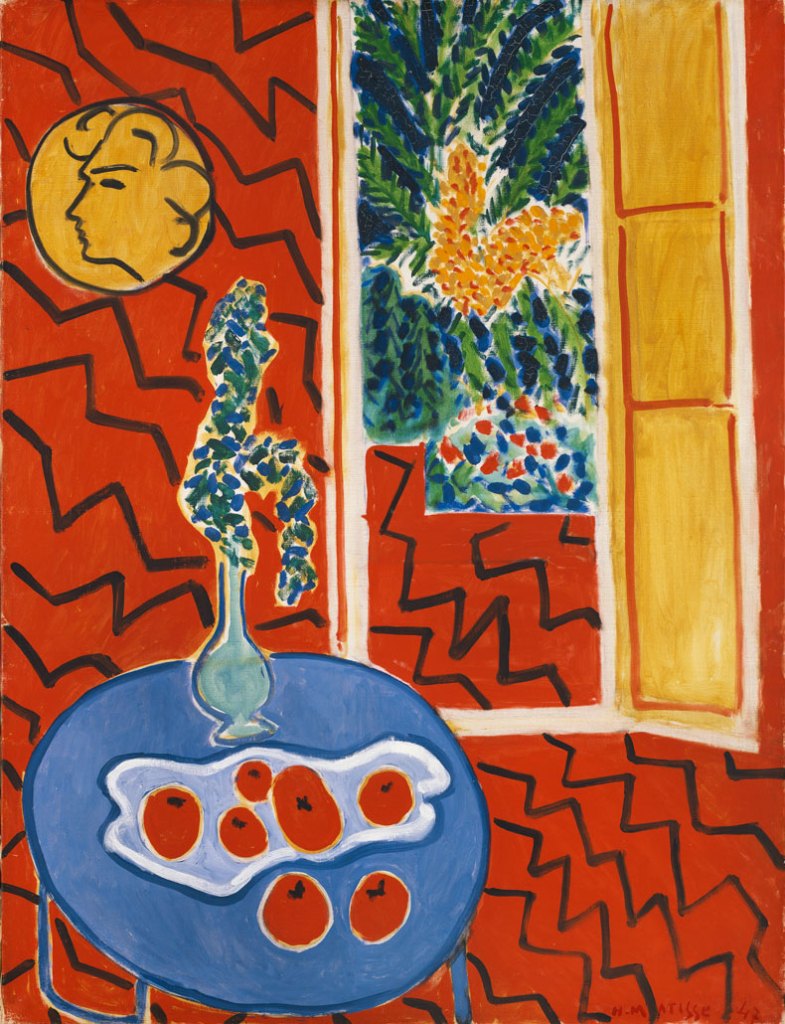
In some paintings, movement arises from the interplay of patterns. Young Girl in Pink in an Interior (1942) gets its energy from parallel columns of colour in the background. Some have subtle white scratches, like pinstripes, while a set of green shutters are marked by horizontal dashes of paint. An armchair with yellow and red stripes dazzles by contrast, mixing as it does two primary shades. Each element is simple, but there is no calm space in the room. By the time we get to Red Interior, Still Life on a Blue Table (1947), the wallpaper has exploded. Thick black lightning bolts shoot across the walls, the floor and the part of the balcony visible through the open door. Outside, the view is filled by sprouting foliage and blooms, reminiscent of herringbone. The plate and tomatoes of the still life seem to be melting under the sultry heat.
Some of my favourite pieces in the exhibition barely make it into the catalogue. These are sheets of paper on which Matisse practiced squiggles and arabesques, notebook pages with women’s faces surrounded by swirls and spirals, and elaborate calligraphic initials. The wall texts state that these pen exercises were Matisse’s way of coping with his chronic insomnia, which, if true, would make him the forerunner of a thousand ‘mindful doodling’ online videos. Particularly charming is an undated notebook with sketches for editions of the poems of Charles d’Orléans and Pierre de Ronsard. It is open on a double-page spread of rabbits cavorting in grass. Surely it is a trick of the eyes, but some of the rabbits glance backwards with the same haughty look as the model in Themes and Variations. Whatever the creature that came out of Matisse’s hand, it was never humble and never stood still.
‘Matisse: 1941–54’ is at the Grand Palais, Paris until 26 July.
From the June 2026 issue of Apollo.