It seems entirely appropriate that the title of this landmark exhibition should be ambiguous. Rather than reveal the secrets of this most enigmatic of painters, both the show and the accompanying catalogue, for all their depth, insight and illumination, rejoice in an art that remains open to endless interpretation but stubbornly resistant to explanation.
Until 2023, when a court ruling allowed the Barnes Foundation in Philadelphia to lend works of art – or even display them in the museum in a manner not prescribed by the maverick Albert Barnes – a collaboration with the Musée de l’Orangerie in Paris was inconceivable. This first partnership brings together the two largest holdings of the artist’s works – both, coincidentally, sourced by the French dealer Paul Guillaume. Eleven of the 18 acquired by Barnes through Guillaume between 1923 and 1929 are displayed side by side for the first time in Philadelphia; nine of these will soon travel to Paris to be united with the 11 now owned by the Musée de l’Orangerie. Added to this core are important loans such as The Sleeping Gypsy, which MoMA has not lent since the 1980s, and The Snake Charmer (Musée d’Orsay). Flanking the home team’s Unpleasant Surprise, they mark the culmination of a compelling journey.
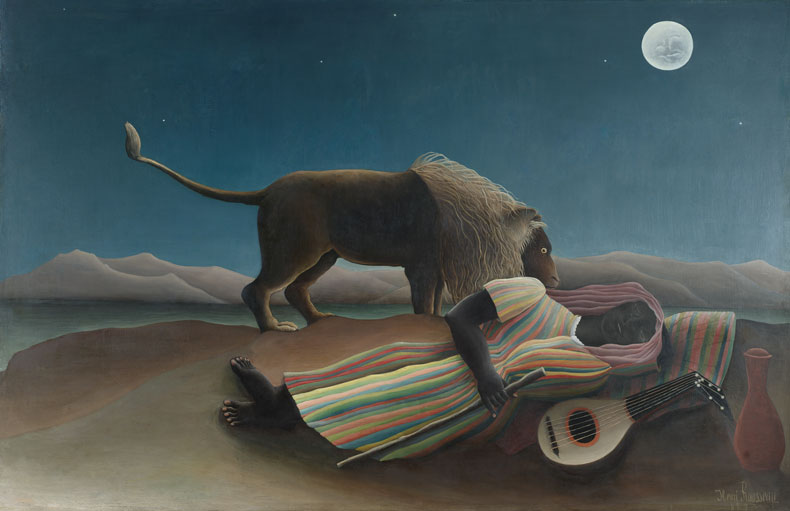
The scale and confidence of these three monumental canvases and the great jungle landscapes that precede them are bewildering in contrast to the modest and more conventional art naïf canvases that open this show. Their dates reveal that these small works were not necessarily made any earlier than the epic paintings. Rousseau began his career working at the toll gates of Paris before he took early retirement and a modest pension, at the age of 49, to chance his hand at painting full-time. Although a self-taught artist, he was not without ambition, astonishing self-belief or awareness of the art and lives around him, despite the apparent otherworldliness of his vision. As the research of Nancy Ireson reveals, it was grinding poverty and the quest for sales that prompted the artist’s ever-changing subject matter and idiom.
Rousseau could play to the admiration for the ‘primitive’ in vanguard circles just as he could paint the kind of portraits, streetscapes and flower pieces that pleased his petit bourgeois friends and neighbours on the edges of Montparnasse. (Works such as Père Junier’s Cart, for instance, were invariably produced in lieu of goods or services.) Rousseau always depicted himself as one of their number, respectably dressed in his Sunday best. He was not, however, entirely respectable. For all his claims to have been a patriot and loyal public servant in order to win public commissions to decorate town halls – he never succeeded – the artist was also a small-time embezzler, fraudster and self-proclaimed anarchist. As a man and as an artist, Rousseau was full of contradictions.

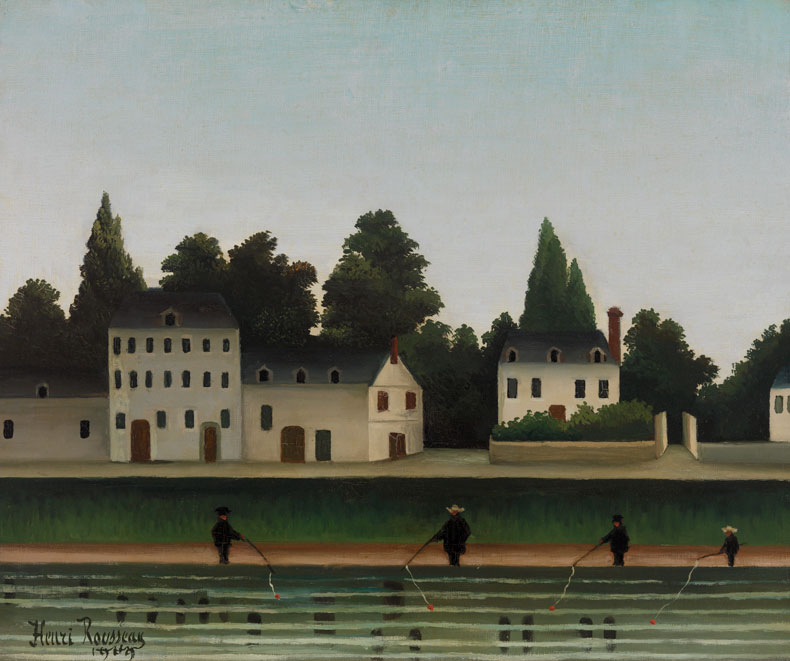
This show stays close to biography, a means of paring back the layers of myth that gathered around the artist even before his death in 1910. His apparent innocence was supported by tales of his belief in ghosts, for instance, but The Past and Present, or Philosophical Thought, in which Rousseau paints himself and his new wife with the heads of their late spouses blessing them from above, may be best explained in the context of the enthusiasm for spiritualism and spirit photography. (And Rousseau was known to attend spiritualist meetings in the studio of the neo-Symbolist Henri Le Fauconnier.) This type of painting Rousseau described as a ‘portrait-landscape’, a new genre he claimed to have invented. Other examples, such as the meticulous moonlit Carnival Evening, featuring the then fashionable figure of Pierrot, have an air of mystery and menace that perhaps reflects the artist’s taste for popular fiction. Like Landscape and Four Fisherman (1909), it might almost have been painted by Magritte.
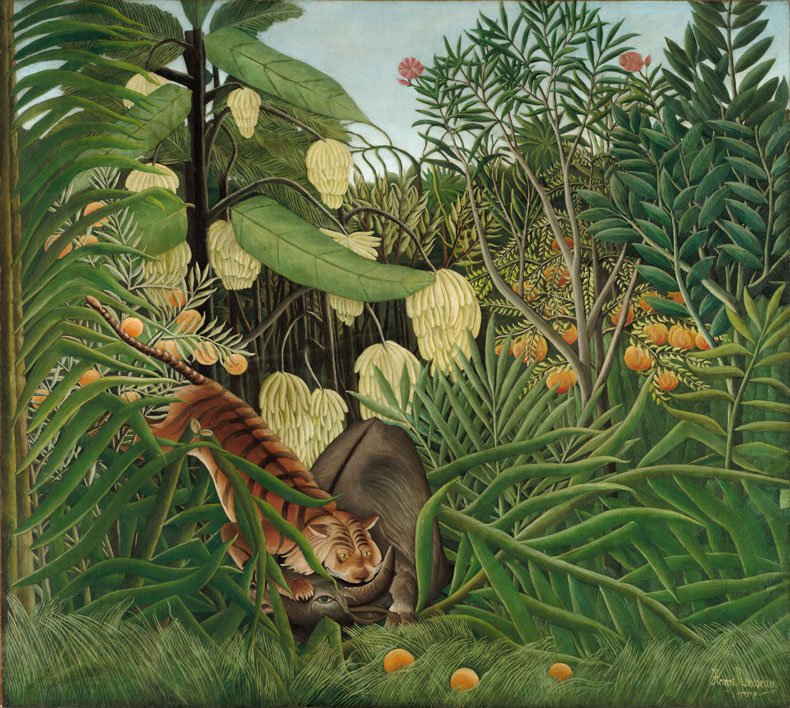
Rousseau was always on the lookout for a novel or topical subject and for a sale. Depicting rugby players in their glorious stripes at a time when the sport was rising in popularity, he also included the Eiffel Tower, aeroplanes and barrage balloons in his backgrounds. He found recognition and some success with the jungle paintings, which were praised by critics in 1891 and 1904, when he showed Scouts Attacked by a Tiger in the jury-free Salon des Indépendants. (He could only get The Snake Charmer into the 1907 Salon d’Automne as a decorative arts ‘tapestry project’.) The artist had, of course, travelled no further than the Jardin des Plantes and the Muséum National d’Histoire Naturelle to fire his fantastical imagination. These deliberately exotic images are here viewed in the context of colonial expansion, popular literature and academic art that delighted in the frisson arising from encounters between man and beast, and contemporary debates about the bestiality of human desire. As Martha Lucy points out in her catalogue essay, it seems extraordinary that the blatant eroticism of Rousseau’s jungle nudes has barely been considered before now. The Snake Charmer, after all, depicts a naked woman entwined by a phallic serpent. It perhaps reflects how Rousseau has somehow always been considered too comedic to take on the themes adopted by both salon artists and the avant-garde.
Rousseau didn’t live long enough to see Albert Barnes pay as much for one of his works as for a major Matisse or Picasso. As for validation from his peers, it is unclear quite what the likes of Picasso and Apollinaire really thought of him when the former staged a party to honour the widely mocked artist in 1908 (an episode wonderfully evoked 70 years later in Tage Danielsson’s absurdist film, The Adventures of Picasso). André Breton, of course, hailed the artist as a Surrealist avant la lettre. Whether intended or not, Rousseau’s rhythmic repetition of precisely contoured and increasingly autonomous formal patterns – such as the magnified fronds of ferns, lotus flowers or bananas, or the flowing stripes of a gypsy robe – induce a hypnotic strangeness, a dream-like suspension of time, that even the best of the Surrealists could never equal.
‘Henri Rousseau: A Painter’s Secrets’ was at the Barnes Foundation, Philadelphia, from 19 October–22 February and is at the Musée de l’Orangerie, Paris, from 25 March–20 July.