Walking into ‘Henry Taylor: Where Thoughts Provoke’ at the Musée Picasso in Paris feels like walking into a conversation – one that, miraculously, manages to continually shift in tone or change direction without losing the thread.
The exhibition begins more or less chronologically, introducing Taylor’s work through paintings created while he worked as a psychiatric technician in Camarillo State Mental Hospital in California in the 1980s and ’90s. During shifts Taylor would sketch the patients he encountered every day. In Screaming Head (1990) a man sits facing us with his head in his hands, the top of his skull replaced by an oversized screaming mouth that looks like it’s where a face should be. Taylor translates something loud into something unsettlingly silent, like the raw noise has been trapped in paint. It makes Edvard Munch’s The Scream feel like a whisper.
Many critics describe Taylor as a ‘late starter’, since he formally enrolled in art school – the California Institute of the Arts – in his thirties. The curatorial choice to highlight early paintings from his days working on a psychiatric ward adds to the impression that he is, or at least was, something of an outsider artist. At the same time, much of Taylor’s work responds to or plays with the legacy of 20th-century modernism – as in From Congo to the Capital, and black again (2007), a reimagining of Les Demoiselles d’Avignon (1907) that foregrounds Picasso’s African influences.
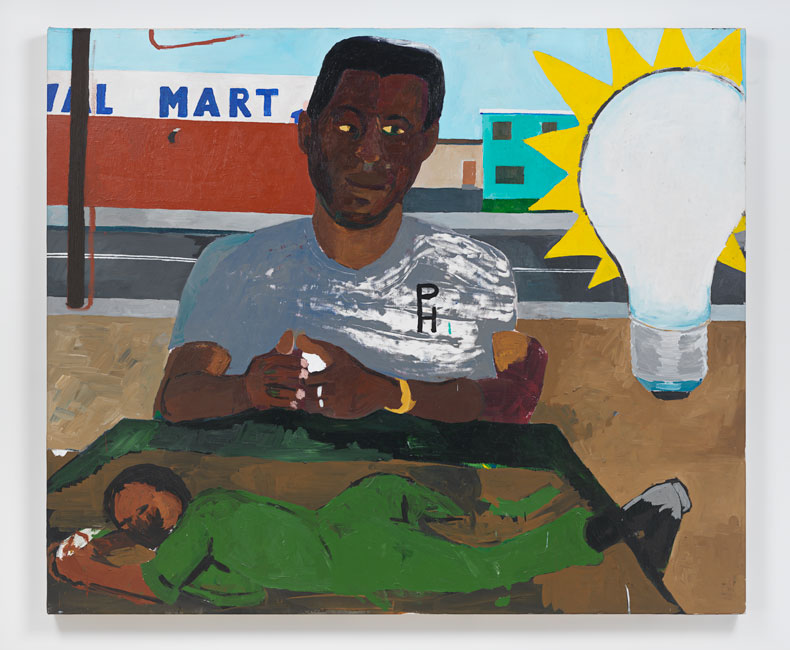
Elsewhere, Taylor playfully slips between insider-outsider categories, reinventing and surpassing the meanings of these frames. The installation It’s like a Jungle (2011) satirises the fetishisation of ‘primitive’ or ‘exotic’ art, creating a forest of totem poles made from broomsticks, jerrycans and other found objects. Taylor’s dark humour is palpable, but he also undercuts the satire with moments of sincerity. In the same room, Not Alone (2013) is a painting of a group of young Black men playing cards surrounded by wooden carvings and statues – totems that in this context feel like sources of protection and connection. Another work nearby is easy to miss even though it gives the exhibition its title. Where Thoughts provoke, getting deep in shallow water (2015) is disarmingly understated. Depicting a forlorn human figure in a bath, its only explicit connection to the surrounding works appears to be a visual echo, an abstract body formed from a few strokes of black paint.
Taylor seems to enjoy giving his paintings these two-part titles. Sometimes they feel like a riddle, at times a punchline, or just a riff on his own thoughts. It’s as if you can hear the artist’s mind at work, pulling you into his inner dialogue as well as into a conversation with the world around him. A Pop art-like collage in which Colonel Sanders holds a KFC bucket between two seemingly indifferent Black men is titled No Chicken Please. We’re Born-Again Vegan (2011–13). The joke is immediately tempered by adjacent works that refer to his brother’s involvement in the Vietnam War and a seemingly muted Fourth of July celebration, which turn the room into a strange and strained collection of motifs of Americana. Taylor rarely lets you settle into one mood: everything is constantly being questioned, teased out or turned over.
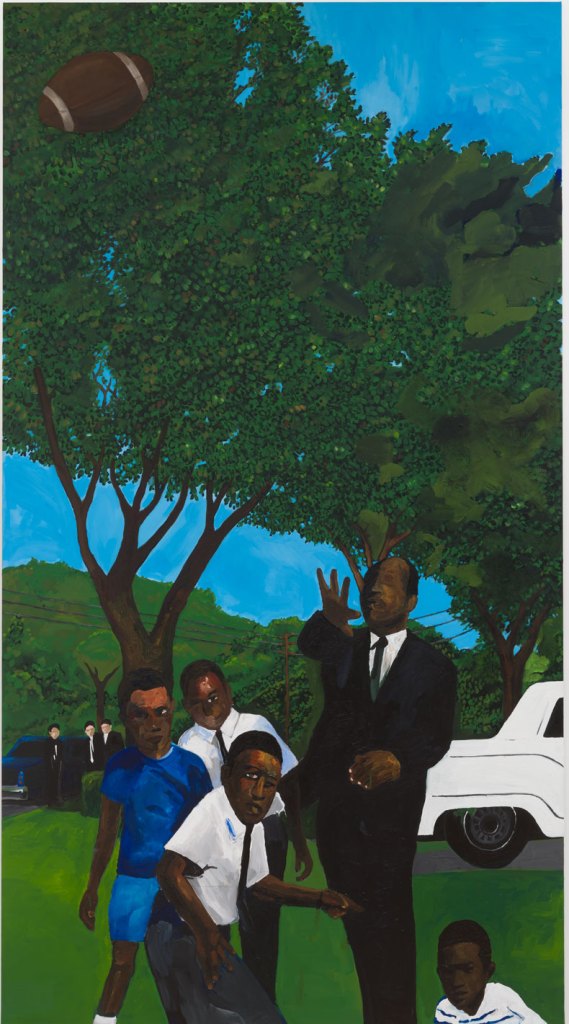
This restless gaze often creates a sense of uneasy ambivalence. An untitled painting of Martin Luther King Jr. playing American football with a group of kids (2016–22) offers an imagined moment of freedom and play, but a cluster of white men in the background chips away at the sense of abandon. Another work, dating to the Obama presidency, presents a figure in a Colin Kaepernick jersey looking out on to a Brooklyn housing project, which is juxtaposed with the White House; meanwhile a group of Black men are led into a white police van. Somehow, in this small, contained painting, Taylor evokes the gulf between hope and reality, progress and stasis, as if to ask, ‘How far have we really come?’ A large geometric painting provides an unambivalent answer: THE TIMES THAY AINT A CHANGING, FAST ENOUGH! (2017). If the title feels unsubtle, it’s because the content demands it. A stark close-up of the murder of Philando Castile, shot dead in his car by a Minneapolis policeman the previous year, this devastating image is a rare moment where Taylor forces your gaze to hold still.
Somehow, the tonal shifts throughout ‘Where Thoughts Provoke’ feel organic, like Taylor is simply riffing on reality – uncovering multiple truths and putting them in dialogue with each other, letting them bounce between the walls of the museum or his mind. As he holds the world up to his scrutiny, the space he makes for conversation is cavernous, with room for screams, laughter, questions, silence and everything in between.
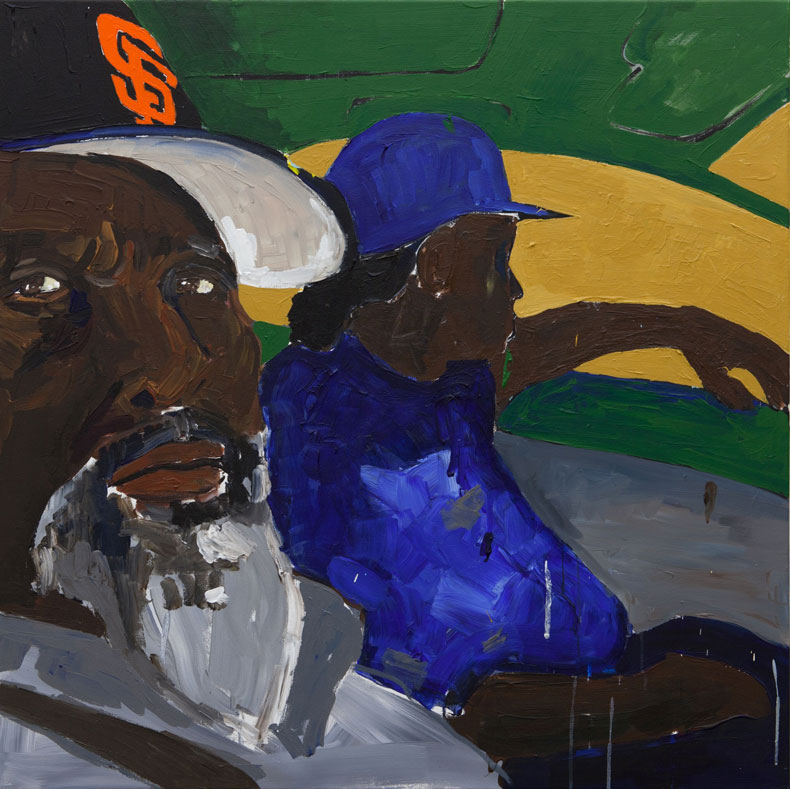
‘Henry Taylor. Where Thoughts Provoke’ is at the Musée Picasso, Paris, until 6 September.