From the January 2026 issue of Apollo. Preview and subscribe here.
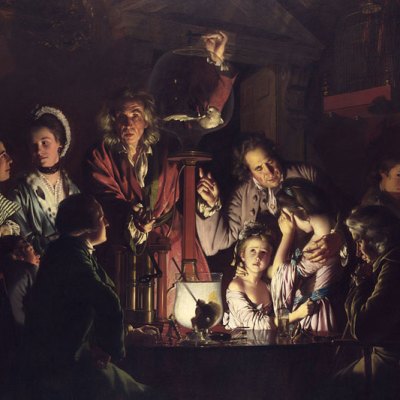
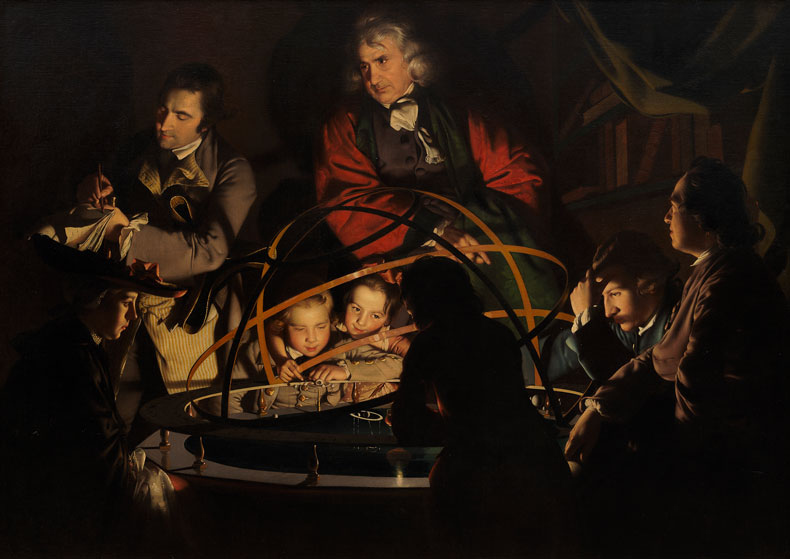
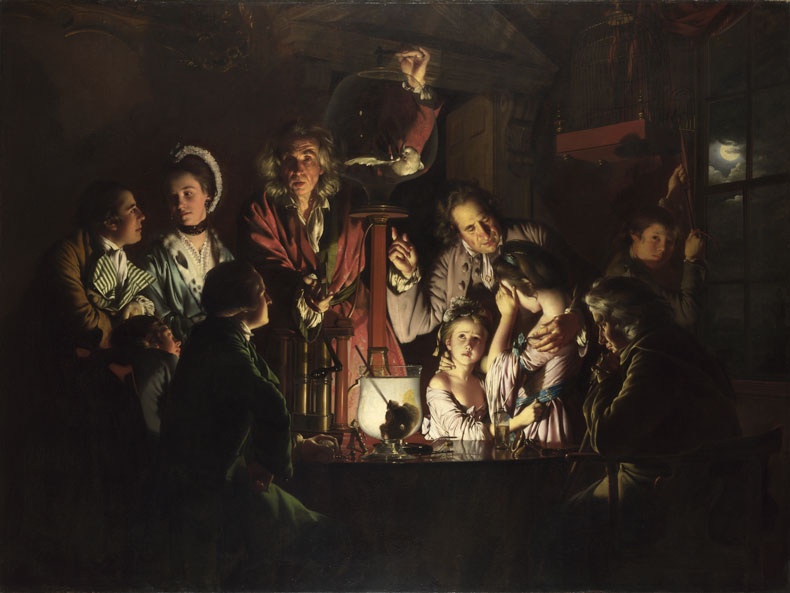
There is a paradox at the heart of Joseph Wright’s two greatest paintings, A Philosopher giving that Lecture on the Orrery in which a Lamp is put in the Place of the Sun (1766) and An Experiment on a Bird in the Air Pump (1768), thrillingly shown side-by-side in ‘Wright of Derby: From the Shadows’. Their subjects, like the pictures themselves, are immense – the movements of planets around the sun and the capacity of the earth’s atmosphere to support life – and yet the mood of each is strikingly intimate. Wright puts modern men, women and children at the centre of things, pitting the domestic sphere against the cosmic by foregrounding their reactions to what they see. Fundamental to the atmosphere of wonder and suspense in both paintings is the candlelight that illuminates faces and actions while casting the surroundings into mysterious shadow. The question posed by the exhibition is: what did the artist mean by his contrasts between darkness and light, in terms of spectacle, morality and the pursuit of knowledge?
Expertly curated by Christine Riding and Lucy Bamford, assisted by Jon King, ‘Wright of Derby: From the Shadows’ is a tightly focused show that teases out meanings from the ‘candlelight’ scenes for which the artist became known from the mid 1760s. Inspired by 17th-century tenebrist paintings by artists ranging from Caravaggio to Godfried Schalcken, these pictures use strong contrasts between light and shadow to infuse a subject with psychological drama (no comparative paintings are included, though a panel indicates where they can be seen elsewhere in the National Gallery). The exhibition introduces Wright with a self-portrait in black pastel, the artist’s face emerging from a shadowy background and the gloom of a huge, feathered hat, with an air of disturbed preoccupation. It establishes a mood of enigma and ambiguity that recurs throughout the show.
The dynamics of looking are central to the first section, devoted to the academic study of art. In Three Persons Viewing the Gladiator by Candlelight (1765) one man gazes at a reduced plaster cast of the ancient Greek Borghese Gladiator, its musculature given dramatic definition by the light of a single candle. Another man (thought to be a self-portrait), seen in profile, holds up a drawing he has made of the sculpture, while a third, older, member of the group looks intently at his sketch. A reflection of candlelight in the draughtsman’s eye reveals the direction of his gaze: he looks not at the cast but at his friend’s face to gauge his reaction. Has he looked hard and incisively enough to meet the challenge set by this exemplary sculpture? He is about to find out. The light that unites the group in their study throws deep shadows over the older man’s face, making his expression hard to interpret. A plaster cast of the gladiator displayed alongside Wright’s painting invites viewers to look for themselves.
A Philosopher giving that Lecture on the Orrery and An Experiment on a Bird in the Air Pump are also about an Enlightenment culture of learning and self-improvement, though the nature of the candlelight in each picture suggests that mystery and enchantment play a significant role. In the latter, the dissemination of knowledge is achieved with a theatrical flourish that owes a good deal to the sensational magic-lantern show; as King observes in his excellent catalogue essay, the demonstrator ‘eerily illuminated […] has the air of a travelling showman who will soon pack up his box of tricks and move on to another household’. A contemporary air pump and orrery draw the visitor’s attention back to the underlying science, the latter in particular giving a fascinating insight into the elegant mechanics of the philosopher’s display. Throughout, the curators have considered the shadows cast by objects under gallery lights, from the gladiator’s magnified outstretched arm to the intersecting arcs of the orrery that leap up the adjacent wall, creating a rich experience.
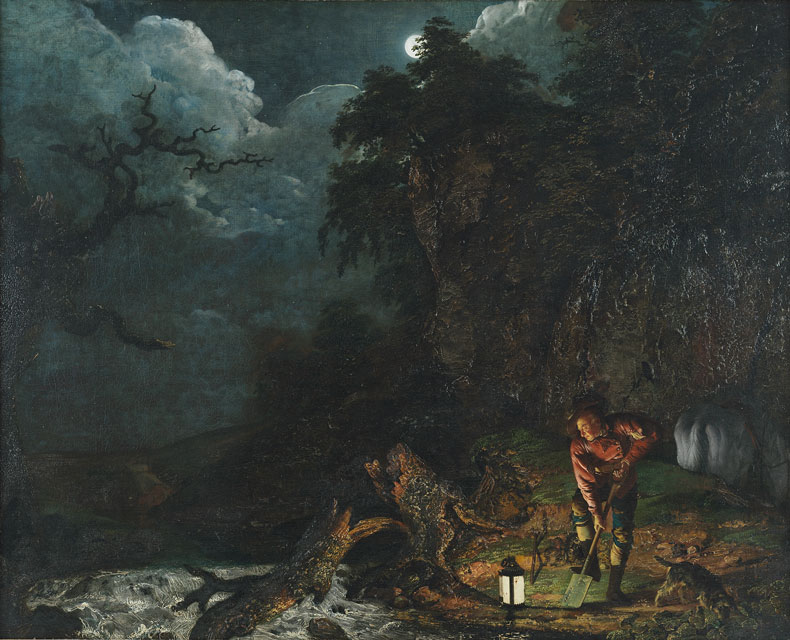
The second half of the exhibition explores the development of Wright’s tenebrist phase with a range of ‘fancy pictures’ and genre scenes, focusing in particular on his growing interest in outdoor subjects. A Blacksmith’s Shop (1771) is a powerful scene that transforms night-time labour into sublime spectacle: a horseshoe is being forged for a waiting gentleman, whose children stand close enough to the smith’s swinging hammer to create a frisson of alarm. The startlingly white-hot gleam of metal, echoing the moonlight, results from Wright’s use of a primer of bright white paint. By contrast, the mood of A Philosopher by Lamplight (c. 1769) is melancholy and reflective, its questions about the fragility and brevity of human life all too clearly answered by its bleak and comfortless setting. Among the most compelling works is An Earthstopper on the Banks of the Derwent (1773), in which the act of blocking fox holes before a hunt to prevent the animals going to ground provided Wright with the excuse for a forbidding nocturnal landscape dominated by a jagged, fallen tree and fast-flowing river. The stolid earthstopper goes about his work by the glow of his feeble lamp, while the landscape around him glitters dangerously in the moonlight.
Towards the end of the exhibition, Wright’s interest in visual spectacle is put into a context of 18th-century optical entertainments. A group of porcelain figures by Étienne-Maurice Falconet of children playing with a magic lantern (c. 1757) invites the viewer to reflect on Wright’s childhood fascination with light shows, while a toy theatre of 1721 by Martin Engelbrecht foreshadows his working method of setting up a room containing objects lit by a candle into which he would look – which, as the curators observe, was essentially a ‘scaled up peep-show’. The challenge Wright set himself with his ‘candlelights’ was to channel the wonder and enchantment of these entertainments into a new kind of history painting that combined visual excitement with intellectual ambition.
An impressive display of mezzotints after Wright’s compositions by masters of the medium including William Pether, Richard Earlom and Valentine Green demonstrates how the artist’s work reached a wide audience. Dramatic ‘candlelights’ lent themselves to mezzotint’s deep, velvety shadows and bright highlights – which was among the reasons Wright painted them.
‘Wright of Derby: From the Shadows’ is at the National Gallery, London, until 10 May 2026.
From the January 2026 issue of Apollo. Preview and subscribe here.