From the July/August 2026 issue of Apollo.
Midway through ‘In the Italian Manner’ there is a letter from 1408, sent from the Provençal agent of the Datini company, headquartered in Prato, to his correspondent in Barcelona, listing silks and their decorative motifs being sold for the Panciatichi family of Florentine merchants. Visitors might pass over this faded document in a display case of elaborate silks, yet it helps explain – at least in economic terms – the embarrassment of riches that the curator Joan Molina Figueras has gathered for this ground-breaking exhibition. In the 14th century, artworks and artists also travelled the same sea routes – sometimes with a stop in papal Avignon – leading to a remarkable flowering of painting in the Kingdom of Mallorca and the Crown of Aragón. While 15th-century northern European influence on Castilian art has been well investigated, this earlier period of exchange between Iberia and Italy has not been explored in a major museum exhibition before – and particularly not at the Prado, which does not have an especially strong collection of 14th-century art.
The exhibition shines a light on the lively system of patronage that consisted of local artisan guilds such as the shoemakers of Barcelona, as well as kings and queens. It also documents the ways in which native artistic communities responded to the art of Tuscany and Liguria while creating a new stylistic language that satisfied local tastes. For example, the large-scale retable, unknown in most of Italy, was particularly adapted to the soaring Gothic ecclesiastical architecture of Catalonia, Valencia and Aragón. There are several intact retables in the exhibition and individual sections of many others. The necessity of making all the many compartments of these structures clear from afar brought about narrative strategies that often veered from Italian models.
Visitors should not be daunted by the thick forest of unfamiliar artists – even in art historical circles, most are hardly known outside Spain – since the show is a delight for all viewers. It begins with two gilt marble candle-bearing angels from the Arca of Saint Eulalia in Barcelona cathedral. Carved by Lupo di Francesco from Pisa, who was probably hired during a diplomatic mission to negotiate peace terms for Pisa’s loss in the Aragonese-Sardinian war, the marble tomb is considered one of Barcelona’s most sacred monuments. Molina Figueras proposes that, thanks to that expedition, the Barcelonan painter Ferrer Bassa trained in Pisa, where he absorbed the Sienese manner of Simone Martini, the Memmi and the Lorenzetti. Ferrer was once thought to be the creator of the Italianising murals of the Franciscan nunnery of Pedralbes; recent scholarship has reattributed them to an anonymous, probably Sienese artist, the maker of a much-damaged Crucifixion in Oviedo. Considering Ferrer separately from Pedralbes has given a fresh focus to his other works and allows us to see how his exploration of new iconographies sets him apart from Italian contemporaries. In one scene of the folding altarpiece in the Morgan Library & Museum, now definitively attributed to him, the Virgin brings a loincloth to Christ, who hangs naked on the cross. Likewise, Arnau Bassa, Ferrer’s son and collaborator, was a master of the penetrating detail. In the retable for the cobblers of Barcelona, the apostle Peter reintegrates Mark’s lost finger so that the younger evangelist is made whole again, as the clergy must not be infirm in body – and in the next scene Mark cures the awl-wound of the shoemaker Anianus in a setting with contemporary touches, such as some very fashionable footwear on his work table.
Despite the documented presence of Italian painters, it was often metalwork or textiles – such as the magnificent embroidered antependium, a bequest from a resident of Manresa to the city’s cathedral in the late 1350s, signed ‘Geri di Lapo, embroiderer, made it in Florence’ – that best represented the Italian manner. Similar objects constituted an important part of the recent exhibition on 14th-century Sienese art in New York and London; this period cannot be understood without them. Nevertheless, royal patrons imported pictures too. Juana Manuel, queen to Henry II of Castile, commissioned, out of Genoa, Barnaba da Modena’s altarpiece in Murcia and his diptych in the National Gallery in London, displayed here alongside the artist’s Polyptych of Saint Lucy (c. 1375–77).
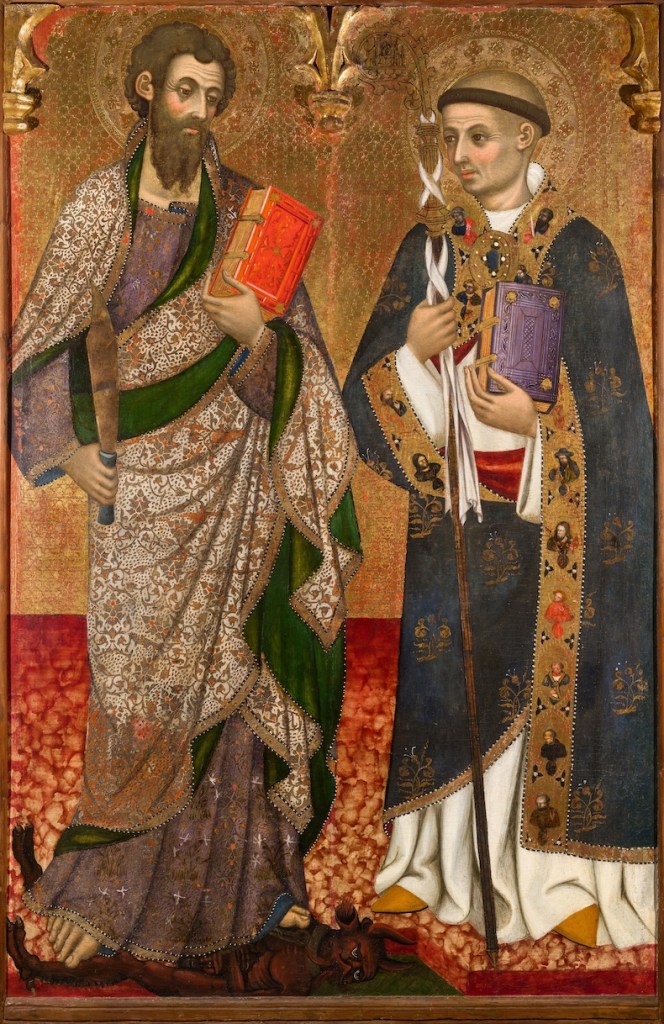
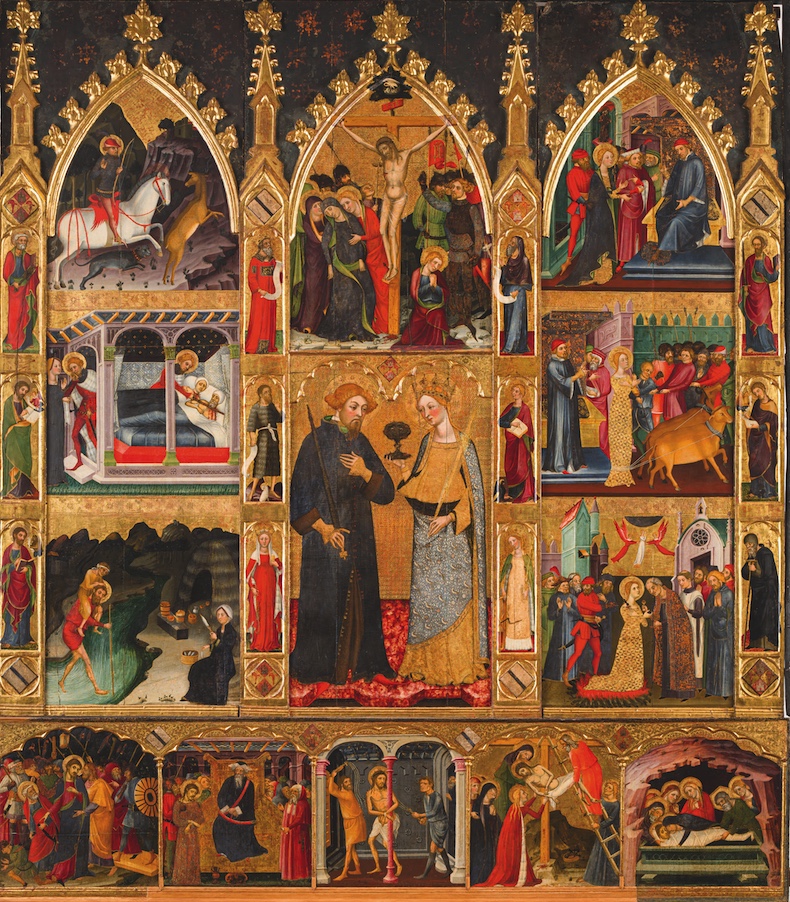
The huge Altarpiece of Saint Julian and Saint Lucy (c. 1384–85) by Pere and Jaume Serra has always been impossible to see in the darkness of the nunnery of the Resurrección in Zaragoza. Here, newly restored, it shines. The dynamic narration of the saints’ legends, including Julian’s murder of his parents in bed and Lucy being dragged by bulls in a gilt dress worthy of the Met Gala, shows that these inventive Barcelonan painters were not simply imitating the Italians but breaking new ground too. The landscape in the scene of Julian fording a river is certainly one of the most original in all of late 14th-century European art.
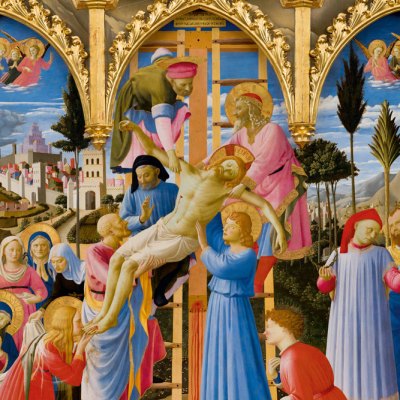
The Florentine painter Gherardo Starnina encountered this lively artistic atmosphere when he came to Spain to work on the high altarpiece of Toledo cathedral, commissioned in 1387 by Archbishop Pedro Tenorio. The altarpiece has had a troubled history, having been dismantled and largely repainted by Juan de Borgoña around 1516. Two of the surviving standing saints have been conserved and are on display here; they show an artist firmly rooted in Florentine tradition. In the final section, two commissions by Starnina are brought together for the first time: the Altarpiece of the Seven Sacraments (c. 1396–97) for Bonifacio Ferrer, brother of Saint Vincent Ferrer, in the Museu de Belles Arts, Valencia, and the Passion scenes of c. 1400 from the parish church of El Collado-Alpuente, the latter painted in collaboration with Marçal de Sas. Starnina brought a new Gothic-inflected style back to Tuscany, best illustrated by two panels of saints (c. 1404–05) from Lucca and his Trinity, which was acquired by the Galleria Regionale della Sicilia last year. The exhibition ends in Florence with Madonnas by Lorenzo Monaco and Fra Angelico – artists who looked carefully at the work of Starnina, a prodigal son who, while abroad, had become, in Vasari’s reckoning, gentile and cortese.
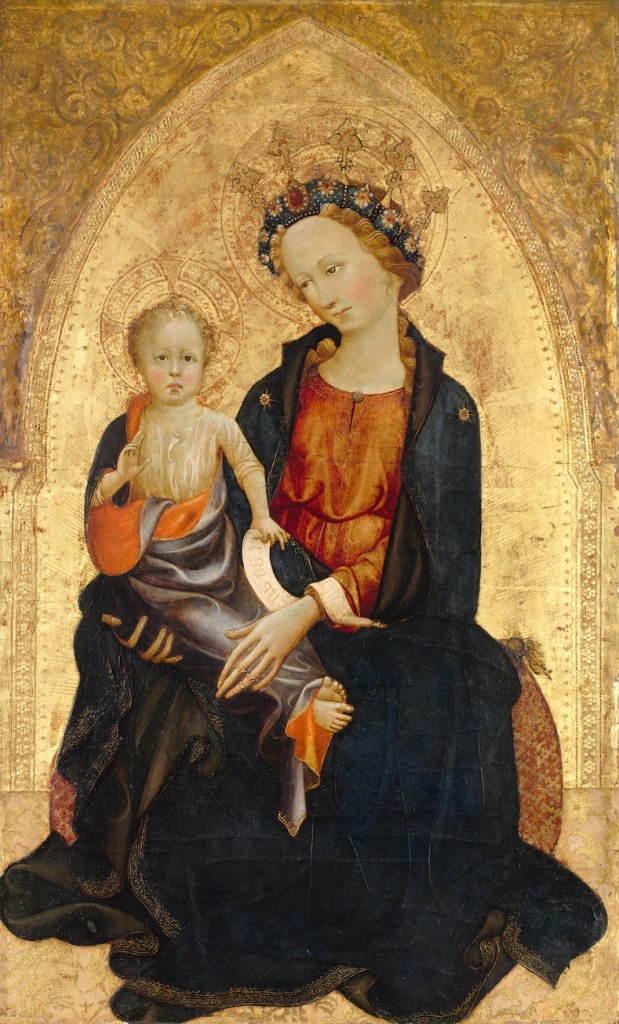
‘In the Italian Manner: Spain and the Mediterranean Gothic, 1320–1420’ is at the Museo Nacional del Prado, Madrid, until 20 September.
From the July/August 2026 issue of Apollo.