From the July/August 2026 issue of Apollo.
This is a thoughtful and intelligent book on a subject that the art world, from dealers to curators, normally does its best to downplay. What actually happened to the artefacts we see in museums before they went on display? What lies behind the seemingly intact surfaces of ancient objects? Margaret Graves, a professor of Islamic art and architecture at Brown University, examines how Islamic ceramics have been treated by excavators, dealers, collectors and museums over the last 150 years. She blends contemporary investigation and 19th- and 20th-century descriptions of restorers’ workshops and dealers’ showrooms to give a detailed and engaging account of how objects were excavated, bought, restored and sold.
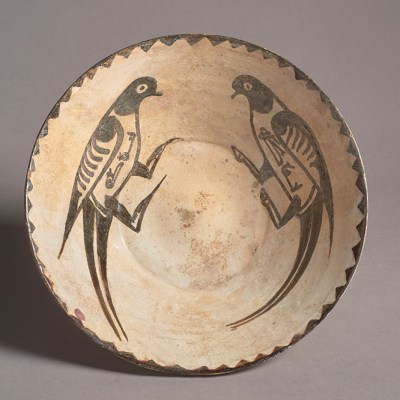
A taste for what Western connoisseurs initially called ‘Persian’ ceramics developed hand in hand with Western political and economic investment in the Ottoman Empire and Persia. Visiting European diplomats and businessmen, many employed on the new British-run telegraph networks that were shrinking the distance from Tehran to London from weeks to hours, returned home with souvenirs. Brightly glazed tiles were especially popular, once they had been pried off the walls of mosques and palaces and respectably framed in dark wood. Home-grown collectors followed their lead; museums, chief among them the South Kensington Museum (now the Victoria and Albert Museum), snapped up Islamic artworks, often displaying them as a stimulus to improve British design. ‘Connoisseurs’ began to classify ceramic wares by their fabric, glaze and design, categorising them according to where they were first found or believed to have been manufactured. By the 1920s, collectors could take their pick from a range of brands whose names promised all the wonders and mysteries of the Orient. Among them, the sites of Rayy in Iran and Raqqa in Syria became particularly renowned for their lustreware ceramics, fabricated from the ninth century onwards, where a secondary firing in a reducing atmosphere produced glittering metallic decoration. Most of this decoration was geometric or floral, but figurative ceramics depicting court life were especially sought after. A group of exceptionally well-preserved Raqqa vessels was said to have been found in a series of storage jars, romantically claimed by their vendors (whom later scholars often followed verbatim) to have been buried for protection during conflict.
These ceramics were excavated from ruined cities dug over by nearby inhabitants anxious to cash in on these newly valuable assets. Graves links some phases of exploitation to the forced migration of penniless Armenian and Circassian survivors of Ottoman and Russian pogroms, providing a parallel with the rise in looting across the Near East after the Arab Spring. Official excavations sponsored by the Ottoman and Persian governments or foreign institutions could not keep pace with informal digging, nor did they manage to uncover objects as intact, as beautiful or as intriguing. In hindsight, should this not perhaps have been a sign that something was amiss? Objects passed from excavators to collectors via dealers who moved with ease between locals and Westerners and added value at every step. Many of these dealers were Levantine, Armenian or Jewish: the more fortunate cousins of the refugee excavators, who harnessed their family and commercial networks to move objects around the world. Dikran Kelekian, an ethnic Armenian from Kayseri in Turkey, operated from Istanbul, Cairo, Paris and New York; his assistance with the Persian display at the World’s Columbian Exposition in Chicago in 1893 gave him Persian citizenship and the honorific title Khan which combined to make him a formidable presence in the art world (‘He was a holy horror!’ his step-granddaughter recalled). Kelekian sold to American museums and private collectors, but also played the long game by lending some of his most important pieces to the V&A at eye-watering insurance valuations that boosted the worth of the rest of his stock. Museums or collectors without specialist knowledge relied on private curators (‘museum agents’) such as Arthur Upham Pope to tell them what to buy, providing another layer of costs, insider dealings and conflicts of interest. Graves writes, tactfully, as though this were a thing of the past.
What exactly were these dealers and collectors fighting over? Fragile, incomplete objects that had been through a lot since their manufacture and which had required varying degrees of restoration and repainting to reach acceptable standards of completeness at the time they were sold. Focusing on museum collections in the Midwest, Graves reveals modern paint glowing under ultraviolet light; seemingly intact figures which, CT scans show, are made of pottery fragments from different vessels; and plain original surfaces incised with bold new designs uncovered by macro photography. One bowl turns out to have been made from hundreds of fragments of eggshell-thin glazed surface, sandwiched together front and back in a pastiche that passed muster for more than 50 years. A particularly refined technique involved custom-making new lustreware fragments to fit gaps in the original, while modern pieces were dipped in specially formulated mixtures, or hung above a smoky fire, to produce the iridescent patinas that collectors drawn to the Aesthetic Movement demanded. The final chapter, ‘The Riddle of Raqqa’, uses thermo-luminescence dating and close examination to light the blue touchpaper under an especially prominent corpus of lustreware.
Much of this making and remaking was executed in the vessels’ countries of origin, often using specialised materials imported from the West. In this exceptionally well-written book Graves brings to light the skill of the individuals who confected these part-modern, part-ancient objects at a time when Western critics viewed contemporary Near Eastern crafts with disdain, and encourages that they be regarded as significant objects and artworks in their own right; easier said than done, perhaps, for the institutions that have had such a penetrating light shone on their collections.
Invisible Hands: Fabrication, Forgery, and the Art of Islamic Ceramics by Margaret S. Graves is published by Princeton University Press.
From the July/August 2026 issue of Apollo.