From the October 2026 issue of Apollo.
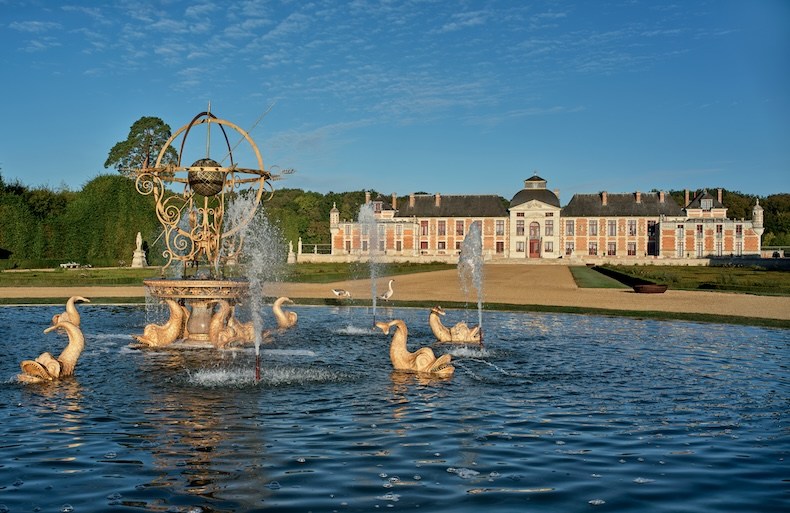
The Château du Champ de Bataille in Normandy has been the project of a lifetime for Jacques Garcia. For the interior designer, now 79, this love affair began when he was 12, on an outing with his father, a man of modest means but nonetheless an avid book collector and bargain hunter who took his son round flea markets and chateaux. The young Garcia fell in love with the classical architecture of Champ de Bataille, with its two symmetrical buildings on either side of a cour d’honneur enclosed by triumphal arches. Facing each other across the courtyard, the main house and service wing are near twins, alternating brick and stone beneath slate roofs.
The chateau was built between 1653 and 1665 to plans attributed to Louis Le Vau for Count Alexandre de Créqui, who had been banished from court by Cardinal Mazarin for taking part in the rebellion against Louis XIV known as the Fronde and confined to his Norman estates, 120km from Paris. A century later, in 1754, the Duke of Beuvron bought the chateau and undertook extensive alterations to its interiors, work that was interrupted by the Revolution. The chateau was subsequently occupied and looted, then passed from owner to owner in the 19th century. In the 20th, it was converted into a hospital but was largely abandoned by the time Garcia bought it in 1992.
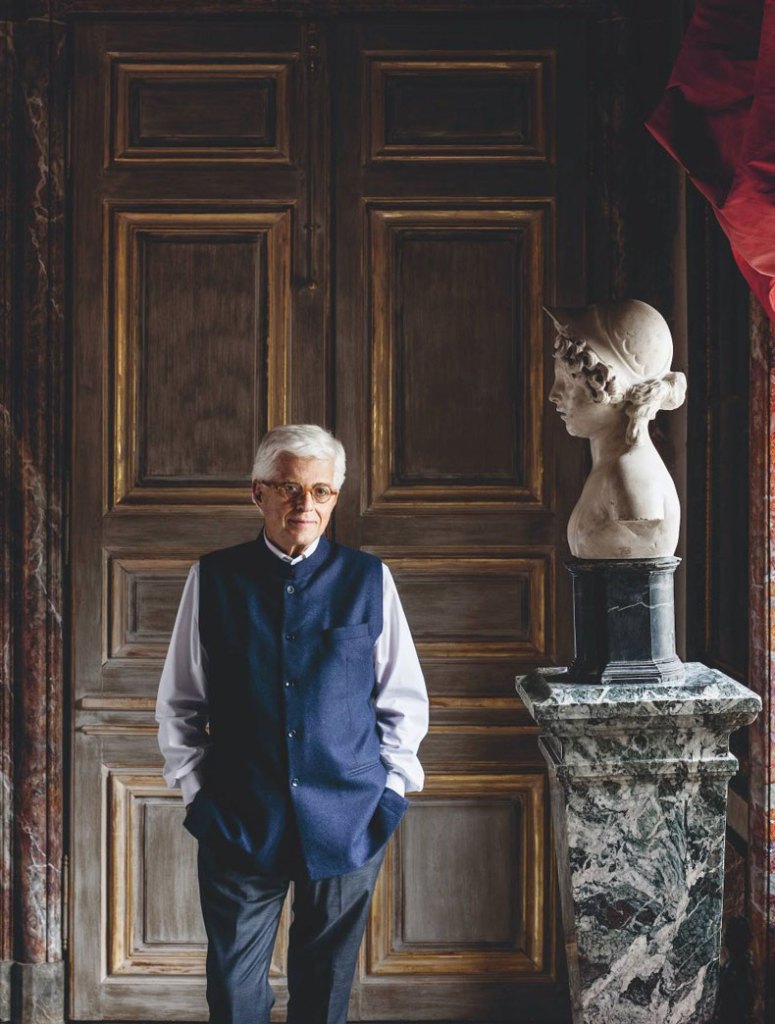
Up to that point, Garcia had been known as a discerning collector of objects with royal provenance. ‘I’d realised that if you knew how to read the inventories compiled during the Revolution, you could track down not just a Louis XIV armchair, but an armchair that had actually belonged to Louis XIV.’ Garcia had started with nothing, but proved remarkably adept at buying and selling furniture and other antiques. In the 1980s he acquired the Hôtel de Sagonne in Paris, built by Jules Hardouin-Mansart, and a small chateau in the Nièvre, his mother’s native region.
He restored and refurnished these properties with pieces from his collections, creating exuberantly baroque interiors that proved enormously popular. Thus began his career as a star decorator, working for immensely wealthy private clients including the Sultan of Brunei, and some of the world’s most exclusive hotels and restaurants. (More recently, he renovated Le Palace, a legendary Paris nightclub of the 1980s, which is due to reopen next year.) While his expertise was not universally admired by museum curators, Garcia finally achieved recognition in that arena in the 2010s, when he was commissioned to refurbish apartments at Versailles and redisplay the Louvre’s 17th- and 18th-century decorative arts collections.
When in 1992 he bought the chateau that had inspired his childhood dreams, its exterior remained intact but the interior was in ruins. No sooner had work begun than the great storm of 1993 devastated the English-style garden that Garcia had intended to preserve. He decided to tackle both large-scale projects simultaneously – restoring the building and creating a new garden – financing them through his flourishing interior-design practice.
The chateau’s reception rooms, the ideal setting for his collections, are on the upper floor, which has an 85-metre enfilade and is reached via a neoclassical staircase probably designed by Ange-Jacques Gabriel for the Duke of Beuvron.
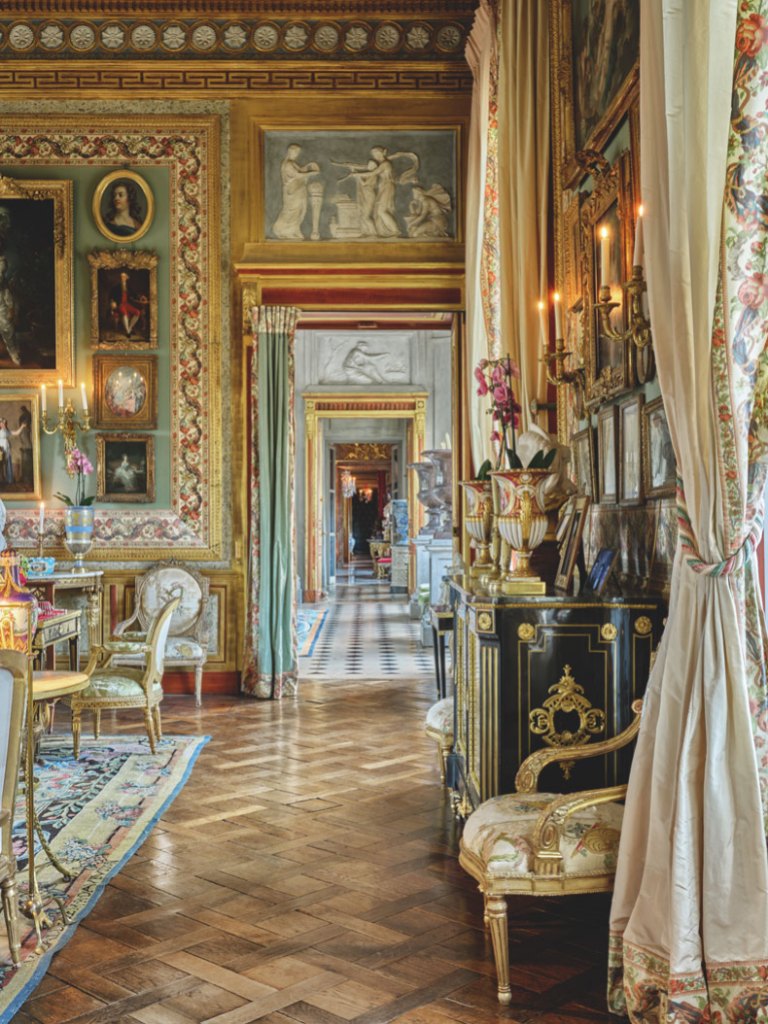
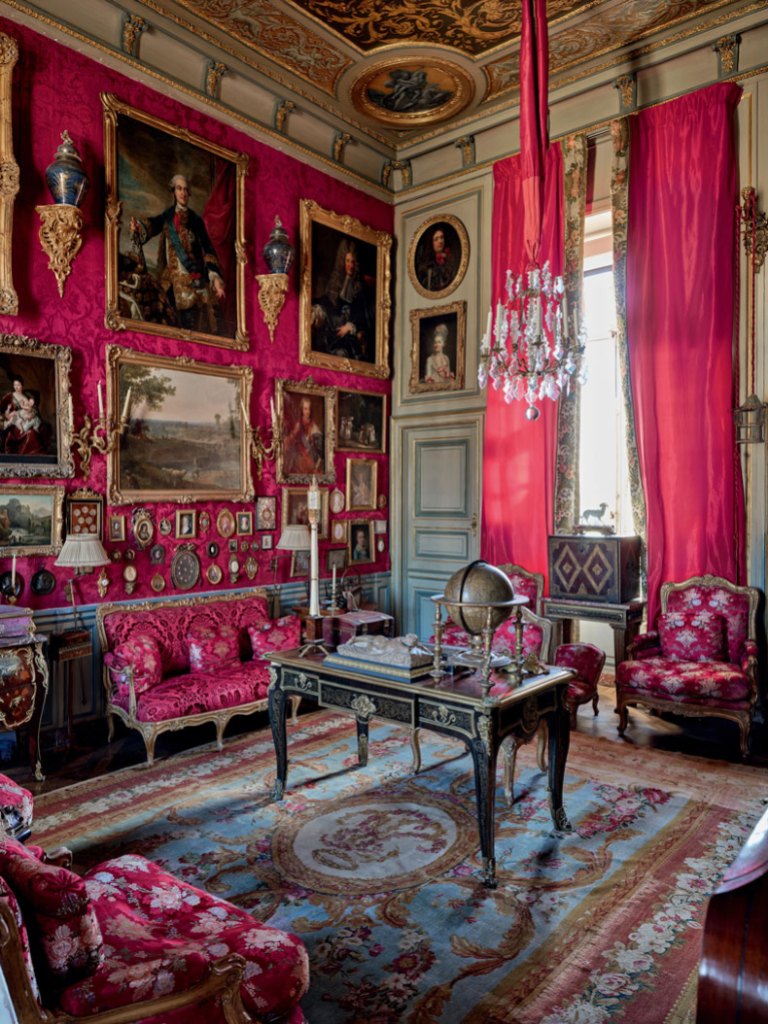
One half of the house – the wing remodelled by the duke in the 18th century – had retained some of its original features, including floors, cornices and fireplaces, all of which were meticulously restored. ‘The end of Louis XV’s reign and the beginning of Louis XVI’s is a period I particularly love, when the Grand Tour to Italy gave rise to neoclassicism, sometimes known as the goût grec.’ Inspired by Talleyrand’s reported remark that those who did not experience the years before the Revolution knew nothing of the pleasures of living, the decoration here evokes the sophistication of the salons of the Ancien Régime.
In the grand formal dining room, with its Savonnerie carpet depicting a trellis that echoes the garden visible through the French windows, there are around 40 chairs by the cabinetmaker Nicolas-Quinibert Foliot. Originally made for royal residences, they were tracked down by Garcia over four decades. Beyond it is a large drawing room redolent of the final years of a world of aristocratic refinement; here Garcia has arranged Foliot giltwood chairs upholstered in a fabric by the textile designer Philippe de Lasalle, which Louis XV gave to his mistress Madame du Barry for her bedroom at Fontainebleau. The room is filled with ornaments, occasional tables and intimate objects that belonged to the royal family. On walls hung with silk-trimmed taffeta, several paintings serve as reminders of the misfortunes of the royal family. These include Dagoty’s portrait of the dauphin, the king’s disabled son who died at the age of seven and whose wheelchair Garcia also owns, along with portraits of Louis XVI and Marie Antoinette – including work by Élisabeth Vigée Le Brun – at different ages, tracing a progression from carefree youth through splendour to tragedy. In a third reception room, decorated with Brussels tapestries, Garcia has installed a billiard table, as fashion at the time dictated; one of its cues belonged to Marie Antoinette.

The chateau’s other wing, which had been disfigured by its conversion into a hospital, was effectively a blank canvas. Here Garcia created a grand suite of state rooms in the manner of the grand siècle, as they might have appeared in the time of Alexandre de Créqui – an entirely new creation, but one inspired by historical inventories.
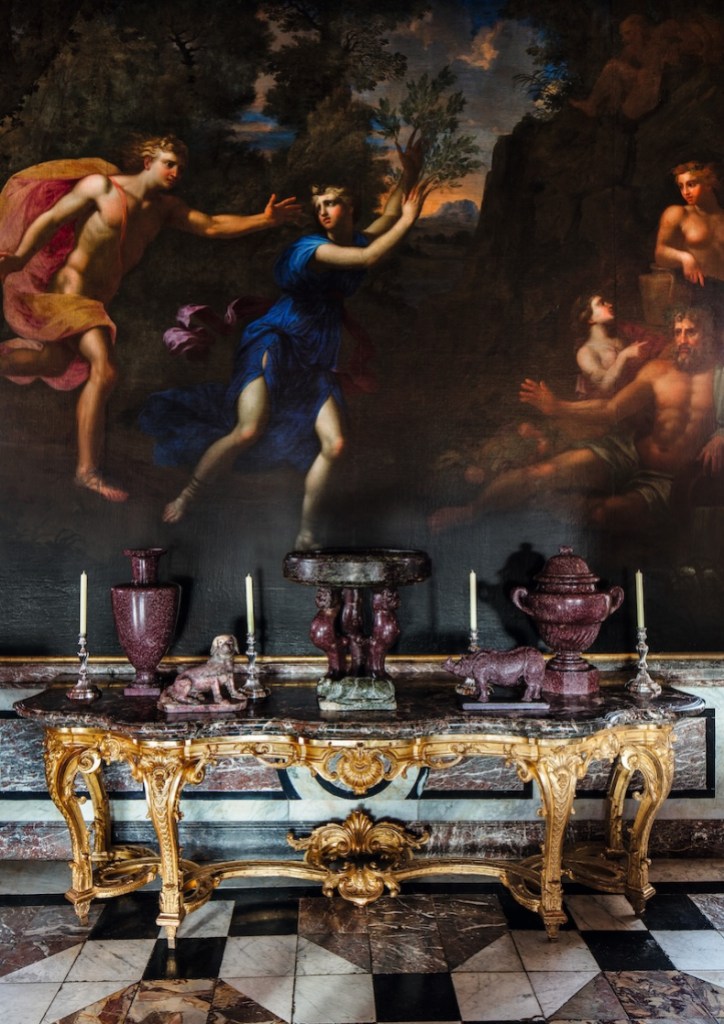
In the monumental Apollo Salon, grandeur is the keynote. The room has a polychrome marble floor, a period copy of the one made for Madame de Montespan at her Château de Clagny, marble pilasters and antique mercury-glass mirrors. Apollo and Daphne, a large painting from the school of Poussin, is paired with a 17th-century bronze of the same subject after Bernini. A mythological ceiling painting, royal armchairs, antique busts and precious Chinese and Japanese porcelain vases complete an interior conceived in sumptuous 17th-century style. ‘This room makes me think of Mazarin,’ Garcia says, ‘who uttered those wonderful words: “To think that I shall have to leave all this!”’
The next room, known as the Salon of Aurora and Cephalus after the figures depicted in a 17th-century ceiling painting by an artist in Simon Vouet’s circle, was designed by Garcia around three pier glasses from c. 1750 by Jacques Verberckt, the sculptor and ornamental designer who worked at Versailles. This Louis XV-style salon is crowded with portraits of the royal family, tables, ornaments and chairs, many of which belonged to Madame de Pompadour. A desk by André-Charles Boulle, made for Jean-Joseph de Laborde, creator of the Château de Méréville, evokes the spirit of the Enlightenment. A state bedchamber, with panelling by Verberckt and a Savonnerie carpet, completes the grand siècle decor of this wing. Behind a balustrade is a bed ‘in blue silk embroidered with figures’, matching Jean de La Fontaine’s description of Louis XIV’s bed at Marly.
Garcia has created other rooms throughout the chateau, including a library, a cabinet of curiosities and bedrooms. The house, furnished with more than 3,000 objects, as though successive generations of an aristocratic family had each left their mark, is open to the public and very much a living place: Garcia frequently hosts dinners and invites friends for the weekend. The sale of some 50 objects at Sotheby’s in 2023 enabled him to raise funds for the upkeep of the estate and reconfigure some of the rooms, ‘but the spirit of the place remains’, he says.
If the chateau’s interiors feel as though they have always been there, the same is true of the garden. ‘Over 33 years, I’ve created the largest private garden in Europe,’ Garcia says, ‘with 44 hectares of maintained gardens within a 300-hectare estate and official Jardin remarquable status.’ This was a colossal undertaking, which entailed moving millions of tonnes of earth, planting tens of thousands of trees – including hornbeam, box, yew and lime – and constructing pools, fountains and complex hydraulic systems. A sketch for the chateau attributed to André Le Nôtre provided the starting point for the formal French garden, with its intricate box parterres, groves and grand canal. The rest sprang from Garcia’s imagination: a succession of gardens dotted with follies, including a Temple of Leda whose interior is lined with semi-precious stones, an ancient-style theatre, a belvedere and a grotto inspired by the Grotto of Thetis at Versailles. There is also a fantastical Mughal palace, made from stone shipped from India over ten years and constructed on a three-hectare site over a further decade.

Garcia is very happy that Champ de Bataille is known as the ‘Norman Versailles’ and hopes eventually to entrust the estate to a foundation that will secure its future. He is delighted, too, that it has been awarded a third star by the Michelin Green Guide. ‘It’s like being listed by UNESCO,’ he says. ‘It entails a lot – catering, refreshments and organising cultural events for the public. That’s what takes up our time now: maintaining all of that.’
Text translated from the French by George Miller.
Jacques Garcia: Thirty Years of Passion – Château du Champ de Bataille, by Jacques Garcia and Alain Stella,
is published by Flammarion.
From the October 2026 issue of Apollo.