From the March 2026 issue of Apollo.
For visitors to TEFAF, the Buccellati stand is a familiar sight. Gianmaria Buccellati, son of founder Mario Buccellati, was one of the first jewellers to exhibit in Maastricht, participating at the fair for the first time in 1992.
‘The vast array of art and antiques is a source of endless inspiration,’ says Andrea Buccellati, the house’s current creative director and the grandson of the founder. A glance at Buccellati’s booth shows how seamlessly the ancient, the artisanal and the contemporary come together in the pieces of the Milanese jeweller. Finely hand-engraved gold mimics the lightness and texture of lace, while gemstones – set without visible prongs, seemingly embraced by the metal – recall the sumptuous garments of the figures painted by Botticelli. At the same time, there is also a striking modernity to these creations.
‘You can recognise a Buccellati piece from afar,’ Andrea says. ‘My family revived ancient techniques of working gold, and we carefully preserve and pass them on to the next generation, which is what sets us apart.’
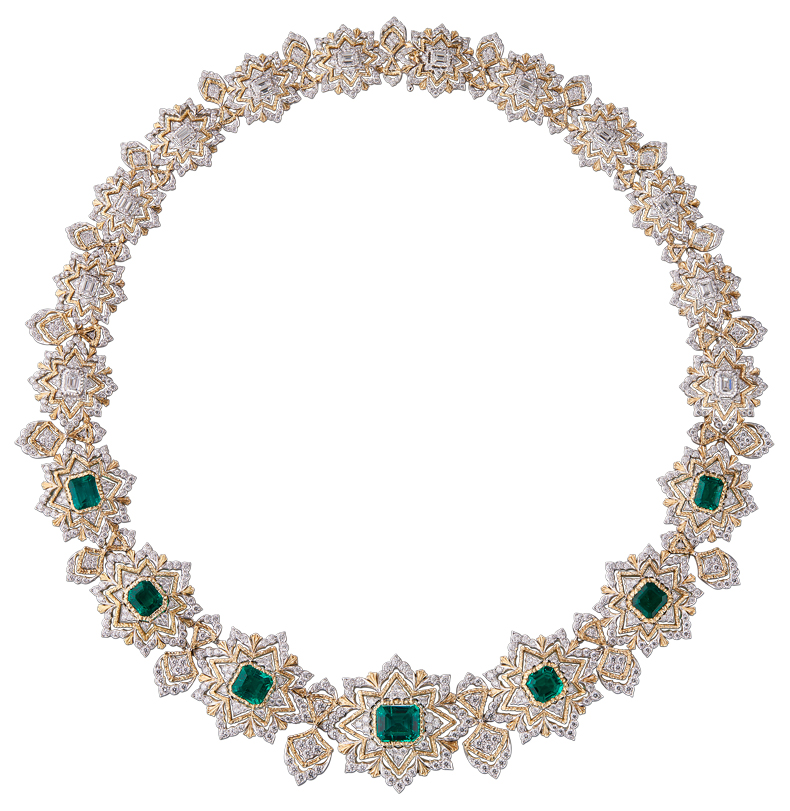
The bib necklace from the Mosaico collection, the house’s centrepiece at TEFAF, brings together many of the hallmarks of Buccellati’s goldsmithing. A sequence of stylised rose-window motifs alternates with mirrored leaf designs, rendered in white- and yellowgold details that gradually increase in scale towards the centre. To the touch, the necklace feels like opulent brocade – an illusion achieved through an extraordinary mastery of engraving techniques.
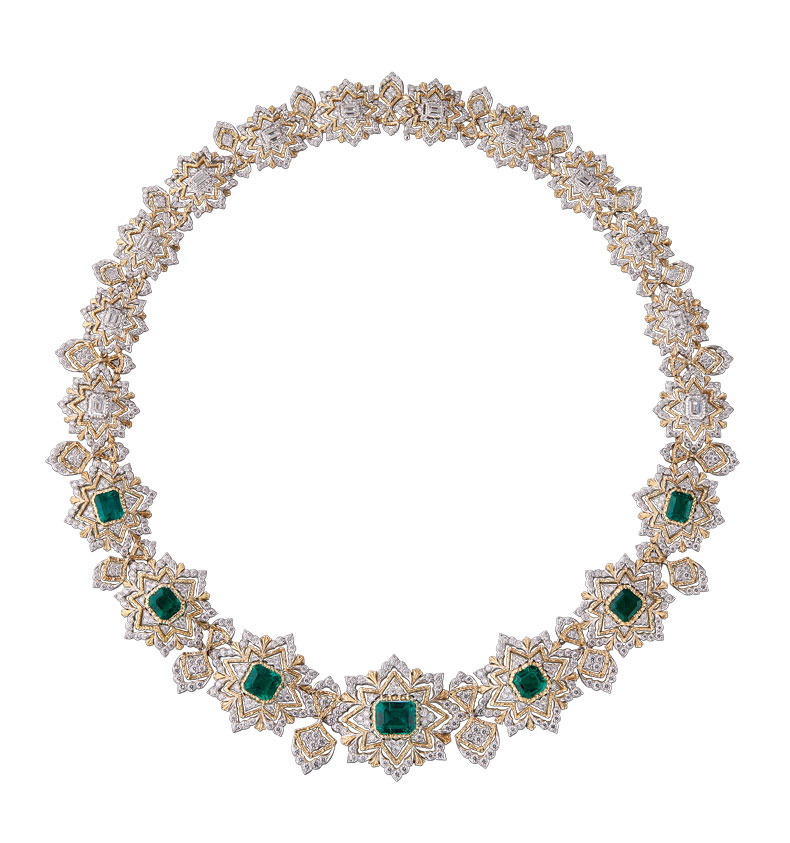
Buccellati regularly employs four principal engraving methods, often combining them within a single piece. One of these is rigato (Italian for ‘lined’), which involves tracing myriad fine, parallel lines with a burin, a tool similar to one used by Renaissance goldsmiths, that gives the metal a distinctive silky sheen. When vertical and horizontal rigato lines intersect on the same surface, the result is telato (‘canvas’), a texture that resembles linen or woven cloth. When rigato lines zigzag in multiple directions, they create the velvety softness known as segrinato, a technique that Gianmaria Buccellati used to recreate the textures of flowers such as begonias and anemones. Ornato (‘decorated’) is achieved when the burin is used to engrave elaborate patterns inspired by rich brocades, damasks and lace. Venetian embroidery, particularly the delicate needlework involved in the production of Burano lace, inspired Mario Buccellati to pierce gold in fine honeycomb patterns, giving rise to the Maison’s well-known tulle technique. This innovation enabled him to create his celebrated gold-lined silver bracelets.
Buccellati can also reproduce the ornate piping of historic garments through filo ritorto, or ‘twisted thread’, a process in which gold is extruded into a fine wire and twisted back upon itself. Finally, the jewellery’s flexibility is ensured through chaining, where individual elements are bound together with tiny links on the reverse of the piece, allowing it to move fluidly while retaining a sculptural form. Counter-intuitively, perhaps, at a time when gold has reached sky-high levels, Buccellati creates value in its pieces by removing gold through these age-old techniques that require years to be mastered fully.
The way the emeralds are set in the Mosaico necklace is a Buccellati signature. Rather than being held by prongs, the gemstones are nestled directly into the metal, which is modelled into a cylindrical form that gently yet securely holds each stone. The surrounding gold is decorated using Buccellati’s signature engraving techniques, allowing the setting to blend seamlessly into the piece as a whole. ‘These emeralds, of the finest and rarest quality and colour, sourced from Colombia, have been in our family for quite some time, until they inspired me to bring them together in this necklace,’ Andrea Buccellati tells me.
The network of relationships with gem dealers and artisans that the family has built up over generations forms a central pillar of the business, while supporting the house’s mission to protect and transmit heritage. One example of the importance of these long-standing collaborations is the grand vase, part of the Doge collection, also presented at TEFAF, which was produced by Venice-based silversmiths with whom Mario Buccellati began collaborating decades ago. ‘I have known three generations of this family,’ Andrea says. ‘Their expertise in creating vases is unparalleled.’
The vase takes the form of a large chalice in hammered silver crowned with an open fluted rim. The double row of foliage patterns echo the scrolling vegetal ornament typical of 15th- and 16th-century Italian decorative arts, such as the foliage that frames Lorenzo Ghiberti’s Gates of Paradise in Florence. Oval cabochons of deep green jasper are set into the body of the vase and framed by finely engraved yellow-gold bezels. Smaller gold rosettes centred with jaspers act as a counterpoint to the cabochons, while the sculpted stem and broad foot echo the motif around the top of the vase, giving a sense of balance. The richly ornamented piece evokes a ceremonial chalice such as those used to present communion wine in 15th-century Venice.
‘We do not make many of these vases, perhaps two or three per year, but it is still important to make them,’ Andrea Buccellati says. ‘They allow us to keep alive techniques that would otherwise disappear and to support workshops whose knowledge has been passed down for generations.’
From the March 2026 issue of Apollo.