This review of the The Complete C Comics by Joe Brainard appears in the April 2026 issue of Apollo.
In the early 1960s, Joe Brainard moved from Tulsa, Oklahoma, to New York City, determined to fall in with the downtown art and poetry movements. Fall in he did. Within a very short time he was either a collaborator, friend or both of Ron Padgett, Barbara Guest, Larry Rivers, John Ashbery, Kenneth Koch, Peter Schjeldahl and many others in what is now loosely called the ‘New York School’.
Brainard had been writing and drawing (and also designing clothes) from an early age. In his brilliant, unconventional memoir I Remember, he seems influenced by comic strips such as Katy Keene, about a fashion model, and Penny, a typically ‘kooky’ teenage girl. Kenneth Koch wrote that their generation ‘grazed’ on comics like sheep on grass. After some censorship battles with various New York literary reviews, Brainard produced the first C Comics. There would be two issues – the first was mimeographed, the quality reminiscent of ‘Tijuana Bibles’, smudgy pornographic comics from Mexico that featured badly-drawn caricatures of movie stars doing naughty things. C Comics featured texts and dialogue by, among many, Tony Towle, Kenward Elmslie (later Brainard’s long-term partner) and Frank O’Hara, who wrote the first piece in the book, about a cowboy named Red Rydler who has the awkward compulsion to steal other cowboys’ clothes. At gunpoint, the posse demands: ‘What is this pants fetish of yours? You’re sick, Red.’
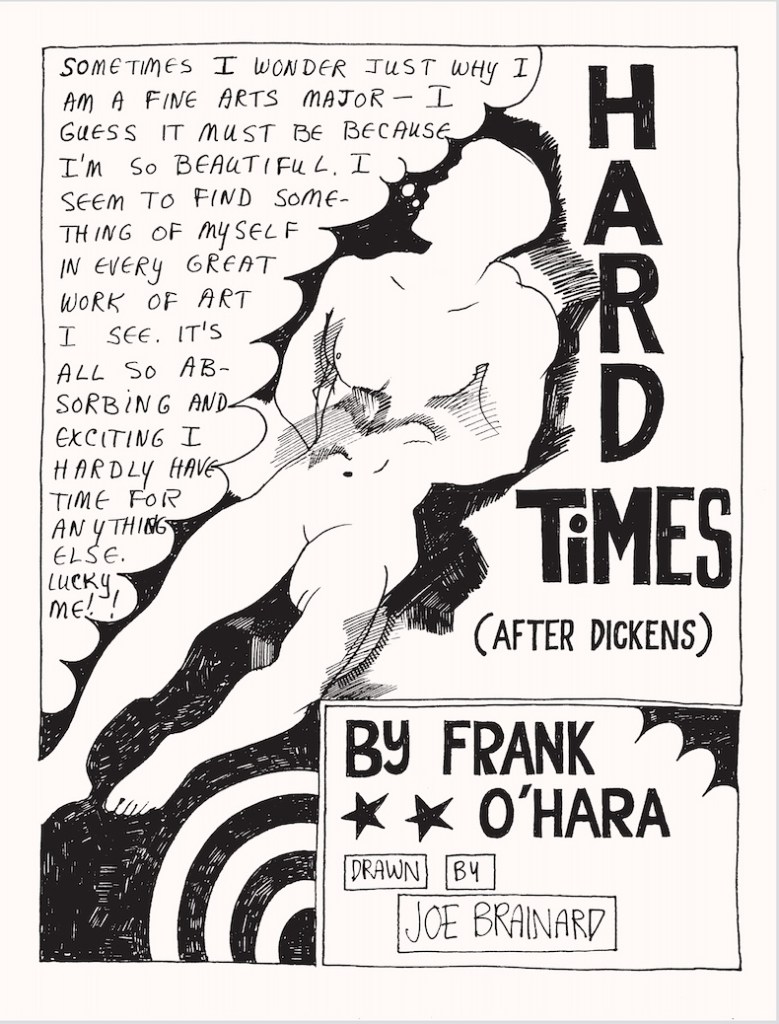
O’Hara also wrote ‘Hard Times (After Dickens)’, with Brainard characters that look drawn or traced from men’s fitness and muscle magazines, and who are shallow art students: ‘Sometimes I wonder just why I am a fine arts major – I guess it must be because I’m so beautiful. I seem to find something of myself in every great work of art I see.’
These guys spend a lot of time posing in pouches and trying to one-up each other: ‘The damn snob. If he thinks I don’t know he uses that contrapposto bit to hide weak ankles, he’s stupider than I thought.’
There’s an existentialist strip about the Everly Brothers written by Barbara Guest, who also wrote ‘Foreheads’, a solemn musing on the animal kingdom, and a number of punchy fake advertisements by James Schuyler, one of which at first glance seems to be a maniacally stuffed page from the back of a comic book, or the listings for burlesque houses in old newspapers. But it turns out to be none of that, hardly anything at all, just the graphics pulling you in, Pavlov style: ‘Woo – AIR CONDITIONED NY. Free lifetime. New Jersey.’ Schuyler also contributed a parody of the Maidenform bra ads: ‘I dreamt I got my nuts off in my Dan River shirt.’
John Stanton provided lines for ‘Beach Party’, a parody of Charles Atlas body-building ads but mixed up with artists and writers: ‘You always let him kick sand in your pen!’ There is a hilarious Kenneth Koch scene with Adam and Eve and a brilliant take on Archie comics and teenage sexual frustration that ends with a pile of superheroes’ discarded underwear.
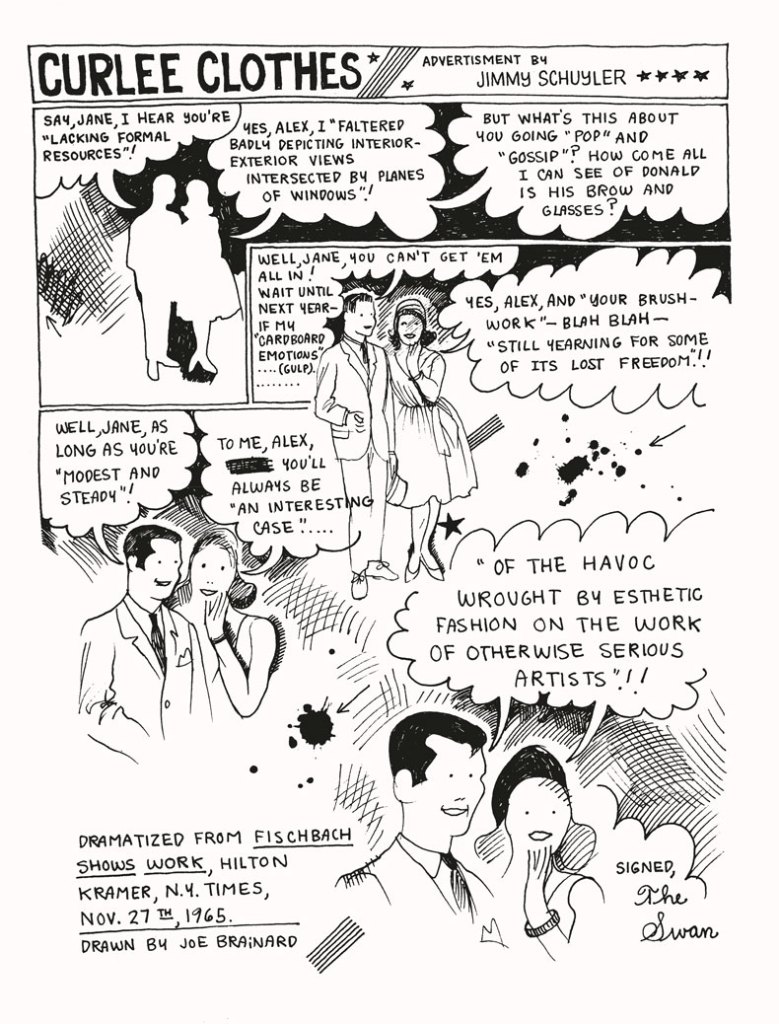
Brainard and co kept up a diatribe against Hilton Kramer, then the art critic of the New York Times, dubbing him Hilton ‘Albeit’ Kramer. They incorporated quotes from his reviews in romance-style comics about an all-American boy and girl at art school: ‘Say, Jane, I hear you’re “lacking formal resources”!’ ‘Yes, Alex, and “your brushwork” – blah blah – “still yearning for some of its lost freedom”!!’
Another of Brainard’s obsessions was Nanc, a long-running comic strip, usually a gag involving suburban sidewalks, garden hoses and practical jokes. He wrote a whole book about it, The Nancy Book. In the second volume of C Comics he extended this infatuation throughout the world. Even the animals are pondering Nancy: the thought balloon of a grand elephant reads, ‘O who is she?’
Throughout C Comics, Nancy is taken from her suburb and put into a variety of weird 1960s situations.
As Bill Kartalopoulos explains in his excellent essay, the truly novel and unexpected aspect of C Comics was that instead of the usual mode of comics production, in most cases Brainard drew the comics first. He left the thought and speech balloons empty, then sent them to the poets to fill in the dialogue.
Which accounts for the fact that some of the dialogue doesn’t fit in the balloons – phrases trail off into the margins and between panels. Instead of being irritating or seeming sloppy, it looks like it was all part of the plan. Far from imitating the close-packed pages of commercial comic strips, and unlike the soon-to-be psychedelic ‘comix’ of the west coast, there’s a lot of blank space in C Comics, and its effect might be compared to the work of a poet using a free and open line (as many of Brainard’s contributors were wont to write). Sometimes it’s as if the artwork is just beginning to appear on the page.
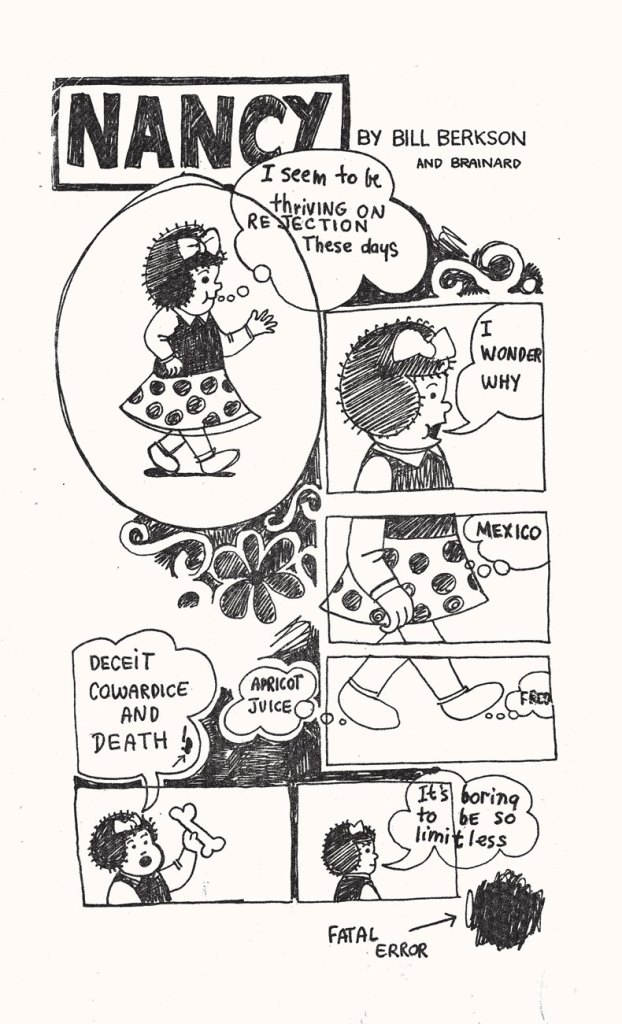
You could say that Brainard and his excellent poets were unconsciously waiting for Robert Crumb to come along and do a better job of kicking America’s ass. Which he did. But there is highly original playfulness, ambiguity, subversiveness and doubt about America in Brainard’s work. As Tony Towle wrote, ‘Our effortless talk comes from our grief.’
One of the two solo Brainard pieces in this collection is ‘People of the World: RELAX!’ In eight pages he contrives to relieve many anxieties which still plague us today: tight pants, masturbation in the shower, smoking, making noise in the toilet and wanting to be a movie star or a dancer. Death: it will not hurt you. ‘PEOPLE OF THE WORLD: RELAX!’ One would so like to.
From the April 2026 issue of Apollo.
The Complete C Comics by Joe Brainard is published by New York Review Books.