From the October 2026 issue of Apollo.
In 1974 John Ashbery published a collection, Self-Portrait in a Convex Mirror, which made him the most celebrated American poet of his generation. The book’s long title poem, a meditation on the painting by Parmigianino of the same title, was testament to the inspiration Ashbery found in visual art.
But what pictures did Ashbery look at every day? The quirky selection of works on paper currently on display at the Morgan answers this question. The exhibition is a record of Ashbery’s friendships in the post-war art worlds of Paris and New York, where he earned his living as a critic writing about art for the New York Herald Tribune, ARTnews and other periodicals. Virtually all the drawings on show were gifts from the artists who created them rather than art Ashbery sought out and ‘collected’. Even in the case of a picture he bought – a watercolour by the New York-based Czech artist Jan Matulka from the mid 1920s – the choice was serendipitous. He just happened to notice the work as he passed the window of a hardware store on the Lower East Side, and he took it home ‘for a very reasonable price’.
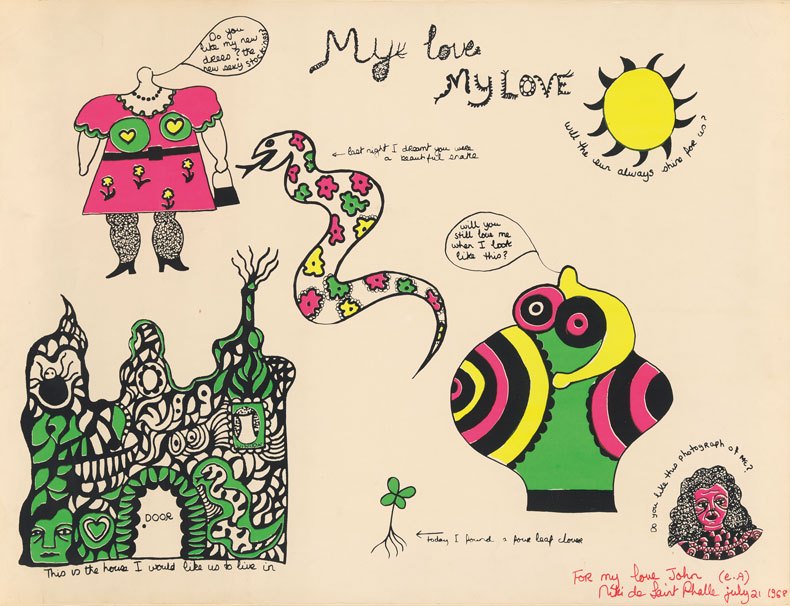
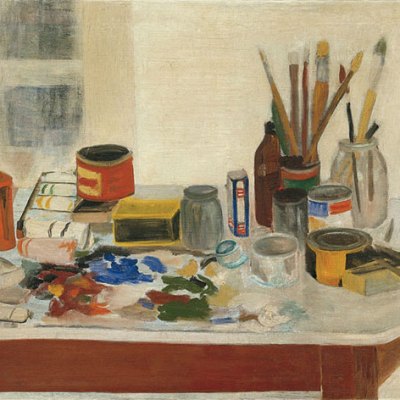
As an art critic, Ashbery described himself as ‘basically disinterested’, by which he meant open to the potential interest of almost any sort of art. The poet had arrived in New York after graduating from Harvard in 1949, when Abstract Expressionism was ascendant and figurative art was supposed to be over and done with. Ashbery and the young painters he befriended, such as Jane Freilicher and Larry Rivers, ignored the claim that the historical progress of Western art made certain styles necessary and others obsolete. They tended to see any style as valid insofar as it was an expression of individual sensibility, the more off-centre the better. This principle promoted camp playfulness, idiosyncrasy and the authority of personal taste. Ashbery himself had a taste for artists such as Jean Hélion and Fairfield Porter, who seemed to paint landscapes and portraits simply to show that someone still could. But he also admired the work of Norman Bluhm and James Bishop who remained committed to abstract painting long after it went out of fashion.
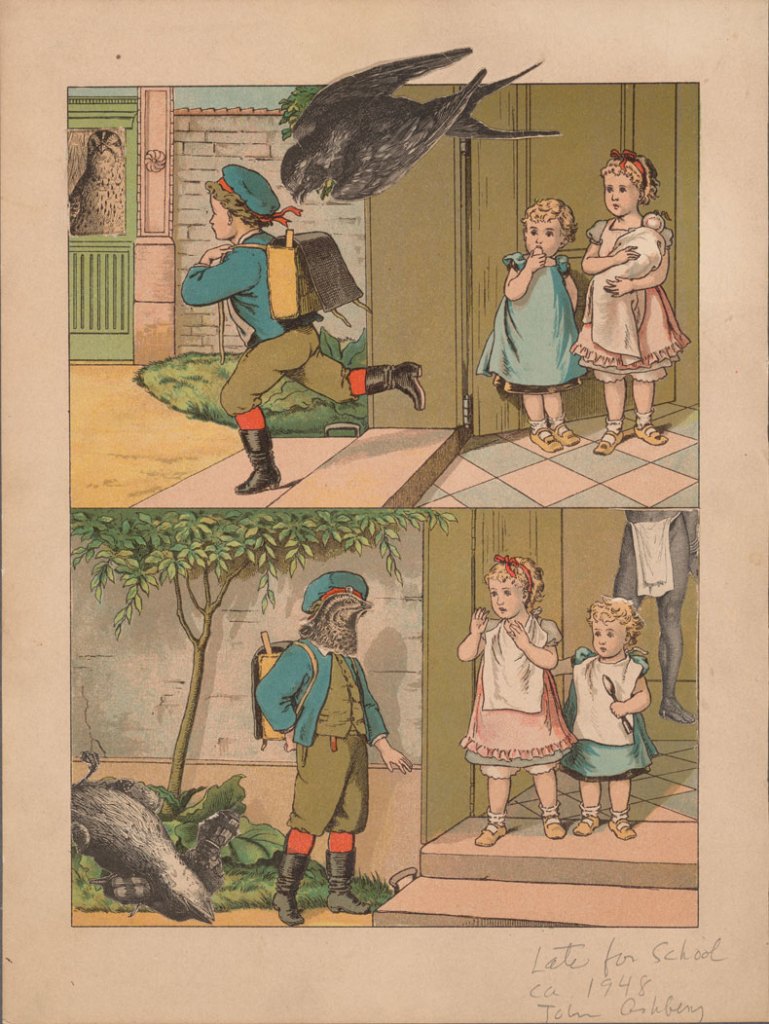
In addition to divergent styles, Ashbery enjoyed the incongruities that emerged from juxtaposing them. His love of mishmash is evident in his own collage-making. The exhibition begins with Late for School (c. 1948), a work Ashbery made in college. By affixing a bird’s head to a schoolboy on a page from a German children’s book, the poet created a dream-like image that he himself accurately described as ‘pretty creepy’. Much later in life he would make many more paper collages, arranged with impish wit. Meanwhile, he introduced verbal collage in his poetry. This was obviously the case in poems made of language cut and pasted from specific sources. More generally, however, he evolved a way of writing that accommodated all manner of discourse, from everyday clichés to high romantic lyricism. Trevor Winkfield, an English-born, New York-based artist, was thinking of Ashbery’s ambition to ‘capture everything’ in his poems when he made an acrylic painting titled The Net (1994). Winkfield gave the study for the painting, a cut-paper collage, to Ashbery on his 70th birthday in 1997. As if it were a summary of the show, the collage is placed last, where it calls back to Late for School across the room.
The exhibition catalogue contains an illuminating introduction by Ashbery’s biographer Karin Roffman and notes by others about each work in the show. It also presents photos from Ashbery and his partner David Kermani’s home in Hudson, New York. These give us a glimpse of a few of the works in the settings where the poet lived with them. Red Grooms’s watercolour of a Maine lake as observed from the rectangular window of a vacation cabin’s toilet, with a can of Barbasol and a razor on the window ledge, and each tiny square of the mesh screen indicated in pencil, hung in Ashbery’s bedroom beside a lady’s vanity and mirror, backed by William Morris wallpaper.
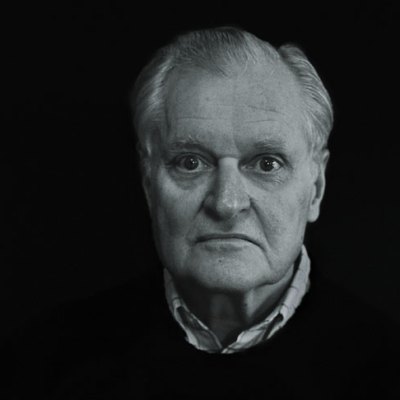
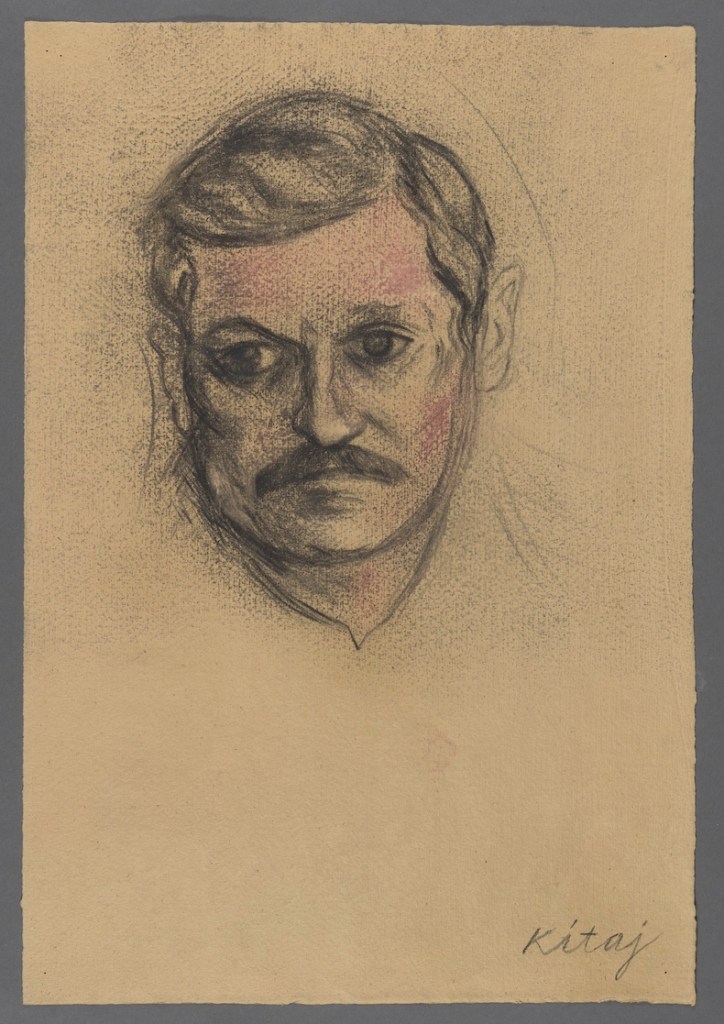
But not all these works were on the wall in Hudson. Some were stashed in ‘the art closet’. These include all but one of the portraits of Ashbery on display in the exhibition. (A charcoal and pastel likeness by R.B. Kitaj from 1979 was neither formally hung nor consigned to darkness with the rest; it stood on the floor, leaning against the fireplace.) In none of these portraits, not even in Philip Pearlstein’s hyper-detailed graphite likeness (c. 1972), does the subject look directly at the viewer. Ashbery’s eyes are cast down or to one side. In the case of Larry Rivers’s three pencil drawings, where Ashbery comes closest to returning our gaze, the eyes have been smudged or erased altogether. Shyness itself seems like the subject in Hélion’s study for a never-completed oil portrait (c. 1965). This work of pastel, crayon, and ink on dark brown paper offers eight glimpses of the poet, his face bowed and averted in each.
There is a long history of poets’ portraits behind these images. Typically, poets such as Pope or Wordsworth look to heaven for inspiration or hang their heads, brooding on invisible things. Ashbery’s averted gaze conveys an intellectual absorption very much in keeping with those conventions. (Although his artist-friends may have been simply deferring to the poet’s preferred pose.) Even as the portraits allow him privacy, however, they all feature his square jaw, sharp nose and broad brow, generating a tension between his elusiveness and a strong physical presence. Together, the portraits in this show suggest a quality of the work as well as of the man. For the collage-like aspect of Ashbery’s poems make them feel impersonal, the poet hard to locate in them. But there is never any question of who wrote them.
‘Friends Who Came to See Me: Drawings from John Ashbery’s Collection’ is at the Morgan Library & Museum, New York, until 25 October.
From the October 2026 issue of Apollo.