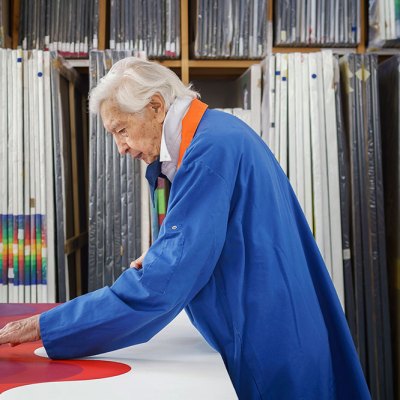
From the January 2026 issue of Apollo. Preview and subscribe here.
One of the first things you encounter upon entering Jorge and Darlene Pérez’s Miami penthouse – even before the panoramic ocean view, or the beautifully designed furnishings, or the museum-worthy art collection tastefully distributed throughout the rooms – is an exuberant Labradoodle named Tamayo. Darlene jokingly refers to him as the family’s most precious prize. No doubt Tamayo offers ample distraction from the absence of a treasured Joan Mitchell painting, Iva (1973), which the couple donated to Tate Modern in 2025.
Mitchell titled the painting after her beloved German Shepherd – a parallel to the Pérezes’ own dog. When the couple visited Tate Modern to see their gift installed in its new home, Darlene found herself automatically tilting her head to look at it. In response to someone’s quizzical look, Darlene explained that the six-metre triptych had hung for years in their bedroom on her side of the bed – usually the last thing she saw before falling asleep. ‘I know every single inch of her,’ she says.

The Mitchell is the most visible element of the Pérez family’s transformational gift to the Tate, which includes a multimillion-dollar endowment for curatorial research into African and Latin American art that supports a new curatorial position and a donation of 36 works by artists from across Africa and the African diaspora – including El Anatsui, Yinka Shonibare and the painter Joy Labinjo, and a group of works by renowned Malian studio photographers Seydou Keïta, Malick Sidibé and Adam Kouyaté.
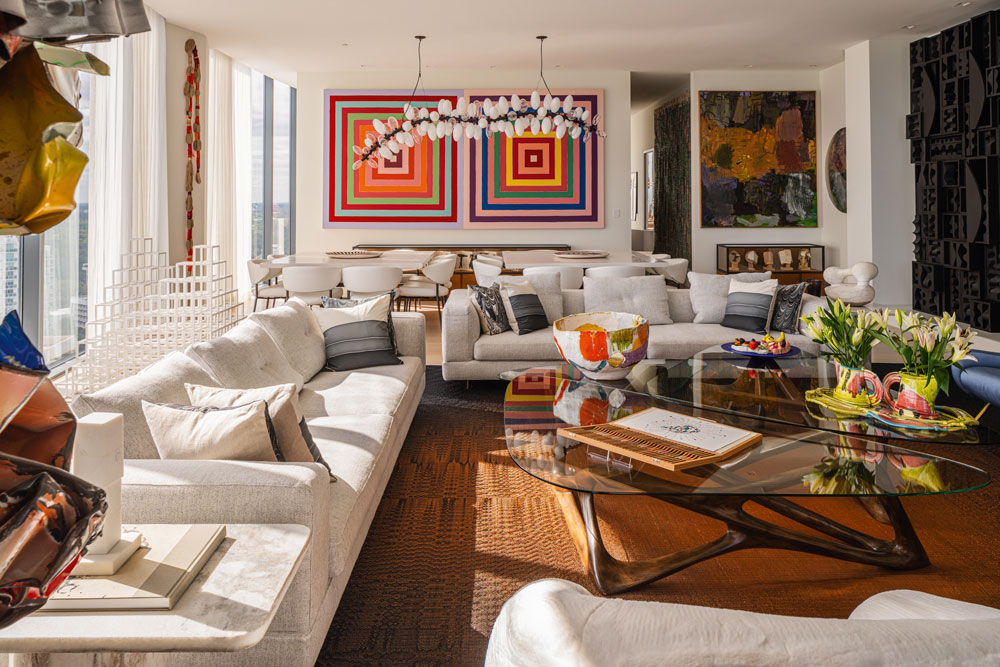
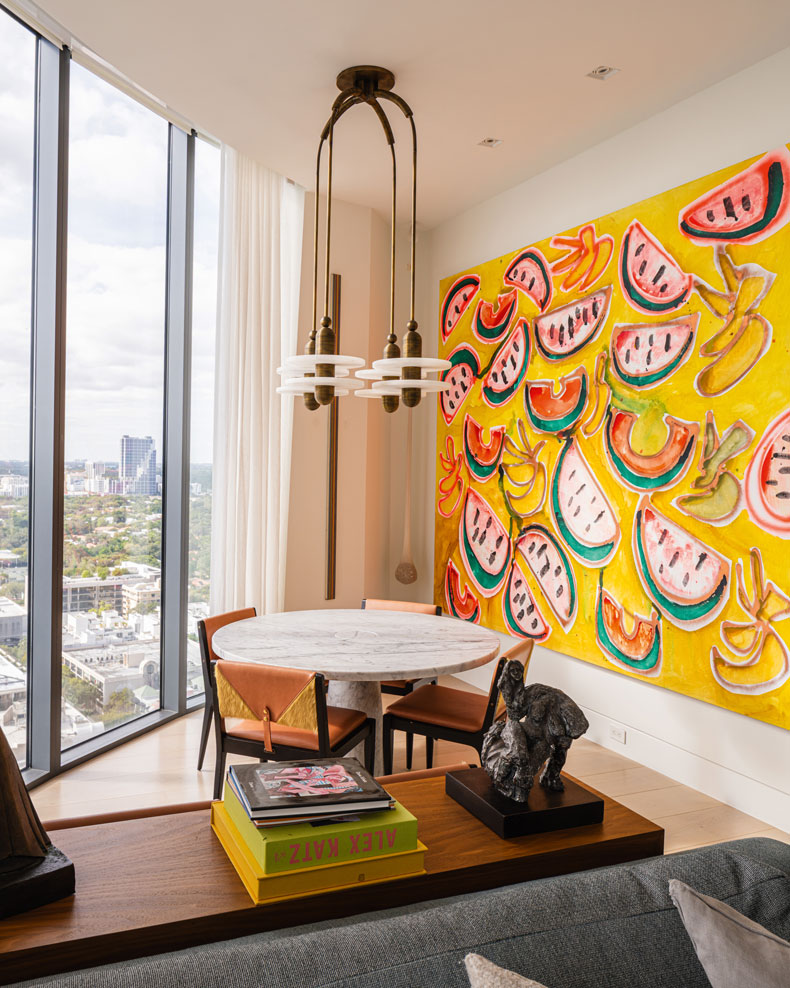
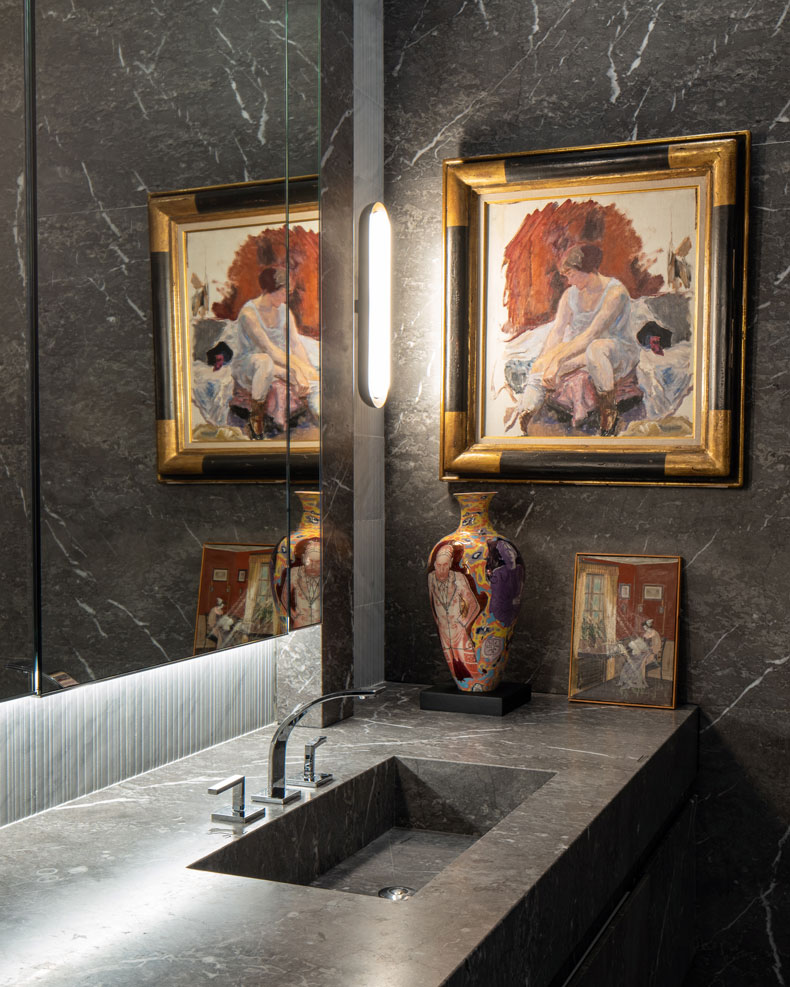
The Pérezes’ penthouse in Coconut Grove – perched atop an OMA-designed tower with undulating facades inspired by Christo and Jeanne-Claude’s Surrounded Islands (1983) – offers a masterclass in living with art. The neutral tones of the furniture and walls provide an ideal backdrop for vibrant colours and textures. As we wait for Jorge to arrive, Darlene gives me a tour. Every few feet there is a different masterpiece to admire, and the art is often wittily integrated into the space. In the library, one wall of shelves comes alive with books bound in Dutch wax-print fabric, a work by Yinka Shonibare titled The American Library Collection (2020). The couple changes out their art collection annually, Darlene explains, because they often lend to exhibitions and because they enjoy the freshness it brings to their daily life. ‘We just had a change out,’ she notes, in anticipation of opening their house to tours during Art Basel Miami, due to open just a few weeks after we speak.

The art in the Pérez home often involves a personal relationship between the Pérezes and the artist. Throughout the apartment, one encounters their ‘babies’ – their pet term for particular favourites. Darlene gestures to a wall where Alex Katz’s Alba (1990), a portrait of his wife, has just been replaced by a gorgeous abstraction by the Lebanese-American artist Etel Adnan. ‘Alex Katz is probably one of our babies too,’ Darlene says. ‘We went to visit him about four years ago. We showed him a picture of the painting, and he looked at me – he’s so clever – and he said, “I painted that of you, I want you to know.”’ Darlene is bemused by Katz’s flattery but acknowledges that she does resemble the portrait.
As we move into the hallway leading to the bedrooms, Darlene points to another ‘baby’: an exuberantly painted abstraction by Grace Hartigan titled The Phoenix (1962). Darlene mentions that she is rereading Ninth Street Women, Mary Gabriel’s acclaimed history of the women painters associated with the New York School: Lee Krasner, Elaine de Kooning, Hartigan, Joan Mitchell and Helen Frankenthaler. The book explores how these women had to navigate chauvinistic institutions – and just plain chauvinism – often while outworking their better-known male peers. She is committed to repositioning these women not as ‘women artists’ but as artists whose contributions deserve equal weight.
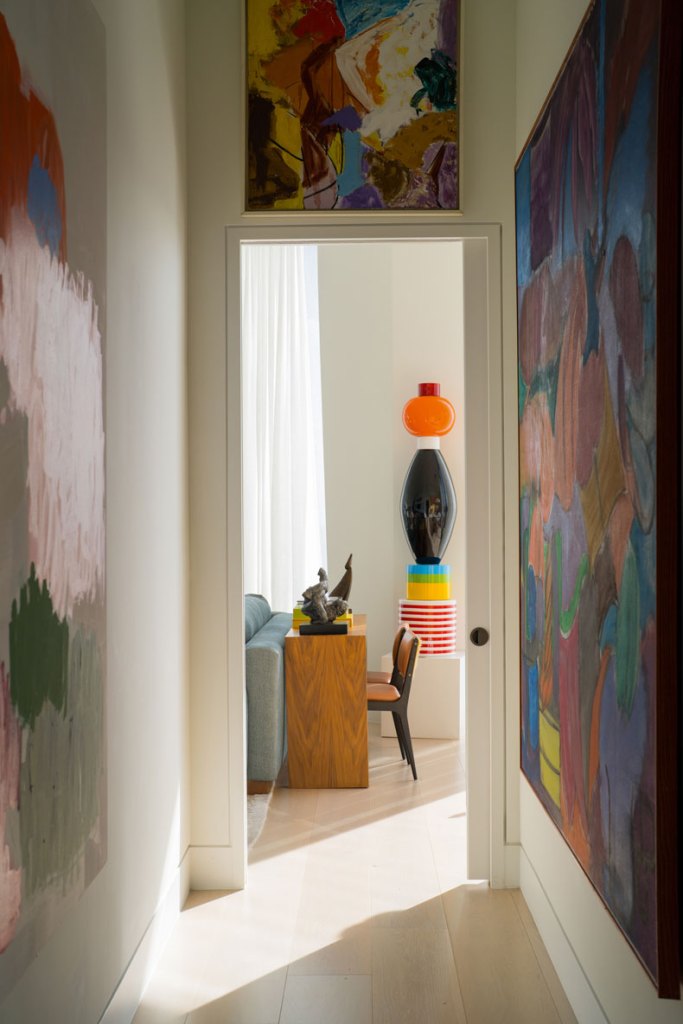
We move to the primary bedroom and bathroom, in the centre of which is a large piece by Michelangelo Pistoletto titled Un bimbo e una bimba (A Boy and a Girl) (2015): a life-size photograph of two young children sitting on the Malecón in Havana silkscreened on to highly reflective stainless steel. Tamayo starts barking joyfully: Jorge has arrived. Tamayo, with his boundless energy, is a worthy companion to Jorge. As soon as Jorge walks in, he enthuses about the different artworks in the house, what he loves about each of them. ‘You know who’s a great artist?’ Jorge says in the living room. He points down at the rug, which is a stunning sunset-hued ombré. ‘This guy. This rug is made of copper, gold and horsehair.’ He and Darlene look up the name of the artisan and his studio: Jorge Lizarazo of the Hechizoo Atelier in Bogotá.
Perhaps Jorge feels some kinship with Lizarazo. The billionaire real-estate developer was born in Buenos Aires to Cuban parents, but he spent his most formative years, from the ages of ten to 19, in Colombia. His love of art and culture came from his mother. ‘She was very much into the theatre and reading and movies,’ Jorge recalls. ‘So very visual. And she would sometimes force me to watch all these esoteric movies, like Ingmar Bergman – those things that a kid probably does not want to be watching as opposed to, like, Rocky.’

Asked about her first experience falling in love with art, Darlene, by contrast, says simply, ‘With Jorge.’ Thirty years ago, when they first met, ‘it was all the Latin American art in Jorge’s house. That’s where it really started for me.’ But she has also shaped the collection profoundly. ‘She’s always been helpful, because she’s always promoting women artists,’ Jorge acknowledges. ‘So that’s important. If you look at her favorites, there’s always Joan Mitchell or Louise Nevelson.’ It was Darlene who ‘made me aware that women artists in most museums, almost in all museums, are super under-represented, and we’ve tried at the Pérez [Art Museum Miami] to really consciously be inclusive – not only women, but Hispanic and African American [artists as well]. We want the art to be representing the community, particularly the community in which we live.’
Jorge’s first art purchases came in 1970, during his college years in New York. ‘A lot of my college mates bought posters of rock bands or of ladies,’ he remembers with a wry smile, ‘and every time I had a hundred bucks I’d go to New York City to look at lithographs.’ His poker winnings bought him a lithograph by Man Ray, another by Marino Marini and one by Joan Miró – all of which the couple still owns, now in storage.
By 1980, Jorge began collecting in earnest at Christie’s and Sotheby’s Latin American auctions, held twice yearly in May and November. ‘Latin American art was – I mean, you could get pieces at nothing,’ he recalls. But this wasn’t mere opportunism. After Jorge moved to the United States for college, collecting Latin American art became a way ‘of staying in touch with my background, my roots’.
But even in those early years of the 1980s and ’90s, Jorge was already thinking long-term about institutional giving. ‘This goes back to my mother,’ he explains. ‘My mother was a very liberal person who always taught me the injustices of the world, and always said, if you can do something about it, do it. So for me, once I started collecting heavily in the ’80s, I immediately thought, this is not for me. I’m just a depository until I give it to a public institution so people could enjoy the art.’
Jorge’s mother was also friends with the critic and curator Marta Traba, who was ‘one of Colombia’s great intellectuals’. Traba championed Latin American modernism and was a co-founder of the Museo de Arte Moderno de Bogotá. From an early age, Jorge was privy to conversations interweaving art and the public. In 2011, he pledged $40m in cash and artworks to the Miami Art Museum, subsequently renamed the Pérez Art Museum Miami (PAMM) – a decision that sparked some controversy but transformed Miami’s cultural landscape. ‘I gave them Diego Rivera, Frida Kahlo, [Roberto] Matta – great, great art,’ Jorge notes. ‘They now have a very strong Latin American collection.’ In 2016, the couple donated some 200 works of Cuban art to PAMM, recognising that Miami’s largest immigrant community deserved to see their cultural heritage represented.
These major gifts freed Jorge to explore new collecting territory. ‘We started collecting video and photography. We went to American Abstract Expressionism, which is our favourite area. We went to German “new wild” [Junge Wilde], and the Italian Transavanguardia movement, and in Britain, the Young British Artists.’
The pivot to African and African diaspora art came when they found themselves with some spare time on safari. Visiting Goodman Gallery in Johannesburg, followed by Stevenson gallery and other spaces, opened their eyes. ‘I started understanding that the history of these countries [was] very similar to Latin America in the sense that they were conquered by the powers – Portugal, England, France. A lot of that reflected colonialism, and we saw similarities. I always like to collect the underdog.’
Jorge’s mention of the ‘underdog’ creates an opening for me to ask about his work as a property developer. Excavations at two sites unearthed significant archaeological finds – artefacts from the Tequesta people who inhabited South Florida for thousands of years – and locals have been critical of how Jorge’s company Related Group has handled the artefacts. Jorge’s face shadows briefly with irritation, but his response is remarkably candid. ‘First of all, some of the articles you read about these sites going back 7,000 years – I mean, with all due respect to everybody, we were definitely not the Egyptian civilisation,’ he begins. ‘Paris, London, Berlin – they could never have been built, because underneath all those buildings are layers and layers of history that goes far back.’
He’s quick to point out Related Group’s investment in archaeology: ‘We are, by far, the company that has spent the most in doing the digs. We don’t do anything on the construction until all that work is done. We have spent over $50m in having this archaeology completed. That’s not counting the money I’ve lost in the delays that it caused.’ The process for handling artefacts, he explains, follows a careful chain of custody: ‘We first go to the tribes and say: do you want these for your museums? If they say no, then we go to local institutions like the history museum of Miami. And then we go to the rest of the world.
Jorge frames the tension as fundamentally one of competing needs: ‘I’m definitely not anti-preservation. I think it’s very important that we preserve our culture. I think government should enforce those things. But there’s no right answer. You still want growth. People need to go someplace. You have to have concentration in urban areas.’ It’s a revealing moment. The Pérezes are building Miami’s cultural infrastructure while literally building over its Indigenous past. They are not unaware of this contradiction, but Jorge sees it as an unavoidable predicament of urban life.
This complex relationship with heritage makes the Tate gift all the more significant. When I ask why they chose the Tate for the Joan Mitchell donation, Jorge’s answer reveals a sophisticated understanding of institutional impact. ‘MoMA has lots of Joan Mitchell. The Tate has a deep interest in American Abstract Expressionism, and they didn’t have any Joan Mitchell, and they have five beautiful Rothkos. So now there’s a complement there.’ The curatorial team worked closely with the Pérezes on placement: Iva now hangs opposite Mark Rothko’s Seagram Murals, creating a powerful dialogue between two masters of colour and abstraction.
‘You want your art to be seen as much as possible,’ Jorge explains. ‘When we donated Iva, they can’t take it down for 15 years. So I know it’s not going to go into storage. We thought that of all the museums in the world, this particular piece would get the most viewed by the public in London.’
The response has been overwhelming. ‘You should see the emails that we get saying, “Oh my gosh, it looks amazing,”’ Jorge says. Then, with disarming honesty: ‘To tell you the truth, as much as we loved it in our bedroom, it looks so much better in the museum.’
The broader gift of African and African diaspora works serves a similar strategic purpose. ‘It’s really important for me to help museums that are trying to build their collections in places they had sort of bypassed,’ Jorge explains. ‘For example, the Reina Sofía in Madrid, MoMA, Tate – they just really did not have Latin American art or African art. So when we work with a museum that is trying to build those collections, it’s very important for us to help them do that.’
The endowment ensuring long-term curatorial expertise is equally crucial. Osei Bonsu, the acclaimed curator of Tate Modern’s ‘Nigerian Modernism’ and ‘A World in Common’ exhibitions, now holds the newly created position of Jorge M. Pérez Senior Curator, International Art, Africa and Diaspora. ‘We’re naming the curator of African art and possibly the curator of Latin American art, research centres to study these regions – they didn’t have that,’ Jorge notes. It’s institution-building at its most ambitious: not just filling gaps in collections, but creating the scholarly infrastructure to sustain and expand that work for generations.
As the political environment in the United States is increasingly fraught, it is refreshing to spend time with Jorge and Darlene, who have an easy rapport with one another and a sunny outlook on life, especially a life enriched by the arts. Darlene, who is a clinical researcher in gastroenterology with a nursing background, points out how important art is to healing. ‘Scientists are looking into how art affects neuroplasticity,’ she says. ‘Having art around helps people recover faster.’ Jorge adds a more personal perspective. ‘You know, as a businessman, I make decisions based on numbers. So, art and artists open up my mindset, right? I mean, artists understand life differently. Art makes you question things. And it makes you, I think, a much more complete and better person. Art helps you understand the world around you better.’
From the January 2026 issue of Apollo. Preview and subscribe here.