From the November 2026 issue of Apollo.
The empress dowager Cixi (1835–1908) went from being a concubine of the Xianfeng emperor to being one of the most powerful women in Chinese history. She was one of a triumvirate of rulers who oversaw the quelling of the Taiping Rebellion (1850–64) and the creation of a customs service, foreign-language schools and the country’s first foreign office. Although the Qing dynasty (1644–1911/12) was in terminal decline, Cixi inherited and presided over a thriving industry of cultural production, with royal workshops producing the finest jewellery, dresses, ornaments and more for the imperial court, and commercially minded ateliers in the port town of Canton turning out comparably opulent products for the international market.
On the other side of the world, in 1861, the same year Cixi assumed power, the liquor wholesaler and railroad magnate William T. Walters left his home in Baltimore for France. A Confederate sympathiser, he sat out the American Civil War in Paris, where he visited Camille Corot’s studio, toured a number of museums and began acquiring objects from East Asia. He cultivated a taste for art in his son, Henry, and after the war ended and they returned to the United States in 1865, the pair began travelling to world’s fairs and international expos, building up – among other things – one of the world’s largest private collections of Chinese and Japanese art. When his father died in 1894, Henry assumed control of the collection and continued to travel the world (though never East Asia) in search of fine objects, including masterpieces of East Asian craft.
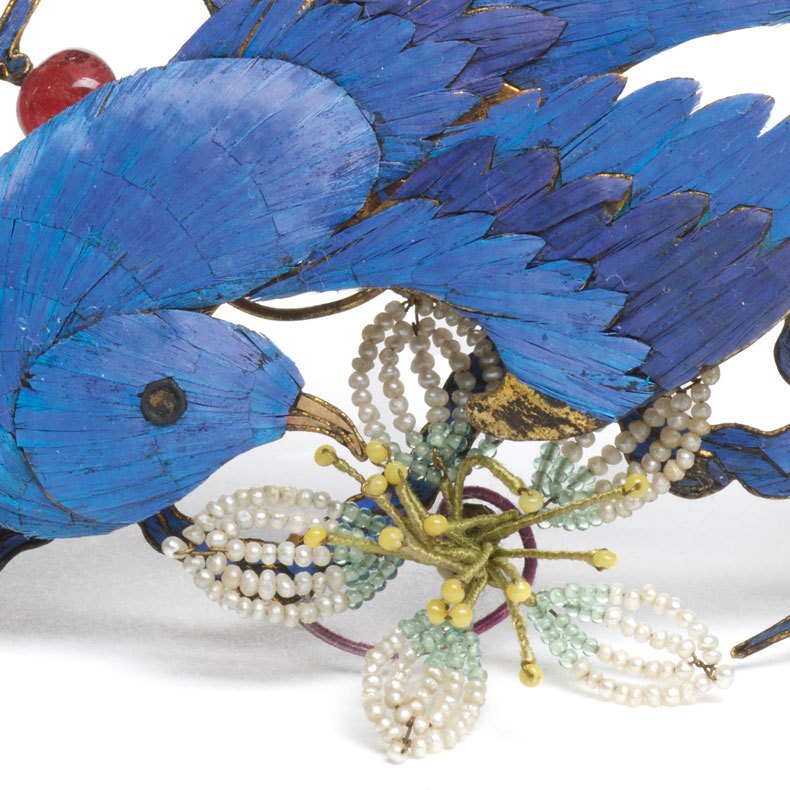
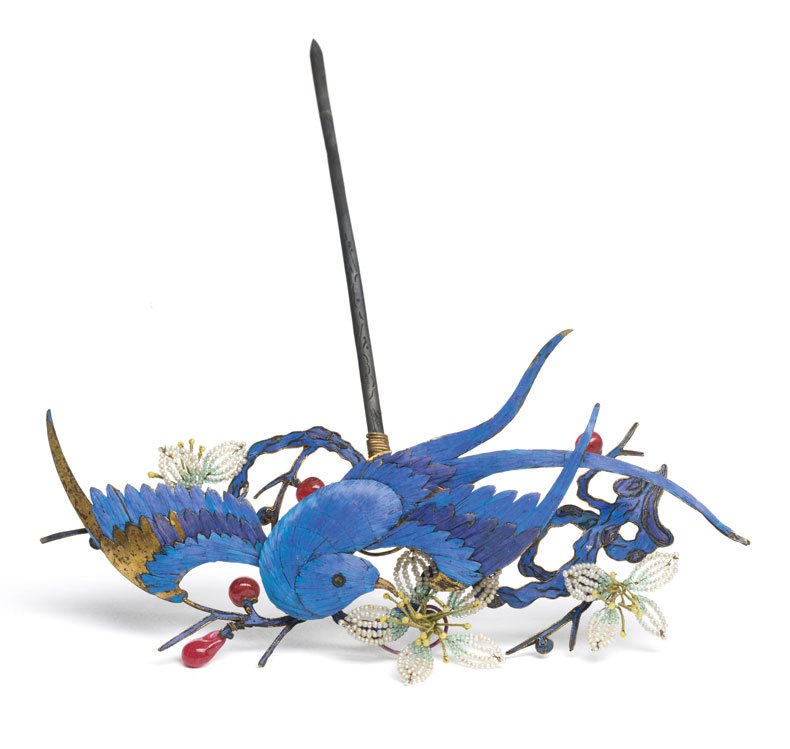
In 1907 he bought a number of works at an auction in New York of the collection of the late Auguste Chamot, a Swiss hotelier who had moved to Beijing in the late 19th century and made good money procuring provisions for besieged Europeans during the Boxer Rebellion of 1899–1901. Chamot had been a keen acquirer of Chinese decorative art, much of which had been looted by international forces during the suppression of the Rebellion. Among the items Walters purchased were two objects made with kingfisher feathers during Cixi’s reign. One was a headdress adorned with phoenixes that had supposedly been made for Cixi herself; the other was a hair ornament in the shape of a swallow, so fine in its conception and execution that it could have been made only for a woman in the upper echelons of Chinese society. Both are now owned by the institution that bears the name of father and son: the Walters Art Museum in Baltimore. (The Walters has not yet been able to determine how Chamot acquired these objects; its provenance research is ongoing.)
The Chinese had been using kingfisher feathers in hair ornaments and jewellery for some 2,500 years; such objects would often be found in the trousseau of an aristocratic bride. In Chinese poetry, goddesses and immortals wore dresses adorned with kingfisher feathers, tying the latter to divine feminine beauty – though the feathers carried darker connotations too. Many traditional Chinese stories told of young maidens wearing feathered garments who met tragic ends. This paralleled the fate of kingfishers themselves – creatures that were so beautiful that hunters were compelled to trap them.
In the decorative arts, kingfisher feathers were prized for their iridescence. The many variations of blue that they show off are a function of the very structure of the feathers and the way light reflects off them. They take on different hues depending on the angle of perception. And unlike with pigment, the colour itself never fades, even if the feathers themselves are easily destroyed. Kingfisher feathers signified both personal power and national might. The most sought-after feathers came from South East Asia, particularly Thailand, Vietnam, Laos and Cambodia – a region that China had not colonised but nonetheless dominated politically. The people living there had to send tribute to the Chinese court every year and kingfisher feathers were among the forms this levy took.
In the Chinese imagination, South East Asia was an exotic land of jungles and swamps – a notion perhaps reinforced by Chinese emissaries’ records of how kingfishers were caught in Cambodia. Trappers would camouflage themselves with leaves, branches and shrubbery and hide in a swamp to capture a female kingfisher. Once they’d caught one, they would use her to lure in a male – the feathers of male kingfishers were considered more lustrous. Some trappers plucked the feathers and released the bird; others killed the bird before plucking the feathers. Either way, the whole process was laborious. Sometimes trappers would catch nothing, even after hours of hiding in a slough.
The hair ornament itself would have been a team effort, made under one roof in an atmosphere of creative cross-fertilisation. First, a metalworker would have crafted a frame in the desired form – in this case, a swallow. Then came the cloisonné technique, perhaps courtesy of another artisan: the shaping of additional metal wires to create the outlines of the surface decoration. A feather-worker would have cut the kingfisher feathers to size and glued them on to the metal base, using the cloisonné outlines as a guide.
The swallow is perched on what is meant to be a plum blossom branch; you can see the cloisonné outlines creating knots, whorls and other bark effects. (What looks like a ravenous maw beneath the swallow’s left tail feathers is actually just the branch.) Plum blossom flowers symbolise perseverance and resilience, since they bloom in late winter, undaunted by frost; the flower is often grouped with pine and bamboo to make the ‘three friends of winter’, a symbol of steadfastness that has cropped up in much Chinese art over the centuries.
In this hair ornament, pearls make up the petals of the plum blossoms, the stamens are made of glass and the fruits themselves are rubies. Whereas pearls are indigenous to China and had been used in art and luxury goods for thousands of years, rubies had been imported via the Northern Silk Road from what is now Afghanistan and Pakistan since the third century.
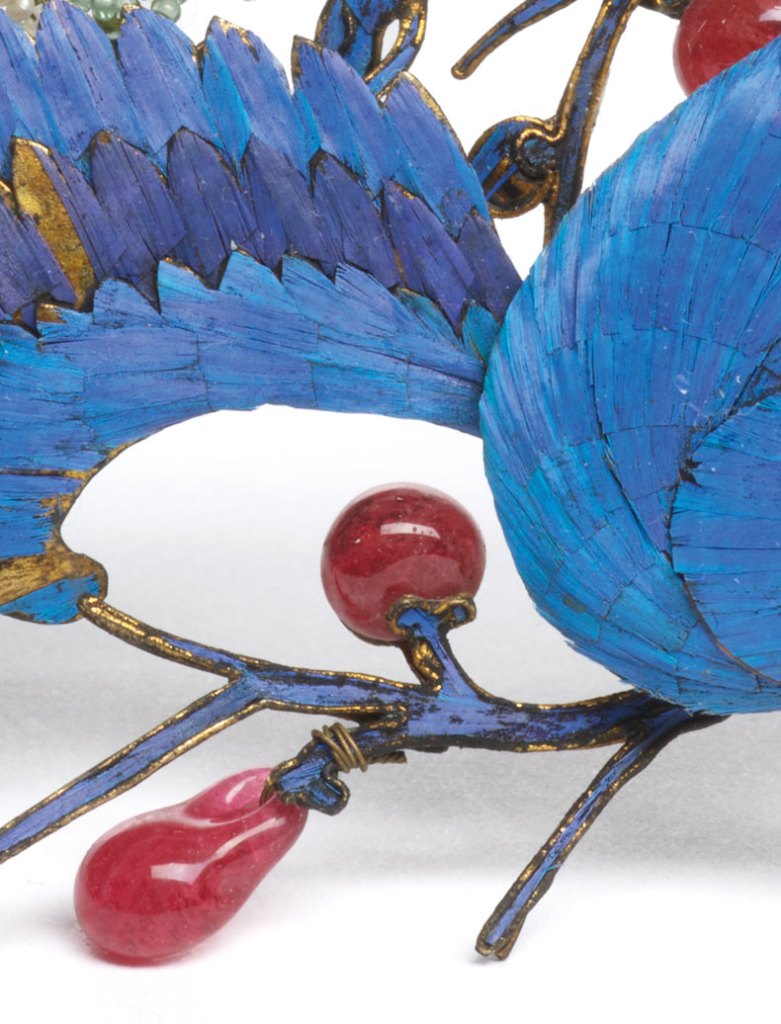
This particular hair ornament is in very good condition. There is some loss of feather in one of the wings, where the metal base shines through – though that does give the object some extra shine. In museum collections, ornaments made with kingfisher feathers almost always date from the 18th century or later, because of the material’s propensity to degrade.
These objects were made to be worn, so some wear and tear is to be expected. Indeed, the value of such ornaments was based in part on their fragility. And if the object started falling apart while still in use, wealthy patrons could always commission another one.
Imperial records contain the names of the supervisors overseeing the workshops that created such objects, but not the names of the artists and craftspeople themselves. We know that they would have been men who, as in Europe, learned their trade through apprenticeship. Most ambitious people in Qing-dynasty China would have wanted to join the literati: you would sit civil service exams, get a political appointment if you did well, and be set for life. Art and craft were alternative pathways for those who either could not afford to study for the exams or were not academically gifted enough.
But just because these craftspeople are nameless in the history books does not mean they weren’t extremely skilled. It is likely, given the refinement of the object, that it was made in the imperial court in Beijing, and only artisans who were at the top of their field were brought to work in the imperial workshops. (There is also a chance that it was made in Canton, a secondary hub of cloisonné objects.)
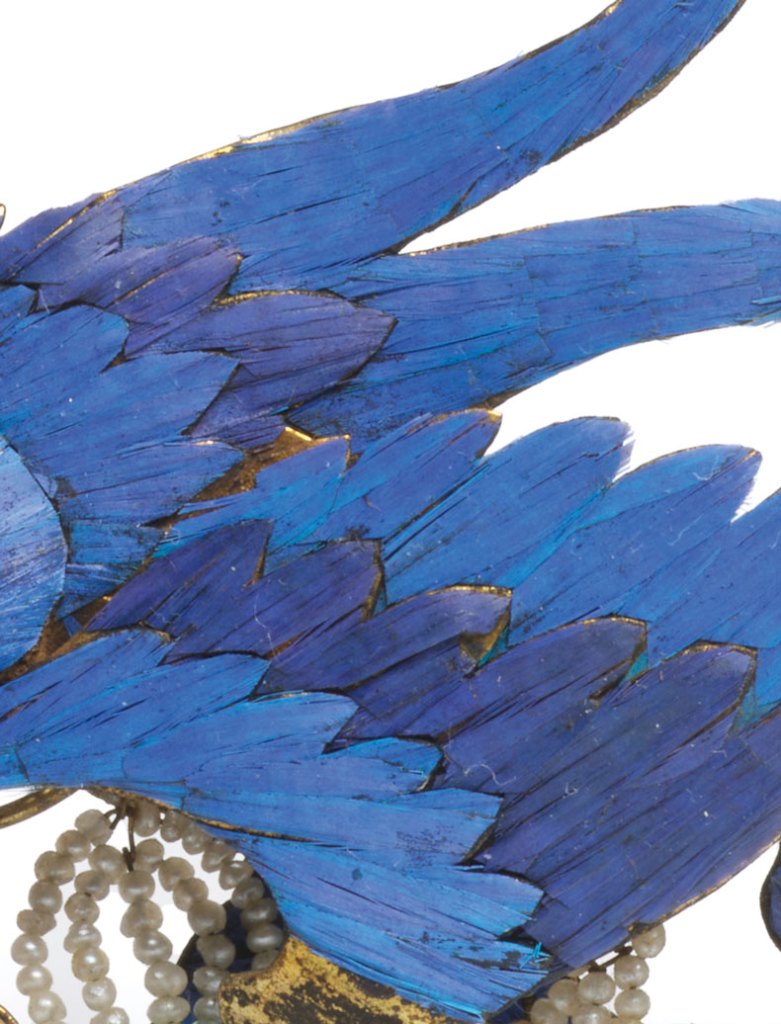
As well as being used for hair ornaments and headdresses, kingfisher feathers decorated objects of all sizes, from sceptres to skirts to folding screens and palanquins. One bird yielded only 20 feathers, so you can imagine how many would have been needed to make a palanquin. It’s hard to know how many kingfishers gave up their feathers even for this hair ornament: each feather had to be trimmed to fit the cloisonné design.
In any case, it’s unsurprising that by the early 20th century the kingfisher population had dwindled – partly due to trapping, but also due to humans razing their nesting grounds. The last studio specialising in kingfisher feather-work shut down in 1933; in 1989 the Chinese government classified various types of kingfisher as protected species. Still, kingfisher feathers hold a fascination even today. Earlier this year, at the New York premiere of The Drama, Zendaya wore an eye-catching dress designed by Daniel Roseberry that featured some 65,000 ‘kingfisher feathers’ made of silk. It took 8,000 hours to put together, but no birds were harmed in the making of this garment – and no one had to hide in a swamp.
As told to Arjun Sajip.
‘Luxury & Loss: Feather, Shell, Tusk, Horn’ is at the Walters Art Museum, Baltimore, from 7 November–24 January 2027.
From the November 2026 issue of Apollo.