From the February 2026 issue of Apollo. Preview and subscribe here.
The trope of Hungarian architects going west in the 1930s and introducing modernism to a conservative and sceptical Anglo-Saxon world is almost a cliché. It is the journey imagined in The Brutalist (2024) and the one made by Marcel Breuer, whose former Whitney Museum has recently reopened as Sotheby’s New York HQ. Meanwhile, Ernő Goldfinger and dozens of others had moved to London.
What is less commonly known, though, is the story of the Hungarian architect who took his brand of modernism east. That is the story of László Hudec, who in extraordinary circumstances came to build Asia’s first skyscraper and help define Shanghai’s identity as a modern cosmopolitan metropolis. Reality, as we so often see, can be more remarkable than fiction.
Born in 1893 in a city of the Austro-Hungarian empire then called Besztercebánya (now Banská Bystrica in Slovakia), László Hugyecz was the son of a successful Slovak-Hungarian construction contractor. As a teenager he worked on building sites getting experience of all the trades (apprenticing as bricklayer, mason and carpenter) and at 17 he enrolled in Budapest’s Technical University. At the outbreak of war in 1914 he joined the Austro-Hungarian army and found himself on the Russian front, where he was injured, his unit captured and sent to a prison camp in Siberia.
In the terrible conditions of the camp Hudec contracted typhoid and broke his leg, which in the spring of 1918 got him sent on to a Red Cross train for transfer back to Europe. When the train was halted for several weeks near Lake Baikal due to the outbreak of the Russian Civil War, he took the opportunity to escape, somehow managing to travel via Harbin to Shanghai. After a long run of bad luck he now found himself in exactly the right place: Shanghai was booming and in the process of turning itself into Asia’s 20th-century city par excellence.
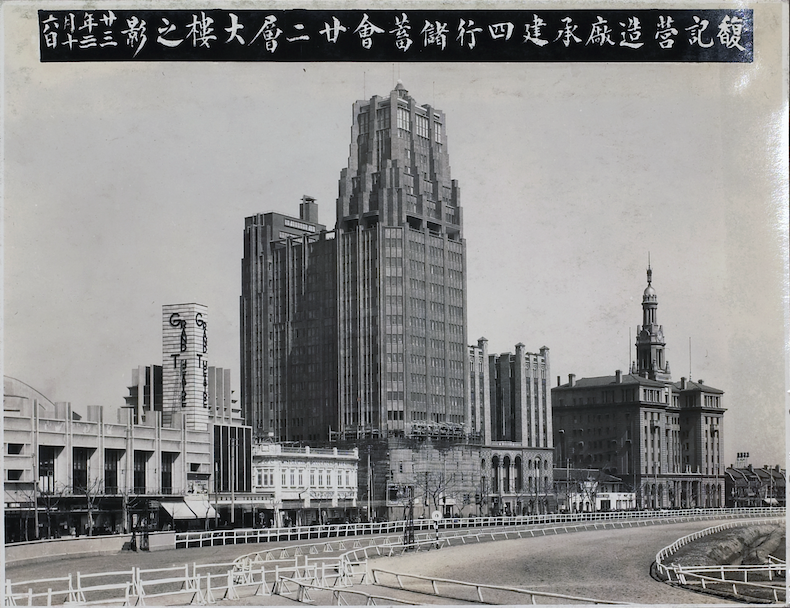
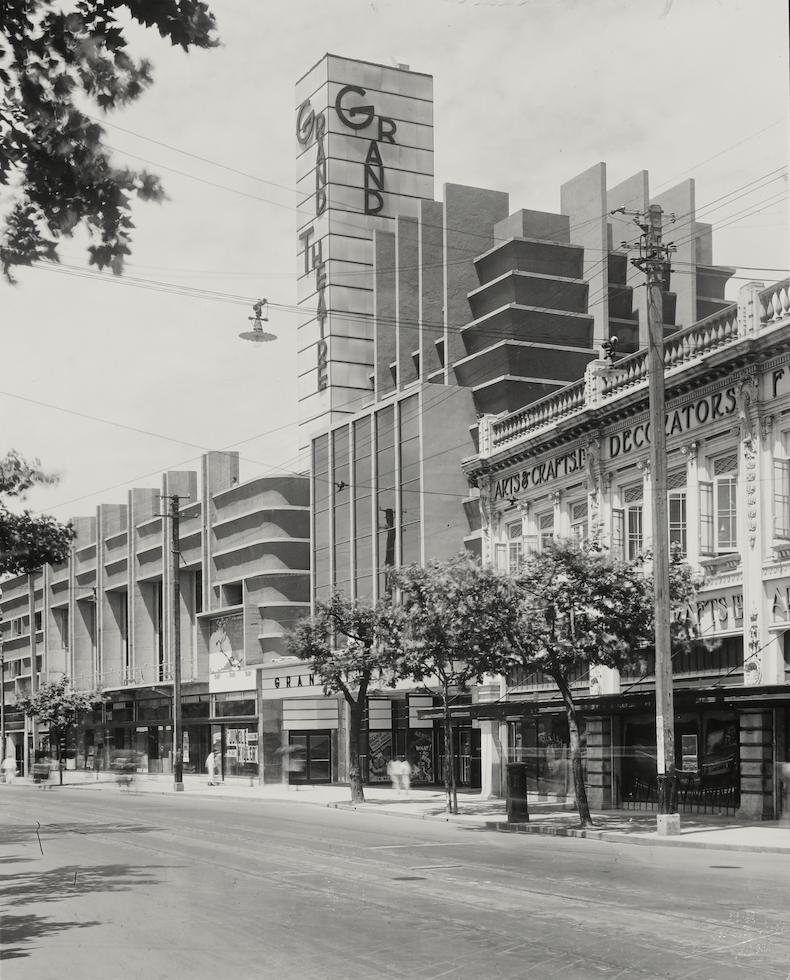
Hudec began by working for Rowland A. Curry, an American expat architect with whom in 1924 he designed the solid-brick, classical American Club and the Normandie Apartments (now Wukang Mansion), a terrific corner building with an almost Milanese feel. Then, in 1925, he set up under his own name and over the next decade would become the most influential architect in Shanghai. His China Baptist Publication Building of 1930–32 is a wonderful blast of German Expressionism in brick, still looking a little sinister. In 1933 he completed the art deco Grand Theatre, at the time the most modern cinema in Asia. Its seats featured individual earpieces so movie-goers could enjoy simultaneous translations of Hollywood movies. Its architecture was sleek and futuristic, its tower and fins lending it a slender verticality.
However, it was the building he completed the following year which really announced the arrival of Shanghai as a city of modern architecture. The Park Hotel, a corner block topped with a tapering crown, blends New York’s ziggurat skyscrapers and Hamburg’s dark-brick sculptural Expressionism; a striking 22-storey tower overlooking Shanghai’s racecourse, it was the tallest building in Asia until 1963, and the tallest in Shanghai for another two decades after that. I.M. Pei suggested, as reported in Carter Wiseman’s monograph on the Chinese-American architect (1990), that it was the experience of being confronted by this building on exiting Hudec’s Grand Theatre that inspired Pei to choose the field he chose. The hotel’s interiors, once clad in black marble, have been much messed about with and the roof garden is long gone; but the building remains one of the most memorable landmarks of this cosmopolitan moment when Shanghai absorbed influences from across the world to create an enduring modernist symbol.
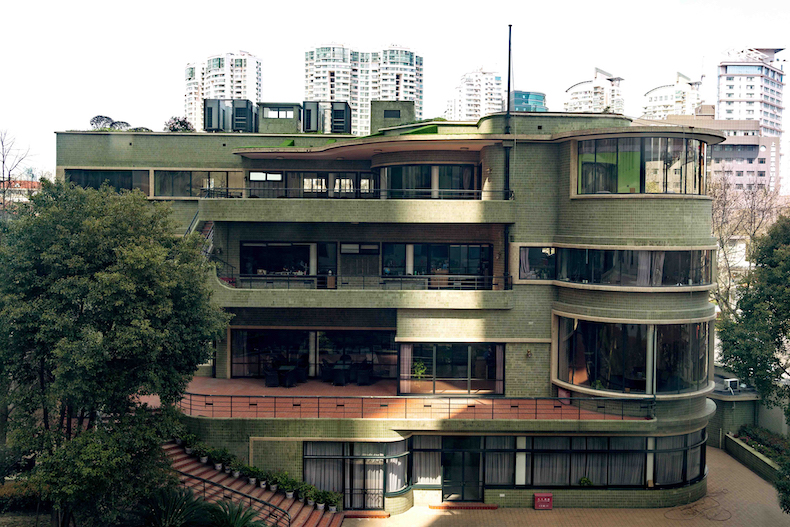
Hudec went on to create a template for modern Shanghai, blending elements of Expressionism, streamline moderne, Viennese-style modernism and art deco with hints of something darker, something between Fritz Lang’s Metropolis and DC Comics’ Gotham City. His Green House of 1938 for paint magnate Wu Tongwen shows a little of all these, a brilliant blend of Berlin, Vienna and Los Angeles with just an occasional hint of something Chinese appearing in the decorative touches but without resorting to condescending chinoiserie. By the late 1930s he was planning huge structures, visionary schemes which would have shifted the city’s urbanism up a gear – but the threat of imminent war stymied investment and almost none were realised.
In 1938, Czechoslovakia – which had absorbed Hudec’s home town after the collapse of the Austro-Hungarian empire – ceased to exist under the terms of the Munich Agreement and Hudec was suddenly stateless. He applied for and obtained a Hungarian passport and in 1942 was made Honorary Consul of Hungary to Shanghai. Thousands of Jews had arrived in the port fleeing Nazi (and Soviet) persecution and Hudec employed many of them in his consulate, arranged passports for others wherever he could and tried to keep Hungarian citizens out of Shanghai’s Jewish ghetto, which had been established by the Japanese in 1941. Hudec’s diplomacy was assisted by his facility with languages, of which he spoke nine (none of them, incidentally, Chinese).
After the war the imminent victory of the Communists looked set to destroy Shanghai’s cosmopolitan richness and Hudec departed with his family in 1947, first for Europe and then California, where he spent a few years teaching at Berkeley. He never returned to Shanghai and died in 1958, having requested to be buried in Banská Bystrica. For an architect who brought modernism to China’s largest city, his burial place is austerely classical, a stone framed by two stripped columns and a pair of attenuated urns. His name is inscribed in Hungarian. Shanghai is not mentioned.
From the February 2026 issue of Apollo. Preview and subscribe here.