From the November 2026 issue of Apollo.
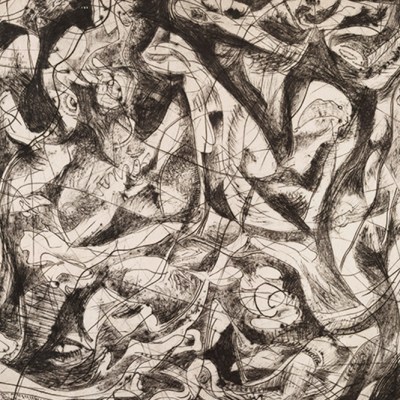
The tangled, drippy messes of Jackson Pollock offer no easy entry points: your only option is to pick a spot and start staring. There are few ways out, either. In Number 28, 1950 – from around the time Pollock tired of finding poetic titles like Lavender Mist for his abstractions and started numbering them – your eye will follow the spindly black lines across puddles of silver and splashes of white, nearly brushing up against the canvas edge but never quite escaping. Something similar can be said for the paintings of Lee Krasner. They lure in and envelop the viewer. What begins as a pleasant semi-abstract landscape slowly becomes more foreboding – when you notice that the nice pink actually looks like dried blood and those triangles you thought were leaves blend together at a dizzying speed.
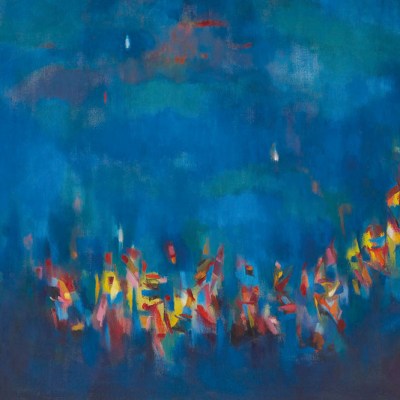
The rapid, almost violent overwhelm of the couple’s best works is essential to their success. But that immediate effect took years of trial and error to achieve. ‘Krasner and Pollock: Past Continuous’ at the Met tells the story of how its subjects worked with and against each other to get there. The show starts shortly before the two painters met, when they were each working through the styles of their teachers, on the way to finding their own. Krasner’s early abstractions, made under the tutelage of the colour theorist Hans Hofmann, want to be exercises in pure chroma but are still constrained by a commitment to reality. In one small work on paper, there is the faint shape of a bottle in a tower of maroon, a spoon of lime green and a napkin of thick spam pink. Krasner attempts to isolate colour itself but doesn’t yet have the confidence to jettison everything else.
Pollock spent years working through the influence of the Mexican muralists and of his teacher, the American regionalist painter Thomas Hart Benton. It’s ironic that Pollock, the personification of the avant-garde, took notes from such populist artists, but the connection to his later abstractions is clear. In Naked Man with Knife (c. 1938–40), Pollock foreshadows a loosening sense of gesture: the swirling knot of an ankle flows into the musculature of the calf, then into the thighs and buttocks, in a single stream of energy.
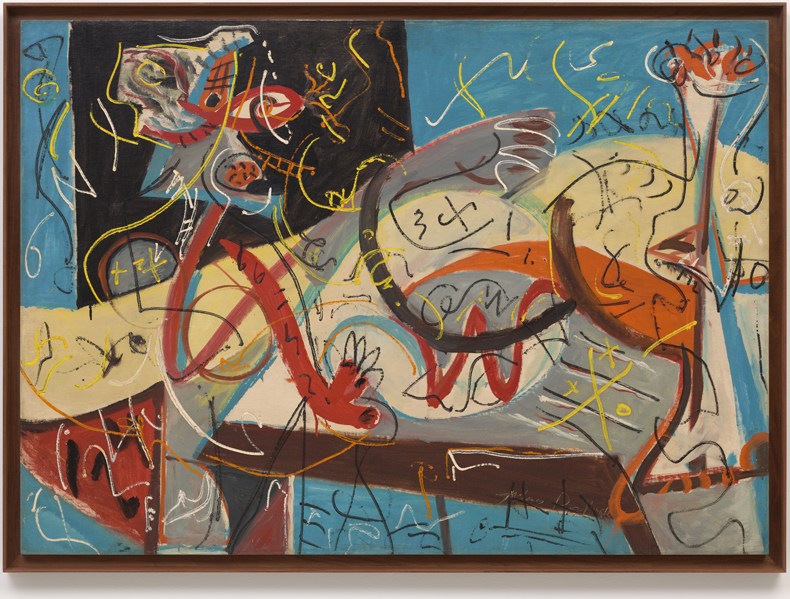
In the early 1940s, Krasner and Pollock started to commit to directions that were uniquely their own. Pollock abandoned any concern for perspective and depth. If looking into a painting is like looking through a window, it is at this point that he starts to draw on the glass. In Stenographic Figure (c. 1942) he paints what seems to be an abstracted still life in the background – a form resembling a table or a piano – and then scribbles mathematical symbols and faces in the foreground in yellow and white as if they are hovering just above the surface of the painting. Krasner, dissatisfied with experiments in abstraction that resulted in muddied grey piles of paint, destroyed most of her work from this period.
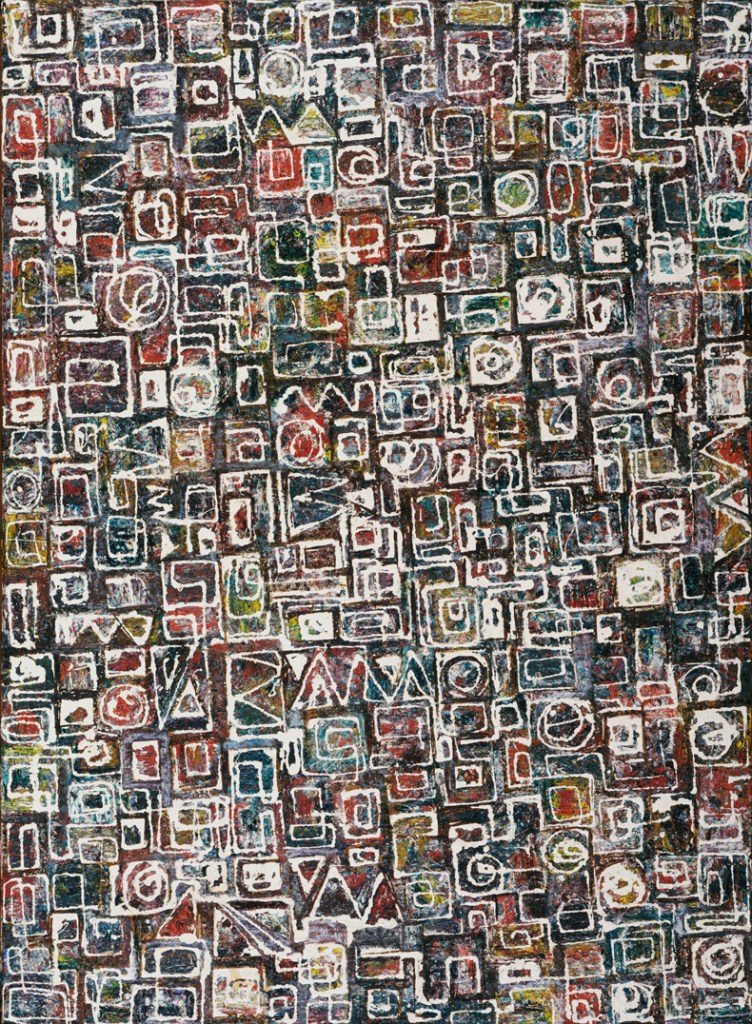
Shortly after the couple married in 1945, they left New York City for Long Island, eventually settling on a property where Krasner painted in the house’s attic and Pollock used the barn. During this time, their work shows evidence of cross-pollination. They both experimented in ‘all over’ painting – covering canvases with an equal amount of activity in every square inch – with varying degrees of success. Krasner’s Composition (1949) succeeds in animating every cell of a matrix with a little rune-like figure, but there’s no flow of motion across the canvas. Every symbol spirals into itself without giving the eye a reason to travel onwards. Pollock, by contrast, found immediate rhythm in the chaos. He did this often by foregrounding a single colour. In Number 13A, 1948: Arabesque, for example, a drizzle of white darts across a jumble of black and grey.
After 1950, Pollock started working big, on canvases up to six metres long. He scrapped almost every traditional expectation of painting: no easels (he painted on the floor); no brushes (he threw the paint); no subject. No one colour rises above the rest. These paintings could be battles or ballets. Some drips seem to dance, jumping and twirling with glee, but others look like bullet holes and some splashes nearly explode. In Convergence: Number 10, 1952, the taut balance of colours creates a lively tension – a macabre black, soaked into the fibre of the canvas, contrasts with glossy pools that tug the eye in and out of the picture.
Despite their troubled marriage, Krasner’s work was always secondary to promoting her husband’s while he was alive. But after Pollock died in a car crash, with his mistress the only surviving passenger, Krasner moved into the barn and her paintings grew, in every sense. She started painting with her whole arm, pivoting at the shoulder and swiping forms taller than herself across the canvas.
The Seasons (1957) reads as nearly the exact opposite of Pollock’s late style. She clearly painted upright (paint drips downwards) and she used her brush aggressively, pressing it all the way down until the bristles splayed outwards. The paint is dry, compared to Pollock’s wet splatters, at points appearing as if she applied powdered pigment directly. Combat (1965) is simultaneously floral and ferocious. Spirals of fuchsia look like the twisting petals of a rose. Accented by anxious pockets of orange, the whole picture looks gory.
Krasner went on to produce her greatest work after Pollock’s death; who knows what Pollock might have accomplished. Towards the end he started to move away from the drips, suggesting he had new directions in mind. But maybe it would have been Krasner’s turn either way. The exhibition’s argument – that both artists had been incubating their mature styles long before they met, and that their marriage was as challenging as it was inspiring – is convincing. Would there have been enough room for both of them to create mythic, monumental work at the same time? Maybe it’s better not to know. What we have is plenty.
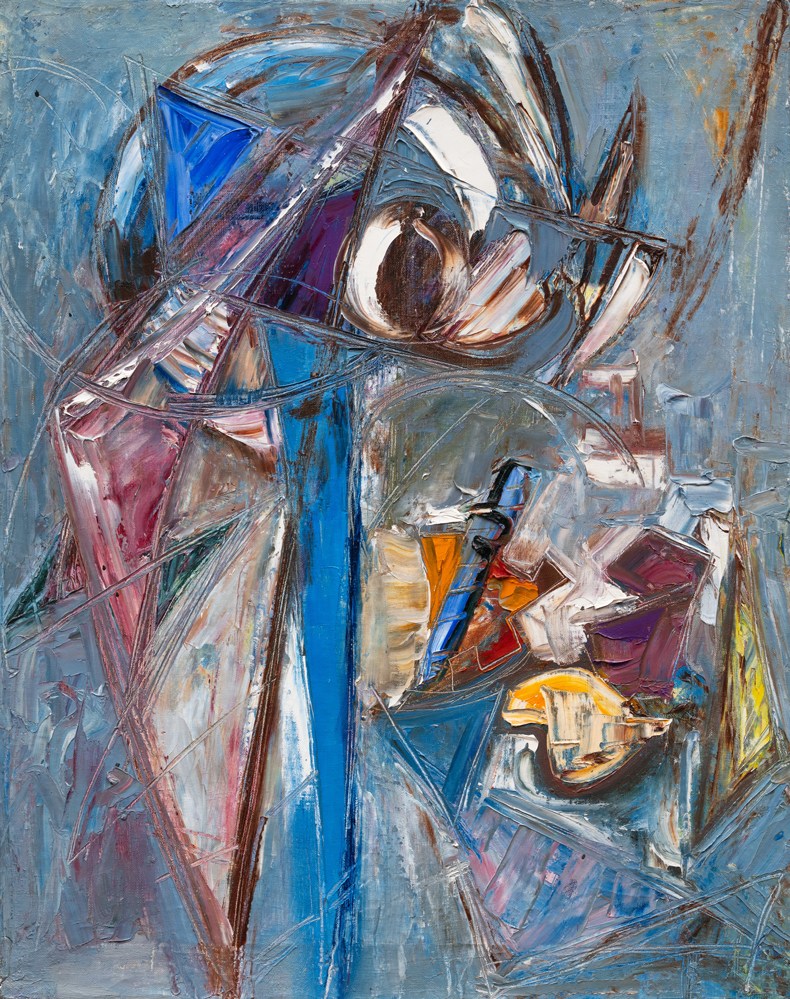
‘Krasner and Pollock: Past Continuous’ is at the Metropolitan Museum of Art, New York, until 31 January 2027.
From the November 2026 issue of Apollo.