There are thought to be fewer than 500 Benedictine monks and nuns left in the UK, scattered across a handful of Catholic and Church of England monasteries. It’s a number that would have been inconceivable in the High Middle Ages, when by some estimates the cloistered religious accounted for as much as one per cent of the total population.
Benedictine monks and nuns take their name from the Rule of Saint Benedict, a sixth-century guide for managing religious lives. The Benedictines were the most numerous order in pre-Reformation Europe; they owned land, built grand cathedrals and commissioned ornate manuscripts. Their rule was strict – they took vows of poverty and stability, promising to remain in one community for the duration of their life – but with some flexibility. Saint Benedict was famous for his provision that half a bottle of wine a day should be sufficient for each monk or nun.
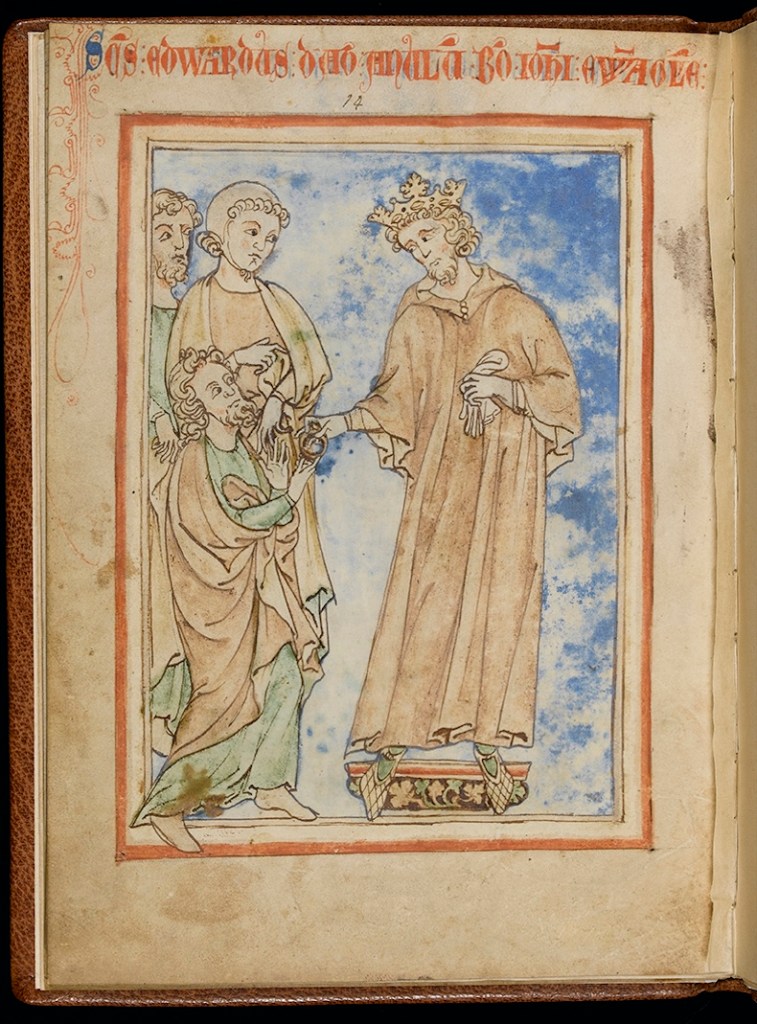
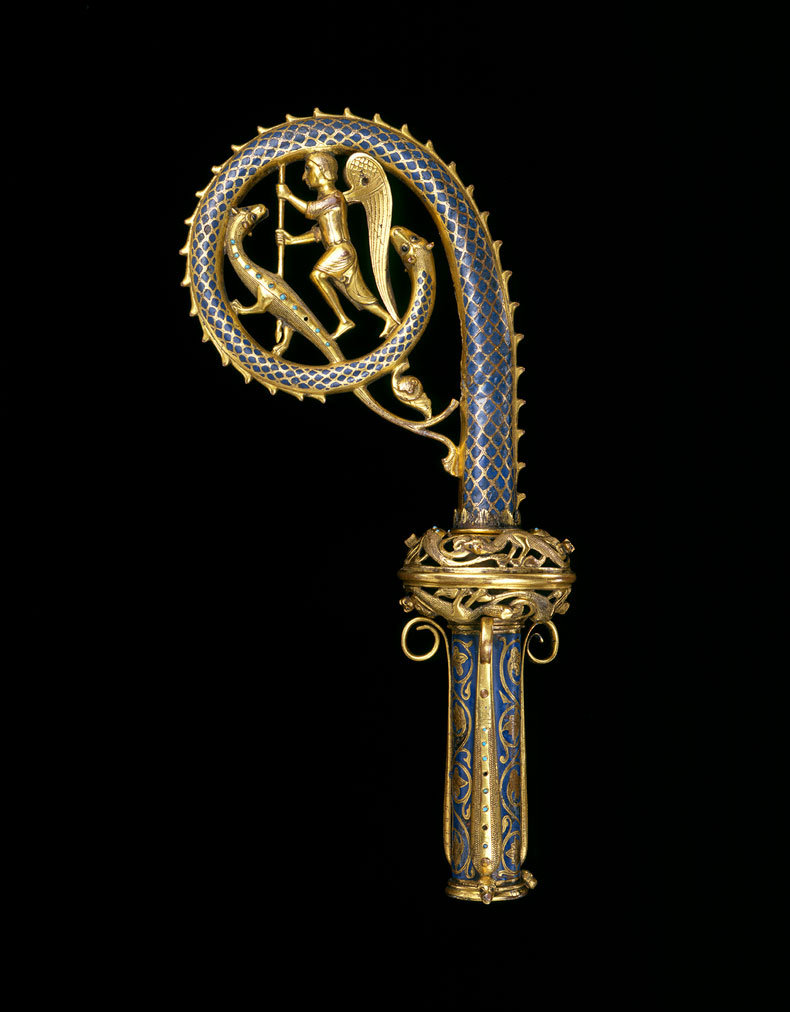
It is difficult to imagine how an entire exhibition could be dedicated to one monastic order’s guiding regulations, but the Sainsbury Centre’s excellent, expansive show ‘Living by the Rule’ moves beyond the letter of the law (here immortalised in the earliest extant copy of the Rule, the Hatton Codex, written in uncial script at the turn of the eighth century) to explore what it means to live with obedience and be moulded by external constraints. Ornate croziers carried by abbots are displayed alongside nuns’ gold rings; archival documents chiding monks for wearing ‘slippers tied with red silk bows’ are paired with wooden mazers for drinking ale. There are also contemporary works in the exhibition, including prints by Tacita Dean and pinhole photographs by Elizabeth Price. One of the medieval misericords that appears in archival footage in Price’s Turner Prize-winning film, The Woolworths Choir of 1979 (2012), is displayed near her video installation.
The show features major loans – including three gloriously ornate, enigmatic psalters created in Norwich in the 14th century that have not been together since the Reformation. One spectacular loan is the San Zeno ‘calendar disk’: a huge timekeeping device from the 15th century with painted plates that rotate when a handle is turned. With disks showing the lunar calendar and other astronomical data, it allowed monks to calculate the dates of Easter and other moveable feasts.
The very fact that these artefacts have survived into the 21st century is worth marvelling at. In the opening room of the exhibition there is a small wooden sculpture of a Benedictine monk, just over a foot tall. At its centre there is a heart-shaped void – a space for a jewel or glass heart that has been lost in the intervening centuries. But the fact that we have this sculpture at all is a minor miracle: it was dredged from the Thames in the 19th century during the construction of London’s sewage system and was saved only by the efforts of a keen amateur collector and archaeologist.
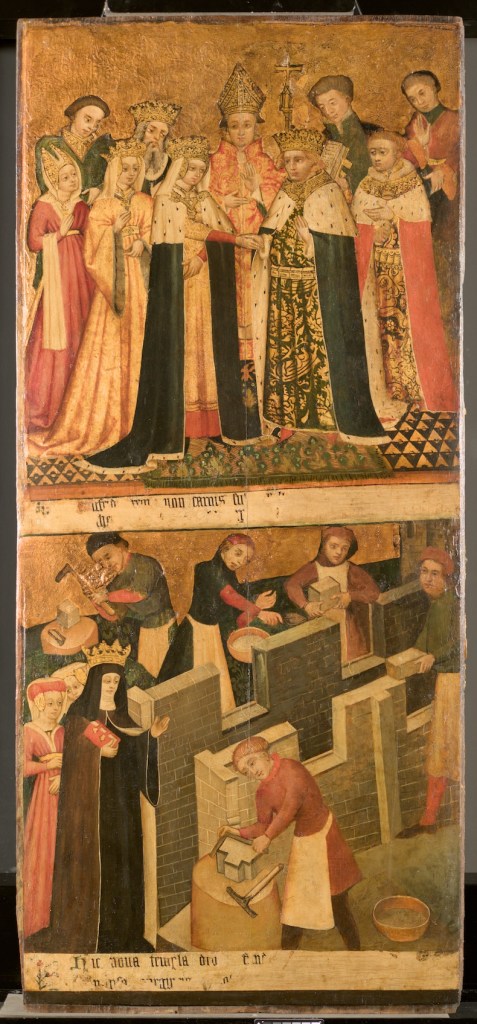
There are other serendipitous survivals. The Etheldreda Panels, shown in a section of the exhibition focusing on obedience, spent the years of the Reformation – and until the late 18th century – being hidden and reused as cupboard doors. A vanishingly rare example of medieval painting that survived the early modern period’s paroxysms of iconoclasm, the panels show scenes from the life of the Old English saint Etheldreda: her marriage to Egfrith, King of Northumbria, her disobedience of her husband as she turned to the spiritual life, her building of a convent, and her entombment in a marble coffin. The partial inscription below the images stresses the fact that she remained a virgin throughout her married years. Likely created for Ely Cathedral, of which Etheldreda is the patron saint, the panels have been subject to extensive conservation work undertaken for the exhibition. The previously dark background has been revealed to be pure gold – and would originally have been covered by bright blue azurite.
At the heart of this exhibition is a question: what does it mean to live a life defined by rules? Do these limitations in fact lead to a kind of freedom? Some artefacts lay the constrictions of the religious life bare: there are breviaries and prayer books for each day’s ordered hours of praying and devices to measure shadows to ensure that services happen at the right time. There are records of monks being disciplined and instructions for the sign language they could use when they weren’t allowed to speak. But other constraints are rather more oblique and less clearly demonstrated in archival sources. What does it mean to live a life where individual agency has been subsumed into the rhythms of a community and structure? To live a life with one eye continually on the world to come?
It is in response to these questions that the exhibition’s impressive array of contemporary works comes to the fore. Huge tapestries by Susan Morris record years of the artist measuring her sunlight exposure or waking hours. The final geometric works reveal a modern life just as regulated as those of her medieval counterparts; each rectangular stitch is redolent of a convent’s narrow room. Large woodcuts by Andrea Büttner – of dancing nuns, a beggar and Giotto’s depiction of Saint Francis of Assisi’s table – condense and distil religious imagery until the resulting works seem to resemble contemporary icons. Perhaps the most evocative pieces here are Alison Turnbull’s ghostly architectural drawings of religious buildings, made in the late 1990s. Her bird’s-eye views of chapels, abbeys and a monastery that didn’t survive the Reformation glow in muted tones on pale backgrounds. Here is a spiritual substrate, a structure unearthed by archaeology, that is present beneath contemporary life. Perhaps we haven’t lost as much as we might think.
‘Living by the Rule: Contemporary meets Medieval’ is at the Sainsbury Centre, Norwich, until 4 October.