From the May 2026 issue of Apollo.
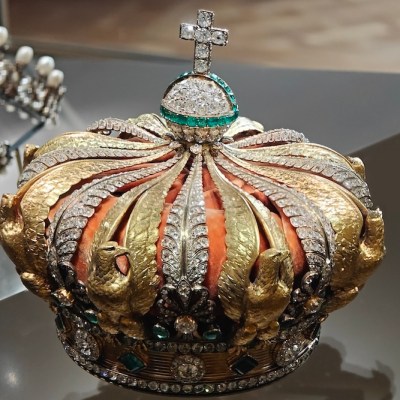
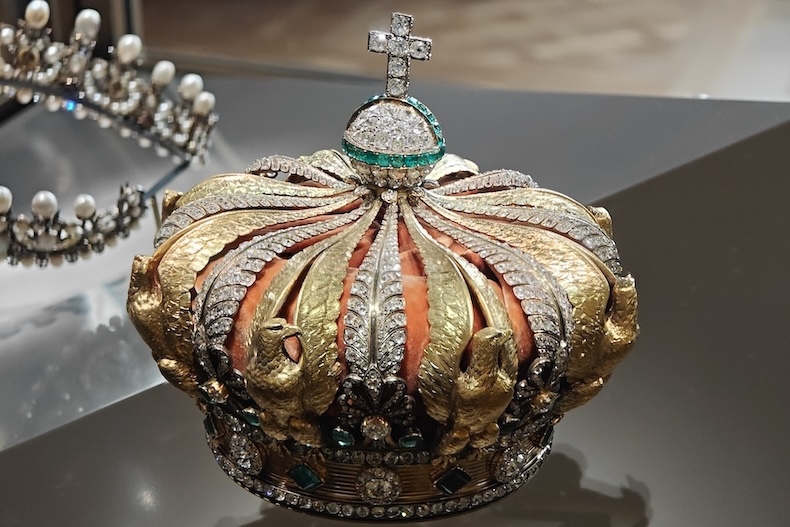
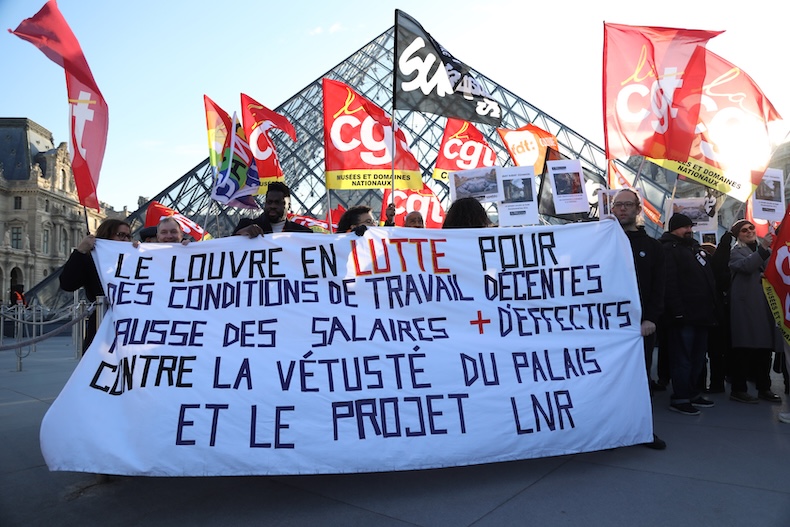
The French media calls it a série noire, a series of unfortunate events. After the theft of some of the French crown jewels in October, the Louvre has remained in the headlines for all the wrong reasons. The building has suffered structural leaks, endangering artworks; staff have gone on strike demanding increases in staffing and urgent repairs; and, in February, police arrested members of a suspected ticket fraud scheme worth €10m. The same month, the Louvre’s director, Laurence des Cars, resigned after a parliamentary inquiry criticised her leadership and described the institution as a ‘state within a state’.
Staff representatives of the CFE-CGC union, which represents managerial and professional workers, were distressed by the heist and the debacle that followed. Asking to remain anonymous and writing by email, several told me that the Louvre’s difficulties have been ‘weaponised for political battles’ and that the media ‘fed the frenzy’. But some saw an upside nonetheless: ‘While it was painful to see the Louvre lose its prestige, this series of revelations at least had the advantage of alerting the public to the fact that the Louvre is in a bad way,’ said one. Problems stretching back a decade or more have left ‘buildings, collections and workers in a pitiful state’.
This might come as a surprise, given that the Louvre is the world’s most visited museum, with more than nine million visitors a year – most of them paying customers. The Louvre has charged an entrance fee for more than a century, but over the last 25 years ticket prices have risen from €7 to €22 and, since January, to €32 for non-EU visitors. It’s a sign, says the art historian Sophie Cras, of how the museum’s priorities have shifted. ‘In the 19th century, a public museum had to be at the service of the nation,’ she says. ‘A modern nation was a nation of educated citizens. Access to big museums was to be, as much as possible, free. Today, a museum like the Louvre contributes to the country’s economy and to French capitalism, via its contribution to tourism.’
The revenue this brings in is a mixed blessing. ‘Due to the enormous number of visitors, ticket sales have given the Louvre’s directors a lot of independence, via money that can be used for big projects,’ says the museologist and former museum director François Mairesse. But that has come at the expense of other demands. Recent investment at the Louvre ‘has given priority to works that are meant to attract rather than consolidate’, Mairesse says. ‘As for the media, when they assess the legacy of a museum director, they value acquisitions which increase the museum collections, works allowing for a museum to expand, rather than, say, the enlargement of the storehouse or all the invisible work that goes into maintaining a building.’ The museum’s internal culture has changed too, according to insiders. Recent directors have ‘allowed in-depth projects and long-term investments to drag on, and concentrated their energy on visible, immediate, high-impact projects conveying their vision’, says one staff member.
According to the CFE-CGC union’s figures, management staff numbers increased by 43 per cent between 2018 and 2024, ‘creating a small circle of courtiers that isolated the directors from the rest of the staff’. Louvre directors don’t last long in the job these days: they can serve a maximum term of 15 years, but des Cars lasted just five. Her predecessor, Jean-Luc Martinez, who left amid an investigation into the possible trafficking of antiquities, was in post for eight.
The departure – or arrival – of a director is highly political. When des Cars resigned, it was President Macron himself who announced her replacement, the former Palace of Versailles director Christophe Leribault. As Mairesse says, ‘In France, there is this very strong link between political power and [national] museums.’ Presidents have a fondness for reshaping cultural institutions, or creating new ones, to cement their legacy.
Valéry Giscard d’Estaing, for instance, bequeathed the Musée d’Orsay, the Cité des Sciences et de l’Industrie and the Institut du Monde Arabe. Jacques Chirac had the Musée du quai Branly to his name.
Mairesse points out that the Louvre – founded in 1793 by France’s revolutionary government in a former royal palace to display confiscated aristocratic property – is also partly a modern presidential scheme. It was François Mitterrand who initiated its renovation in 1981 with the decade-long Grand Louvre project whose centrepiece was I.M. Pei’s glass pyramid. Macron, too, had his own ambitions. In early 2025, des Cars and the president announced the grandly titled Nouvelle Renaissance scheme, which aims to create a new entrance at the Colonnade facade on the eastern edge of the complex and a dedicated underground space in which to exhibit the Mona Lisa.
Mitterrand’s project left many questions about the Louvre’s future unanswered. ‘The Grand Louvre works allowed the museum to enter the modern era but they stopped halfway, doing very little for the Sully and Denon wings, which are currently in a state of complete obsolescence,’ says one union representative. ‘And the culture ministry, deeming it had done enough for the Louvre, took a hands-off role after that.’ In the 1990s the Louvre, like other major museums, was given greater autonomy (which was further enhanced in 2003), but it lost much in state subsidies as a result. Today, half its budget comes from the Louvre’s own revenue.
These changes allowed the Louvre’s directors to reshape the museum – which, says Mairesse, wasn’t necessarily what the government intended. Henri Loyrette, director from 2001–2013, ‘entirely transformed’ the Louvre as his power grew. A satellite museum was opened in Lens, northern France, on the site of a former coalfield. International partnerships, including Louvre Abu Dhabi (which Loyrette initially opposed) became the order of the day. ‘Loyrette was invited abroad more often than the culture minister,’ Mairesse says.
Despite this greater autonomy, however, the government retains control over who occupies the top job – as it does with other major cultural institutions. Susana Gállego Cuesta, head of the smaller Musée des Beaux-Arts in Nancy in the north-east of France, says that the heads of major institutions are ‘entirely dependent on the orders of the French president’. Leribault, a respected art historian, was at Versailles for less than two years; before that, he had been plucked from a project to overhaul the Orsay. ‘He is told to go to the Louvre and he has to go,’ says Gállego Cuesta. ‘That’s not great autonomy, is it?’
For some of the Louvre’s staff, this relationship is part of the problem. ‘Henri Loyrette, then [his successor] Jean-Luc Martinez, then Laurence des Cars – they all made the same mistakes. They became obsessed with currying favour from the Elysée and courting the press. Everything became a PR exercise,’ says one union rep.
Gállego Cuesta emphasises how much strain the need to keep visitor numbers up can place on a museum: ‘Over the last years everything has been done so the Louvre can get back to the number of visitors they had pre-Covid: 10 million. But 10 million visitors at an institution that was last renovated in the 1980s, and whose older parts date from the Renaissance, is monstrous and creates a huge problem of wear and tear.’
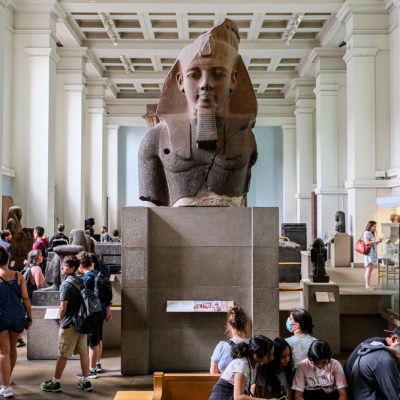
The real challenges are incredibly mundane. ‘Think of the toilets,’ Gállego Cuesta says. ‘The small toilets behind the panelling in the Egyptian antiquities section are now mobbed by crowds, so they’re often broken. Pipes are exploding, there are leaks – which means it’s already too late and the building is in need of major repairs. Bits and bobs are broken in the cloakroom. But none of these things are glamorous, so maintenance is always postponed.’
Nevertheless, the big announcements have kept coming. Under Martinez, the Louvre opened a vast wing dedicated to Islamic art, while the Greek, Etruscan and Roman galleries have all been renovated since 2010. A new department of Byzantine and Eastern Christian art is to open in 2027–28. Nor is the Louvre the only museum in Paris with grand ambitions. ‘In September, the Picasso Museum announced that it was launching a €50 million expansion project,’ Gállego Cuesta says. ‘This makes me want to say: guys, no one has any money, particularly outside of Paris. You’re all announcing crazy schemes. It’s just for political clout.’
There seems to be a consensus among the people I speak to that the priorities defined by the Louvre’s last director might not be sustainable. Opening up the Colonnade, which looks towards the centre of Paris, would certainly ease pressure on the existing, cramped entrance in the central courtyard. But some observers doubt the viability of the current plans. ‘The idea to open the Louvre to the city, so that people can enter without using the pyramid, is really interesting,’ says Marie-Alix Molinié-Andlauer, a cultural geographer whose research focuses on the Louvre. ‘But exhibiting the Mona Lisa, the Louvre’s most precious painting, in an area at risk of flooding? And digging at the Louvre? Archaeologists would have a field day. It would take at least 10 years.’ She believes the eventual costs would be around four times the proposed amount.
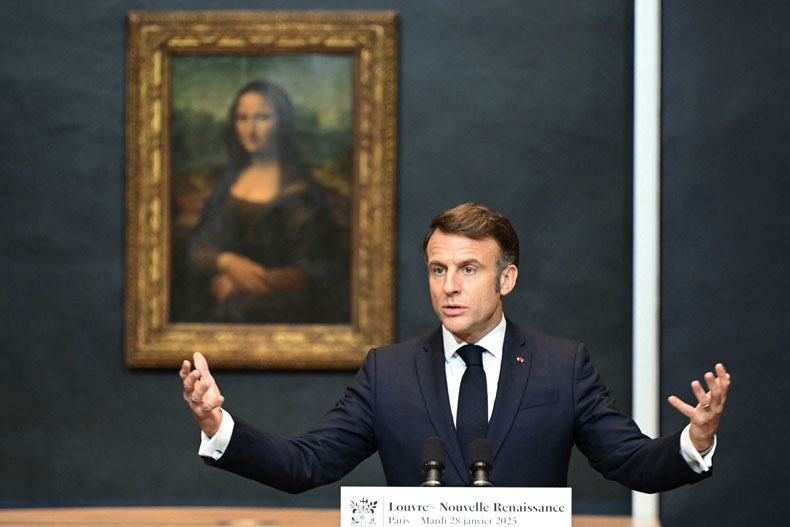
In fact, the Nouvelle Renaissance scheme, whose cost was originally estimated at €700–800m, has already stalled. The museum has indefinitely postponed the announcement of the winning architectural design, while culture minister Catherine Pégard recently said that the plans would need to be ‘adjusted’ to better integrate security measures and budgetary constraints. What’s more, the project as currently conceived relies on political stability and a steady increase in visitors. The first condition doesn’t exist – Macron’s chronically unstable second term will end in May 2027 – and the second is of questionable benefit. ‘I think that the type of cultural consumption that is being envisioned only leads to disaster. Prolonging that exponential curve is entirely unsustainable,’ Cras says.
Lovers of the museum hope that Leribault will concentrate on the less glamorous but more urgent work and improve relationships with staff. Many hope that the project to create a dedicated space for the Mona Lisa – which Gállego Cuesta describes as ‘disneyfication’ – won’t go ahead. Union representatives hope to see more counterweights to the Louvre’s management: from the culture ministry and, within the Louvre, from curators and the museum’s board of directors. For the time being, the staff I talk to also have simple, yet important, objectives: for the Louvre to be able to protect the artworks it is responsible for, to have proper air conditioning and for access to the museum – which one staff member describes as ‘discouraging, stressful and intimidating’ – to take less than 20 minutes. ‘These goals might seem humble but, bearing in mind what the Louvre is like today,’ the staff member says, ‘they’re more like climbing Everest.’
From the May 2026 issue of Apollo.