
Say the word ‘Limoges’ and most people might conjure up images of glorious medieval reliquary caskets, eucharistic doves, croziers or book covers, all sumptuously decorated with jewel-coloured enamels against gleaming gilt or copper grounds. But what of the second, even greater period of Limoges’s renown as a producer of enamelled objects? This is the focus of Galerie Kugel’s spectacular exhibition and accompanying scholarly catalogue on the golden age of French Renaissance enamels: 1520–1630. In this period, the medieval champlevé method of firing ground coloured glass on to troughs or cells made in copper was replaced by a new technique inspired by Parisian and Burgundian goldsmiths. Here, translucent glass paste coloured by metal oxides was painted on to the copper surface before successive firings fused them into glinting permanence. Like their antecedents, these plaques and vessels are immarcescible – unfading and enduring.
Mythological and secular scenes and portraits prevailed, and the brilliance of blues and greens became less dominant than the grisaille or monochrome enamels, where black-and-white was enhanced by subtle flesh tones and softer hues, often with gold highlights. These combine detailed figural scenes with often fantastical ornament, their compositions – like those of Italian maiolica – derived from prints. Limoges’s great makers and dynastic workshops are well represented here, but it is the collectors who take centre stage – kings, princes, plutocrats, connoisseurs and adventurers. Testimony to the value that these works of art were often accorded is that in 1916, the prominent American collector Henry Clay Frick paid more for J.P. Morgan’s 40 Limoges enamels – $1,157,500 – than for any other purchase he ever made, save Fragonard’s Progress of Love series. Bellini’s masterpiece Saint Francis in the Desert cost him a mere $170,000.
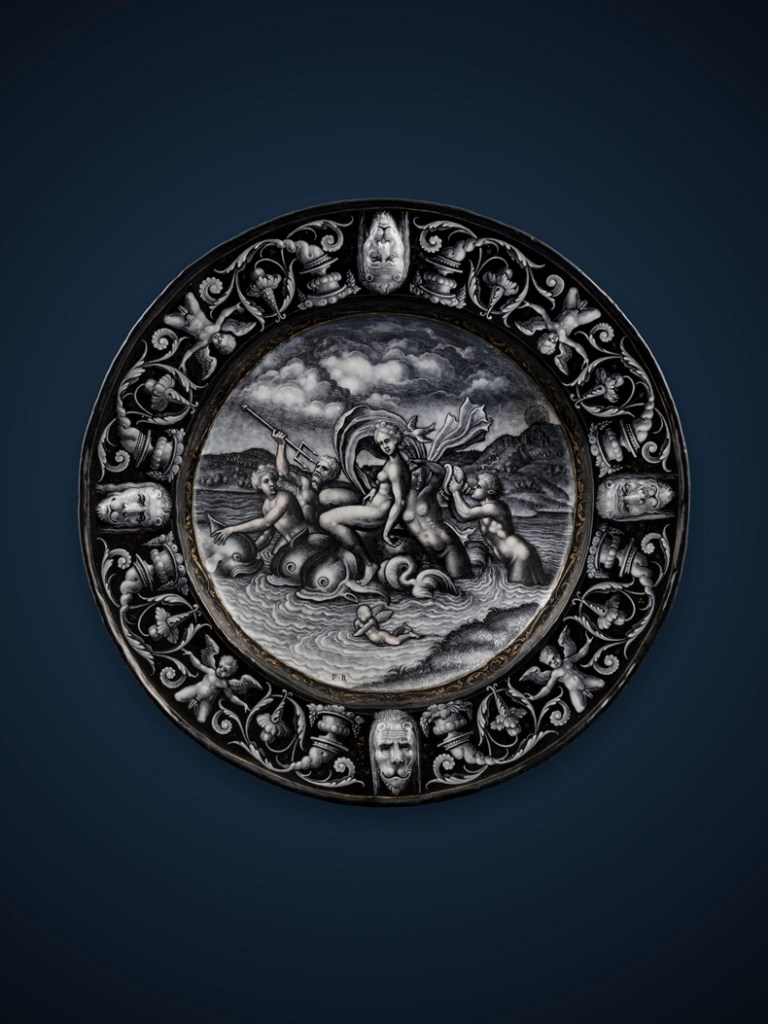
As with every art form, Renaissance enamels swept in and out of fashion over the centuries, and fashion, in the form of the remarkable couturier and collector Hubert de Givenchy (Apollo, October 2012), is really where the Kugels’ relationship with these enamels began. After Alexis and Nicolas Kugel acquired M. de Givenchy’s Limoges enamels and displayed them at the Biennale des Antiquaires in 1994, they were snapped up by another legendary collector, Pierre Bergé. The collection’s five unique pieces from the Chaspoux service decorated by Pierre Reymond – the most important surviving armorial table service from Limoges’s Renaissance heyday – return here, having been bought back from Sheikh Hamad Al Thani, who had had them installed in his Rothschild-inspired ‘Cabinet des émaux’ at the Hôtel Lambert.
Large groups of enamels acquired from various Rothschild collections form the basis of this show, including two plaques from the most celebrated early 16th-century group depicting episodes from the history of Troy taken from the period’s finest illustrated edition of Virgil’s Aeneid. Unsigned and undated, they are the work of one of many anonymous Limoges masters, known as the Master of the Aeneid. These intensely coloured plaques, enhanced with abundant gold highlights, were probably made to adorn a cabinet. Such pieces, as well as buffets or sideboards massing grisaille enamel vessels, bring an impressive sense of spectacle.
One gem, almost literally, is a refined two-sided medallion depicting Marguerite de Lorraine of c. 1540, now attributed not to Léonard Limosin but to Master MP, its reverse a woman kneeling in prayer painted in gold on a black ground. Happily, Limosin, the greatest of Limoges enamellers, is well represented here, not least by his portraits of François and Charles de Pérusse des Cars of around 1553–60 and a group of ten plaques depicting the Apostles.
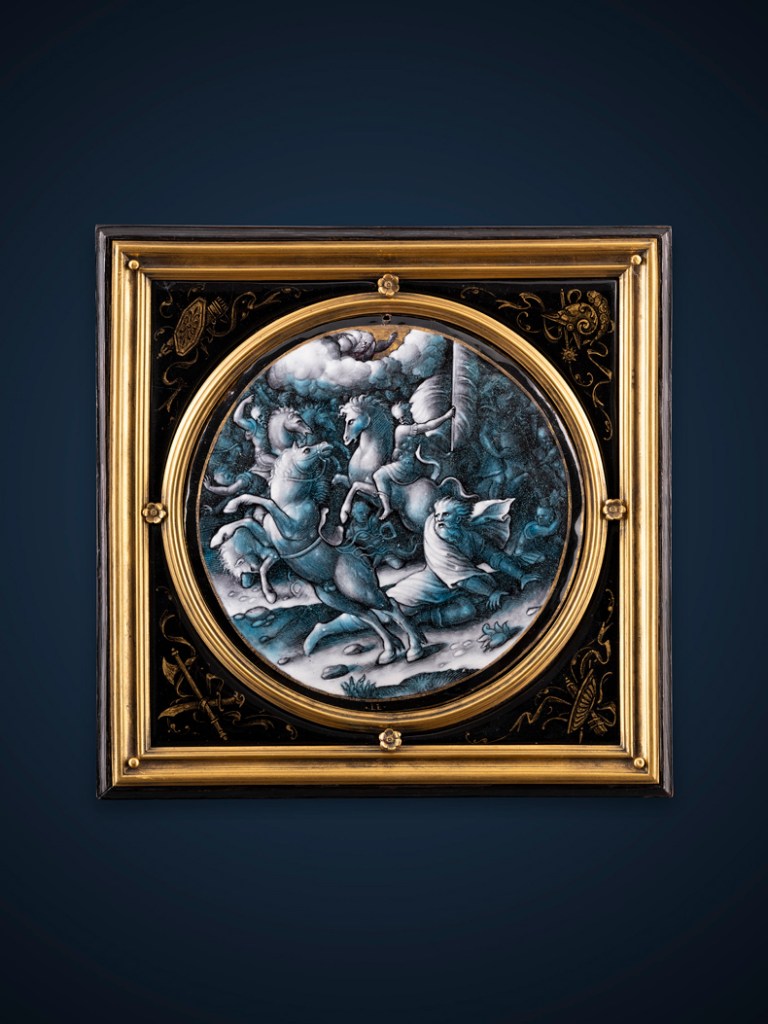
‘Immarcescible’ brings together not only plaques and portraits but also tazze, ewers, footed cups and covers, candlesticks, spoons and salts. Apparently unique among them – and arguably the most delectable piece on show – is a small cylindrical box with silver-gilt mounts vividly but delicately painted with scenes of Diana and Actaeon, the former bathing, the latter already turned into a stag. The cover depicts the Abduction of Helen; its base, a boar hunt. There is much else to charm and impress, from the Pierre Reymond cup decorated with an allegory of wine and Jean de Court’s cups with Moses striking the rock and Noah’s flood to Couly Nouailher’s bad-tempered horses. Also included among the 72 exhibits is a piece by one of the few women enamellers, Susanne de Court, no doubt the daughter of Jean. Prices range from a relatively modest €10,000 to more than €1m, but everyone who visits the gallery can feast freely on this illuminating show.

‘Immarcescible: Limoges Renaissance Enamels and their Collectors’ is at Galerie Kugel, Paris, until 20 December.