The Portuguese businessman and art collector Armando Martins first began negotiations to buy the Palácio dos Condes da Ribeira Grande in 2006, envisioning it as a place to store his art collection. The building stretches 110m along the Rua da Junqueira, adjacent to the Tagus River. The original palace was built in 1701 but has been transformed several times since then; it was being used as a girl’s school when Martins acquired it. Covid and severe structural setbacks delayed the project, but earlier this year it reopened as the Museu de Arte Contemporânea Armando Martins (MACAM), a combined hotel and art gallery with a new wing decorated with azulejos made from environmentally friendly materials by Maria Ana Vasco Costa.
Martins says that art should not ‘just be used to decorate houses or hidden in warehouses’ but should be ‘displayed for everyone to enjoy’. At MACAM, guests can see everything from the first artwork he purchased – an abstract work by Rogério Ribeiro, bought in 1974 on Martins’s 25th birthday – to dishes in the restaurant Contemporâneo, inspired by recipes from his childhood in Penamacor. Portuguese indigenous grapes such as Baga and Alicante Bouschet feature on the wine list.
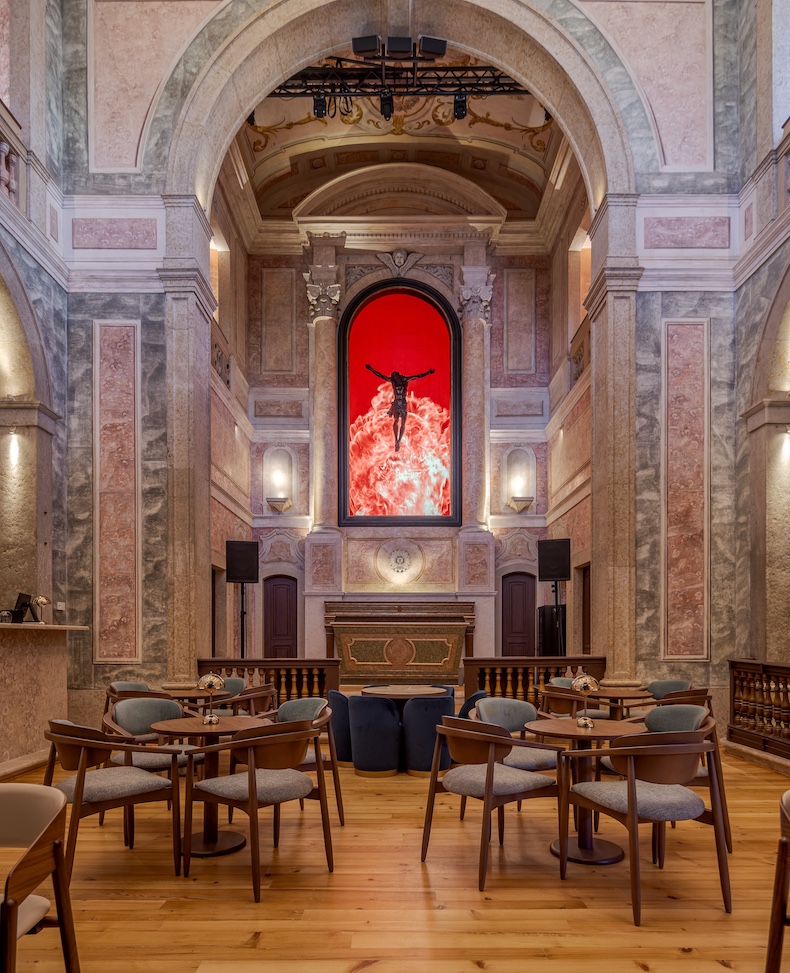
This is also a private enterprise, however, and Martins is realistic that ‘museums need financial support’. To this end, the 600-plus pieces of art, acquired over four decades, are put to work in a business model that blends hospitality with cultural experience in order to generate revenue – a model for other cultural institutions to follow, perhaps. ‘I prefer to rely on our own effort and innovations for funding instead of the state,’ Martins says, which allows him to ‘follow [his] vision on the real connection between hospitality and art’.
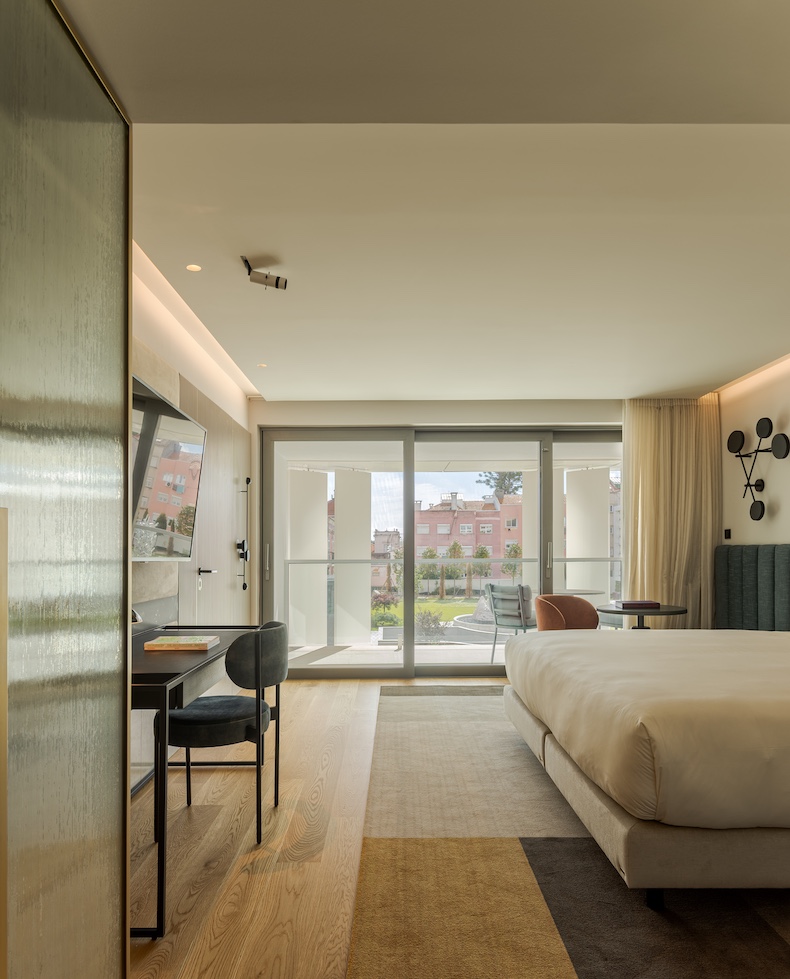
This vision is pursued behind the Etruscan-red facade of the Palácio. Visitors encounter art in a slow, leisurely fashion everywhere on the premises: on the balconies (a four-metre-high tower of rhombuses by Angela Bulloch, and three red, yellow, and blue glass discs by José Pedro Croft); in the gardens there is an iceberg marble mountain fountain by Cristina Ataíde). The lobby is both the museum entrance and hotel reception, which reinforces that the buildings’ twin functions are inextricably linked. There, next to the ticket desk and bookshop, is Thomas Struth’s Audience 4 (Galleria dell’Academia – Florence) (2004), an oversized photograph of a group of museumgoers looking up at something out of view. The furniture, fittings and decor are all made exclusively by Portuguese designers and craftsmen to promote local industry.

Martins’s collection is divided into two parts, with Portugese paintings, works on paper and sculptures in the first seven galleries, which include the palace’s original kitchens, displayed in chronological order from the late 19th century to the 1990s. Many masters of Portuguese modern art are little known to the general public; MACAM’s director, Adelaide Ginga, believes that ‘this peripheral position does not stem from a lack of artistic innovation or depth, but rather from historical, political and cultural circumstances that often kept Portuguese artists distant from the major centres of modernism’. The dictatorship that lasted from 1926–74 ‘effectively isolated Portugal from the outside world and from the new artistic currents emerging elsewhere’. Artistic developments did, of course, reach Portugal, and in the 1920s and ’30s Portuguese artists incorporated elements of Expressionism, cubism, Futurism and other forms of modernism into their work. Eduardo Viana studied in Paris with Robert and Sonia Delaunay and his Expressionist portrait The Crockery Man (1919) is a key work in the collection. Surrealist works are also significant for MACAM. As Ginga explains, ‘artists such as António Dacosta, António Pedro, Cruzeiro Seixas, and Cândido Costa Pinto are represented with exceptional pieces that illustrate both the originality and the independence of Surrealism in Portugal, a movement that, while deeply influenced by the second phase of international Surrealism after the Second World War, maintained a distinctly poetic and metaphysical dimension’. With the slight loosening of the Estado Novo regime in the mid 20th century, abstraction and other more experimental practices came to the fore; the Pop artist Nikias Skapinakis’s painting The Seduction of Miss Europe (1970), for instance, is a highlight.

The other part of the collection comprises works made outside Portugal. The intention, Ginga says, is for ‘the public visitors to recognise Portuguese modernism not as a marginal episode, but as an integral and distinctive voice of undeniable quality within the global history of modern art’. The artists represented here include Marina Abramović, John Baldessari, Olafur Eliasson, Elmgreen & Dragset, Carsten Höller, Cristina Iglesias and Erwin Wurm. There are some more time-consuming works too, which visitors can explore at leisure if they are staying in the hotel as guests, such as Carlos Aires’s Sweet Dreams are made of this (2016), a four-minute video work in which a pair of male riot police tango to the Eurythmics song of the title.
Martins believes that the international pieces in the collection might be the initial draw for the visitors, ‘but then they come and learn about the local artists and see the permanent exhibition of Portuguese art, and they stay for that’. He also believes that this place suits the Portuguese temperament, which is quiet and subtle. As a cultural and hospitality experience, MACAM may be understated, but the innovation shown in its disruption of both the art museum and luxury hospitality model is anything but.
More information about the Museu de Arte Contemporânea Armando Martins (MACAM) can be found here.