From the May 2026 issue of Apollo.
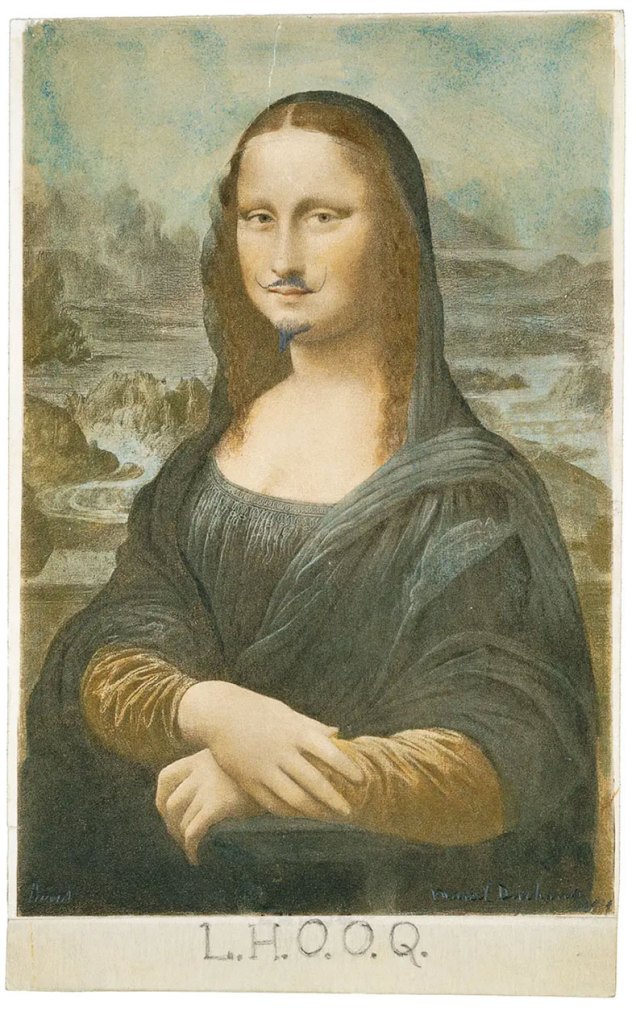
In the nearly 60 years since Marcel Duchamp’s death in 1968, his reputation as an art provocateur has grown, but that fame has clouded the public’s sense of his artistic vision. We know him best for his readymades – the mustachioed Mona Lisa of L.H.O.O.Q (1919) and the infamous urinal, Fountain (1917) – mass-produced items presented as art objects on which we rest the risky argument that anything is potentially fit to be art. He prioritised ideas over aesthetics, the mind over the hand, and his convictions wielded vast influence on successive modes of art, including Pop, Fluxus, Nouveau Réalisme, Op Art, minimalism and conceptualism. After Duchamp’s death, the painter Cleve Gray wrote that his most lasting effect on contemporary art was not his work but ‘the way he taught other artists to say yes’.
Duchamp most certainly provided a new model for what being an artist looked like and the concepts and materials of artmaking have expanded considerably since he set a bicycle wheel atop a stool. But his career is puzzling. In 1913 he effectively renounced painting and seven years later chose to stop exhibiting his art. A longstanding myth developed that he didn’t make art after the age of 30. He did, but often through collaborations, under alter egos and in forms – posters, magazine covers, window displays – that seem ancillary to an artist’s primary output. Some of his work touched on Dada, cubism, Futurism and Surrealism, but he maintained a distance from all movements. He’s wrongly considered a prankster; though there are aspects of play in his body of work, he wasn’t trying to fool anyone. In a career so hard to pin down, what was Duchamp trying to achieve?
A chronological retrospective, his first in North America since 1973, aims to reintroduce the artist to contemporary audiences and to dispel the haze surrounding his output and intent. Curated by Ann Temkin, Michelle Kuo and Matthew Affron, the show will be presented in two versions, first at MoMA then at the Philadelphia Museum of Art. It includes some 300 objects – paintings, sculptures, readymades, works on paper, photographs and films – spanning nearly 70 years, from teenage portraits and plein-air paintings made in the first years of the 20th century to studies for Étant donnés (1946–66), Duchamp’s final work, created in secret over the last two decades of his life.
Duchamp was born in Normandy in 1887. He had five siblings, three of whom also became professional artists. He took up drawing, painting and chess very early on and, in the 1910s, he was exploring the formal languages of Impressionism, Post-Impressionism and cubism. In 1912, he submitted Nude Descending a Staircase (No. 2) to the Salon des Indépendants. Not content with rendering a still object or figure in the planar vocabulary of cubism, Duchamp sought to capture ‘a static image of movement’ and was influenced by Étienne-Jules Marey’s experiments with chronophotography. Nude is magnificently complex: an overlapping sequence of mechanistic, almost sculptural bodies that appear choreographed into disorder. The Salon’s hanging committee expressed reservations about the work and Duchamp withdrew it the day after the preview; it was ridiculed in the press.
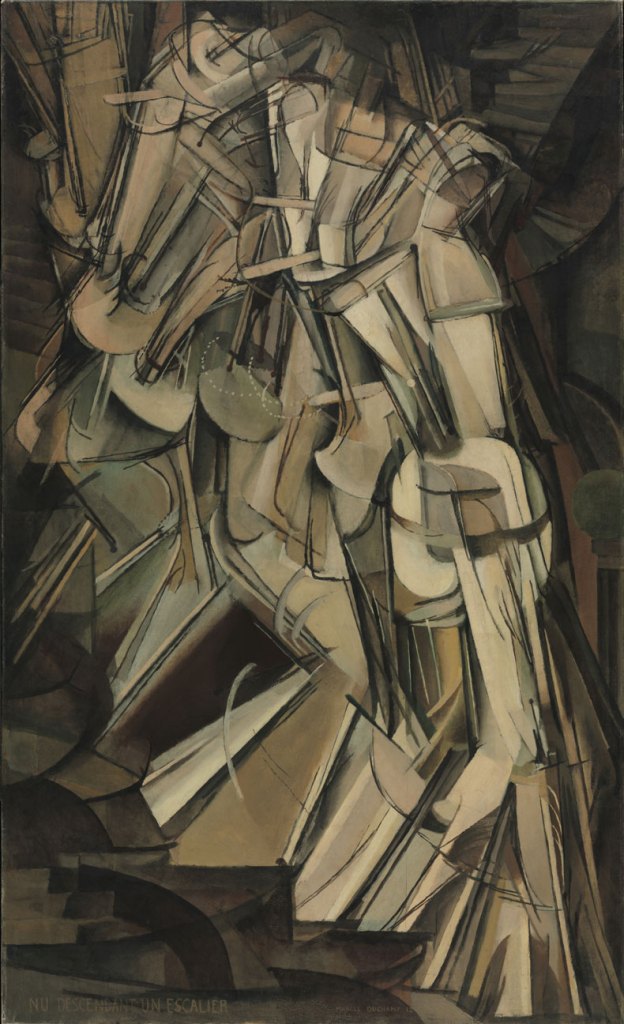
Duchamp was undeterred. He expanded the dimensional quality of Nude in The Passage from Virgin to Bride (1912), which, as the title implies, signals change rather than movement. The illusion of shallow depth in Nude here becomes a scene of undulating transformation in the round. Duchamp felt that he was heading in the right direction, later telling MoMA’s director Alfred H. Barr Jr. that the painting represented ‘my own passage from something into something else’. The next year, he began studying philosophy and optics and announced that he would no longer pursue painting.
Duchamp’s first work after this shift was 3 Standard Stoppages (1914), made according to a process he termed ‘canned chance’. To create it, he dropped a metre-long piece of sewing thread from a height of one metre on to a canvas. He repeated the action to produce a trio of unique linear shapes and used these curving lines to make wooden templaes that could serve as new standards of measurement. Duchamp considered cubism to be merely an aesthetic revolution and he wanted to get away from both painting and from the idea of taste in general. In embracing the accidental, he sought to remove himself from the realisation of the work. He posed the question, ‘Can works be made which are not “of art”?’ He wanted art to be, he said, ‘at the service of the mind’ – meaning the object itself would come not from manual manipulation, as painting and sculpture do, but as if from his subconscious.
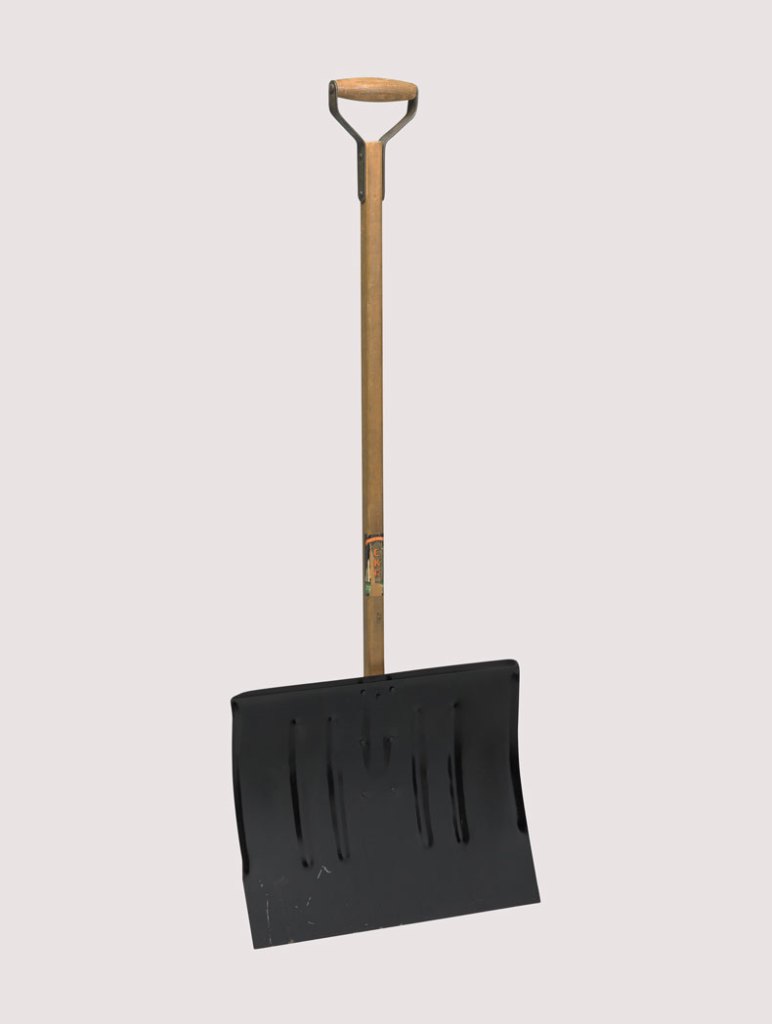
The readymades are the purest example of this drive. They are objects Duchamp chose based on what he called ‘visual indifference’, in which questions of good or bad taste or aesthetics were irrelevant. He made his first readymades in 1914: Pharmacy, which consists of two dots, red and yellow, added to the background of a store-bought print of a wintry landscape, and Bottle Rack, a commercial item Duchamp purchased from a department store and placed untouched in his studio. The next year, he bought a snow shovel and titled it In Advance of the Broken Arm, explaining that, as a Frenchman who had never seen a snow shovel before, he was interested in it not for its shape but for its ‘intention’. He first used the term ‘readymade’ in 1916, in a letter to his sister Suzanne. He asked her to paint an inscription and signature on Bottle Rack, but she had thrown it out, thinking, Duchamp guessed, that ‘it was one of my crazy ideas’. Around 1921, he purchased another bottle rack and gave it the same name. If Duchamp selected the item with aesthetic disinterest and could replace it at will with a similar version, then the object itself was of little importance. The significance lay in the idea that animated its transformation from ordinary commodity to fine-art sculpture.
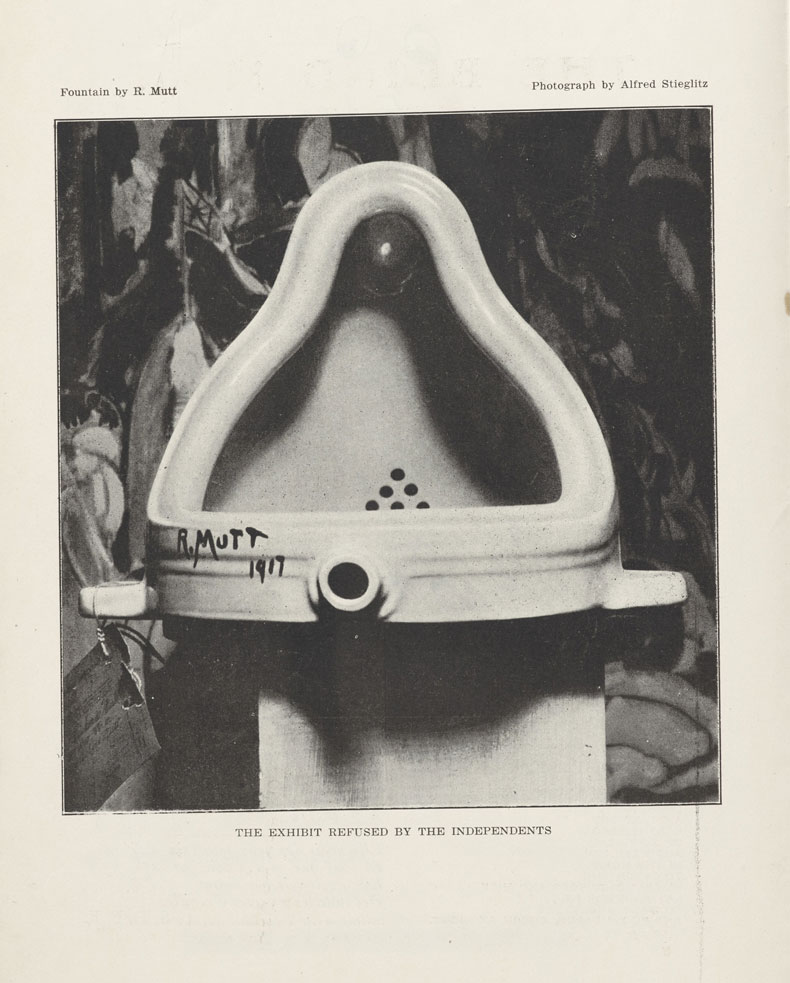
In 1917, Duchamp submitted Fountain, a white porcelain urinal signed ‘R. Mutt’ (he borrowed the surname from Bud Fisher’s comic strip Mutt and Jeff), to the first annual exhibition of the Society of Independent Artists. The board of directors decided that it was a practical joke made in poor taste and removed it from the show. The Dada magazine The Blind Man published Alfred Stieglitz’s photograph of Fountain together with an unsigned article that defended the sculpture:
Whether Mr. Mutt with his own hands made the fountain or not has no importance. He CHOSE it. He took an ordinary article of life, placed it so that its useful significance disappeared under the new title and point of view – created a new thought for that object.
In upending what the article referred to as art’s ‘meticulous monogamy’ – the belief that it must conform to traditional associations, such as a toilet with urination – Duchamp sought a new ‘attitude of mind’, as the art historian Pierre Cabanne put it, a complete rewiring of the interplay between materials and ideas.
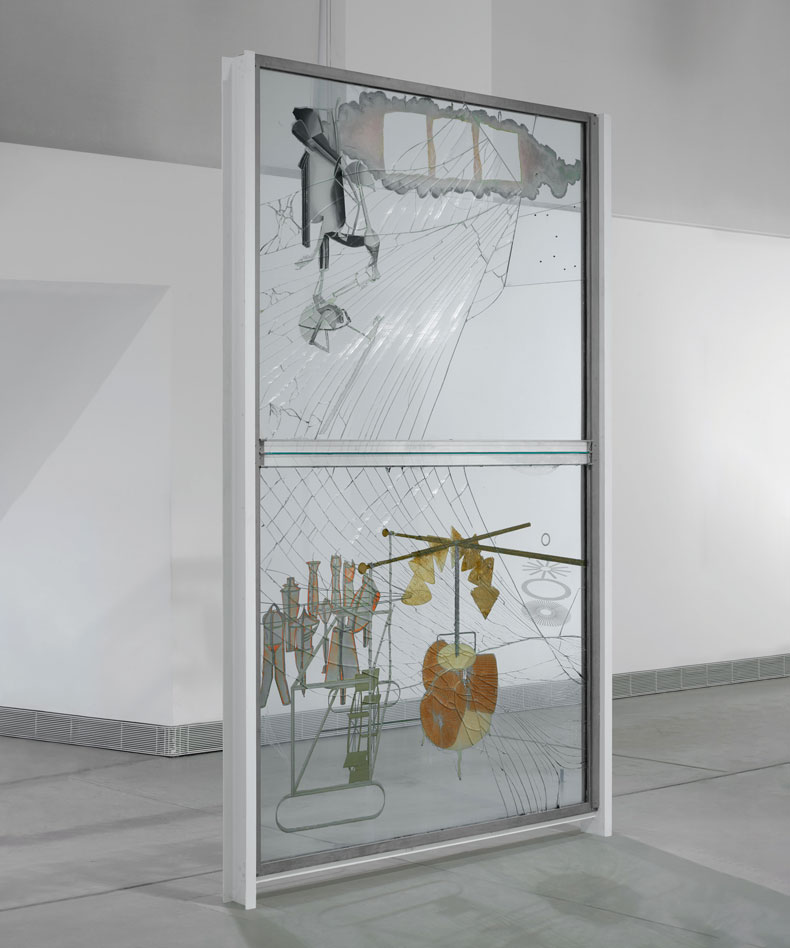
In tandem with his development of the readymade, Duchamp began making notes and studies for The Bride Stripped Bare by Her Bachelors, Even (The Large Glass) (1915–23). The ineffable ‘something else’ he expressed to Barr centred on a rejection of ‘retinal art’, Duchamp’s term for art that relies purely on the physical aspects of execution. Like the readymades, the mechanical drawings for The Large Glass marked an effort to prioritise concept over, say, paint-handling. He created the allegorical, mechanistic imagery with oil, lead wire, lead foil, dust and varnish sandwiched between two panes of glass. Duchamp thought of windows as a medium akin to painting or sculpture and glass appeared elsewhere – in To Be Looked at (from the Other Side of the Glass) with One Eye, Close to, for Almost an Hour (1918), for example, and La Bagarre d’Austerlitz (1921) – forming the basis for a new conception of space and perspective.
Because the picture plane is transparent, the background of The Large Glass is changeable, meaning that moving the work to a new location, or activity on the other side of it, alters the viewer’s perspective of the work. Duchamp compared The Large Glass to a reference book,
in which you look for such a thing and such a time for a minute, and then you forget, and ten days later you look at another thing. And not ensemble, not physical, not retinal, but a conglomeration of things almost disparate.
It was not to be studied at length, but looked at anew each time, in a sort of glancing way. That refraction of attention recalls Nude Descending a Staircase in its incorporation of movement into a static image. For Duchamp, The Large Glass rehabilitated perspective in a conceptual and scientific sense.
In the middle of working on The Large Glass, Duchamp stopped publicly showing his art – he didn’t want to be associated with ‘retinal’ painting and sculpture – and was absent from exhibition spaces for a decade. During that time and through the mid 1940s, he was active in other ways: disseminating his work through print reproduction and curating the art of others (between 1920 and 1950, he organised some 80 exhibitions as well as numerous publications and programming events under the auspices of the Société Anonyme). He designed book and magazine covers, window displays and posters (including one, doubling as a catalogue, printed on large sheets of tissue paper, which were then crumpled into balls and presented in a basket); bought and sold art; played in chess tournaments; wrote puns and word games as Rrose Sélavy; experimented with 3D optical disks called Rotoreliefs; and collaborated with Man Ray and others.
In 1929, he declared that his ‘intention to remain outside of any art manifestation is permanent’. But in 1946, he began making studies of his last major work, Étant donnés: 1° la chute d’eau, 2° le gaz d’éclairage… (‘Given: 1. The Waterfall, 2. The Illuminating Gas…’). Duchamp worked on it for 20 years in his New York studio and only his wife, Teeny, knew of the project’s existence. MoMA’s version of the retrospective includes related drawings, studies and photographs, as well as the instruction manual for its assembly, but not the assemblage itself, which is permanently installed at the Philadelphia Museum of Art.
The audience’s view of Étant donnés is straightforward. In peering through two small holes in a wooden door set into the wall, one glimpses a tableau visible beyond a crumbling brick wall: a nude woman, her face out of frame, lies on a thicket of branches and holds aloft a glowing gas lamp; behind her in the distance is a waterfall and landscape. But a look at the highly detailed manual reveals why Étant donnés doesn’t travel. The environment is a thoroughgoing illusion structured like an exploded diagram – a mix of two- and three-dimensional elements, lighting and support structures constructed in separate parts and set in relation to one another just so, in order to achieve the desired effect. Duchamp’s attention to technical details in his instructions is meticulous. The work itself evokes the perspectival play of The Large Glass and the formal deconstruction of Nude Descending a Staircase. In the manual, Duchamp refers to the audience of Étant donnés as ‘voyeurs’.
Aside from Étant donnés, Duchamp’s most extraordinary activities during the span in which he was thought to be not making art were the replication of his readymades and the production of boxed facsimiles. Like Bottle Rack, the original Fountain was lost and Duchamp recreated it in 1950 for an exhibition at Sidney Janis Gallery. In fact, he repurchased or replicated most of his readymades. The retrospective devotes a section to them and the curators have co-written a fascinating essay for the catalogue on Duchamp’s relationships with museums and his remaking of various works. Over the course of his career, he produced several editioned boxes that house facsimiles of manuscript notes, drawings, diagrams and photographs. The Bride Stripped Bare by her Bachelors, Even (The Green Box) of 1934, for instance, collected 94 facsimiles of material related to the making of The Large Glass. The most notable may be Box in a Valise (1935–41), what Duchamp called a ‘portable museum’ that included replicas and reproductions of 69 of his works housed in a leather suitcase – a retrospective in miniature. In the 1960s, he began authorising the fabrication of replicas, both of sculptural pieces such as 3 Standard Stoppages and of the readymades, which hew precisely to the ‘originals’ through careful consideration of related documentation and measurements.
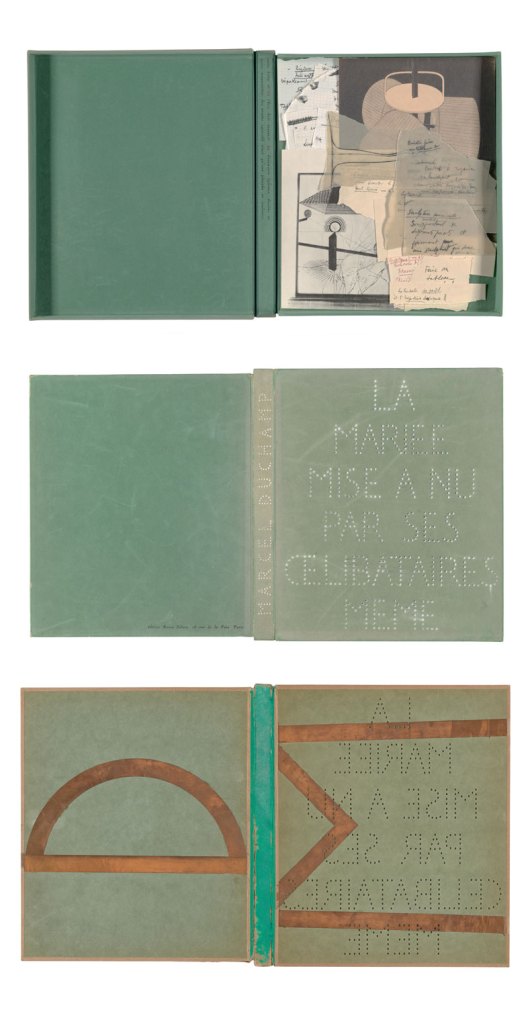
The ability of institutions to acquire and exhibit Duchamp’s art was fuelled by these multiples and ‘versions’. It was no longer necessary to loan pieces if a museum owned or had ready access to a replica. The curators report that Duchamp had little involvement in the making of some of the replicas, writing that his ‘main act was that of authorisation’, akin to an artist’s use of assistants and apprentices in Renaissance workshops or Warhol’s Factory. Duchamp’s instructions and notes are also a form of authorisation and oversight. They make visible and accessible the ideas behind the objects, presaging the elision by conceptualists of the physical artwork by its supporting documentation. Thirty years after Duchamp published The Green Box, the artist Richard Hamilton reconstructed The Large Glass for a Duchamp retrospective he was curating at the Tate Gallery by referring to the copious photographs, notes, and drawings. (Hamilton’s version is included in MoMA’s show.) ‘The text that accompanies the glass is a document, which gives it its life,’ Hamilton said. ‘It feeds it with the animation and gives it its significance.’
If we don’t know whether we’re seeing the original or a replica, but the original idea is transmitted, does it matter? Barr worried that MoMA’s holdings were devalued by the proliferation of replicas, but a lack of uniqueness was for Duchamp part of the concept of the readymades, and replicating them only enforced that idea. To insist on the specialness of the original is to introduce aesthetic considerations where Duchamp wanted to erase them. As Barr feared, Duchamp’s intentional confusion of original and copy undermines the dominance of and control of the art museum and, as the retrospective’s curators write, overturns ‘nearly all the conventional terms of museological categorization and display’. Duchamp’s replicas, which allowed audiences around the world to see his art first- hand, emphasised the museum’s responsibility to the public sphere – a cornerstone of institutional critique, which emerged in the late 1960s and which aligned with Duchamp’s feeling that the viewer completed the work of art.
In a letter to Suzanne in 1952 he criticised American museums for encouraging in students of modern art a belief in ‘the chemical formula’, the phrase he used to describe the cheapening of artistic invention that results in the plodding creation of unoriginal art whose value is market-driven. He bemoaned the resultant ‘total disappearance of the original fragrance’. This sounds like an insistence on a work’s aura and it’s hard to reconcile this with Duchamp’s readymades and his involvement in making replicas and reconstructions of his own work. But for Duchamp, the object is negligible, a vessel for the idea, which is itself the original fragrance. The offence for him was in making art that looked pretty but had no concept behind it.
Duchamp further cedes his authority over the work by insisting on the interpretive role of the viewer. He told Cabanne in 1967 that ‘a work is also made of the admiration we bring to it’. It echoes Roland Barthes’s contemporaneous argument in the essay ‘The Death of the Author’ that ‘a text’s unity lies not in its origin but in its destination’. Duchamp rejected the aesthetic value of the bottle rack and urinal he chose; we aren’t meant to read beauty or pleasure in their forms, though that doesn’t mean we can’t. He felt that there was danger for him in trying, he said, ‘to please an immediate public – the immediate public that comes around you, and takes you in, and accepts you, and gives you success, and everything’. Better, he thought, to ‘wait for fifty years or a hundred years for your true public. That is the only public that interests me.’ He expressed this belief in 1956, which means that the audience he was waiting for is us, right now.
‘Marcel Duchamp’ is at the Museum of Modern Art, New York, until 22 August and at the Philadelphia Museum of Art from 10 October–31 January 2027.
From the May 2026 issue of Apollo.