Museum extensions are a seemingly unstoppable phenomenon. In London, the National Gallery is planning a whole new wing, architects to be determined. MoMA is the undisputed global leader in this field, having now grown to occupy nearly an entire city block. Whether this expansionary zeal can be justified by the quality of the works they are currently unable to display remains to be seen.
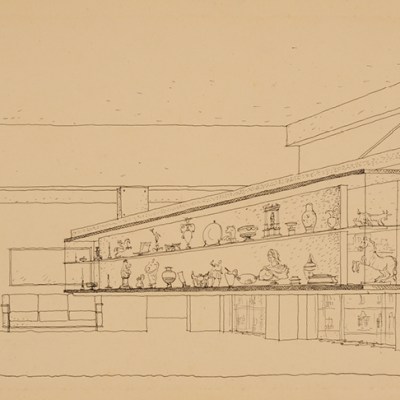
The new extension to the São Paulo Museum of Art (MASP) is part of this tendency but also departs from it in some important ways. For a start, Lina Bo Bardi’s museum building of 1968 is one of the greatest examples of its kind, with a unique silhouette: the main gallery is an oblong box squatting beside Avenida Paulista, the city’s main thoroughfare, on four red legs. This created an open patio at ground level – the famous ‘vão livre’, or free space – beneath which the rest of the museum is buried. Sacrificing the ground floor to the public was a remarkably generous gesture, but one which left no scope for expansion: if future curators wanted more room, it would have to be accommodated in a discrete structure.

In fact, the initial impulse for the expansion of MASP was not curatorial but financial. The private institution was deep in the red by the turn of the century, struggling to pay its staff and with the electricity sometimes being cut off. Fortunately, the museum’s then-president, the architect Júlio Neves, had a plan: he had spotted that the owners of a neighbouring residential tower were keen to dispose of it, and in 2005 this was bought for the museum by a benefactor in the form of Brazilian telecoms giant Vivo. Neves proposed rebuilding the tower as a much taller, mirror-glass-clad skyscraper, with a showroom and the naming rights going to Vivo. (The Brazilian press reported at the time that Vivo would pay MASP a regular but undisclosed fee for this privilege.)
In any case, the city objected to the project’s effect on Bardi’s building and insisted on reducing its height by almost half. Then it banned outdoor advertising, which put the kibosh on the phone company’s main objective: seeing its name in lights on a distinguished if somewhat down-at-heel institution. Eventually, Vivo pulled out and MASP was left with a large bill and the stump of the partially demolished tower. But these tortuous proceedings turned out to be a blessing in disguise, as the extension it has ended up with is a vast improvement on Neves’s ill-conceived proposal.
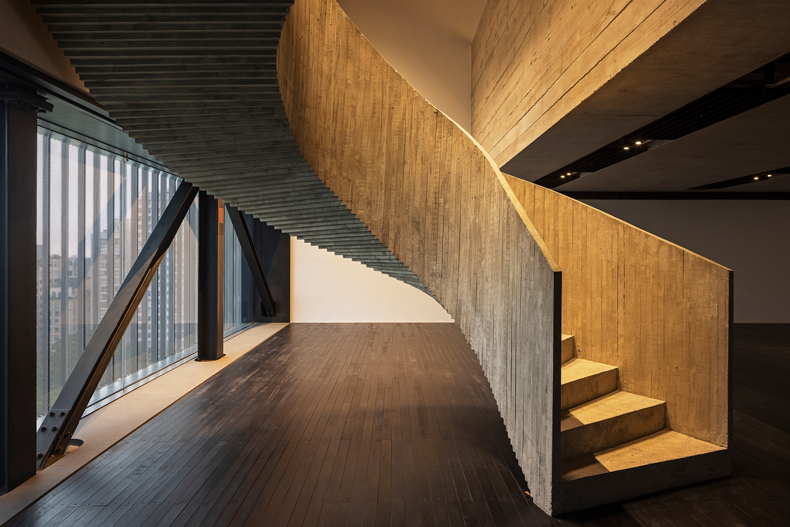
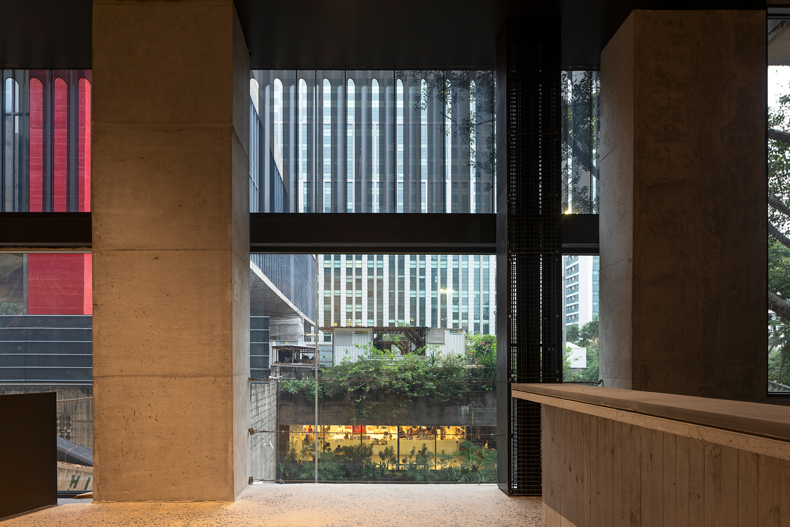
In 2019 MASP returned to the stump with a new plan, no longer requiring an outside sponsor, devised by local practice Metro Arquitetos. The 14-storey building is dedicated exclusively to the museum’s visitors, with a ground-floor restaurant and shop, five floors of gallery space for temporary exhibitions and an education centre and conservation laboratory at the top. The galleries are perfectly serviceable, albeit strangely subterranean given their altitude. For the first show the curators chose to cover over the few windows, perversely blocking what must be great views of the avenue and the Bardi building. As with any museum tower – the Whitney or the New Museum in New York, for example – the main problem is circulation. There’s no happy solution: one becomes reliant on lifts, or scuttling up and down a fire escape (Tate Modern’s extension is the exception, but MASP did not have the luxury of the expansive footprint that made Herzog & de Meuron’s space-hungry stair possible). It is no different here, although the architects have let windows into the stairwell, which alleviates its dinginess.
In line with the original planning approval, this project now adheres to the city-mandated height limit of 70 metres. Happily, this makes it volumetrically identical to its pronel neighbour. In another improvement, Metro Arquitetos has given the facade the opposite treatment to Neves’s proposed blingy mirror glass: instead, it is swathed in a skin of matte-black perforated aluminium. This protects artworks from the sun’s rays, smooths the junction between the superstructure and the stump (which had to be retained to avoid going through planning again) and unifies the irregularly fenestrated building – until the evening, when the gallery lights shine through the translucent wrapper. In contrast to some of the more attention-grabbing structures on Avenida Paulista, including its colourful neighbour, it has a sombre, mute appearance, like a heavy looming at the back of a gangster’s funeral.
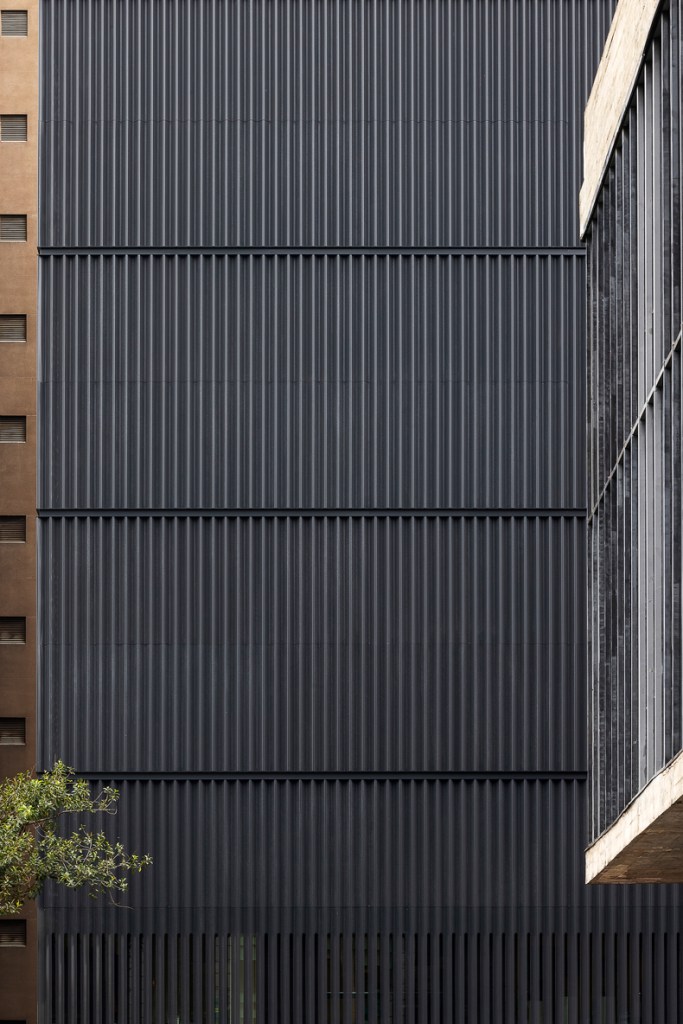
But the greatest success of the building is the effect it has had on its older sibling. Under Neves, the ‘vão livre’ had become cluttered with ticketing offices and, latterly, security stations. These functions have been moved into the base of the new tower and, when a conjoining tunnel is completed this year, visitors will be able to enter the Bardi building via an underground route instead. This strategy has been adopted in other museums – the Kunstmuseum in Basel, for instance, whose two buildings are linked beneath the road that separates them – but in this instance the pay-off more than compensates for the somewhat gloomy passage. São Paulo has regained one of the world’s great public spaces.