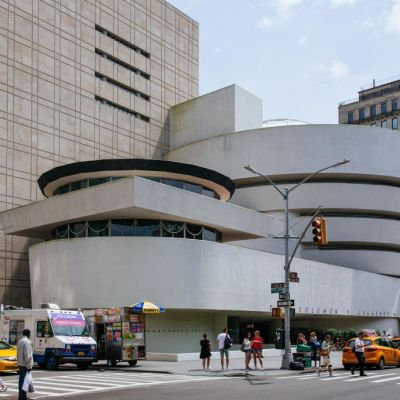
Melissa Chiu is leaving the Smithsonian’s Hirshhorn Museum and Sculpture Garden in Washington, D.C., which she has led for 12 years, to be director of the Solomon R. Guggenheim Museum in New York. Born in Darwin, Chiu worked in Australia as a curator specialising in Chinese contemporary art before moving to New York in 2001 to become a curator of Asian and Asian American art at the Asia Society, where she was appointed director in 2004. After a decade in the role, she became director of the Hirshhorn, where she increased fundraising by 75 per cent. Among the exhibitions she oversaw was a survey of Yayoi Kusama that drew some 160,000 visitors, breaking the museum’s attendance records. Chiu will assume her new role at the Guggenheim on 1 September, taking over from Mariët Westermann, who will continue in her role as CEO. Aaron Seeto, who is currently deputy director at the Hirshhorn, will become interim director.
The Getty Center in Los Angeles will close from March 2027 for a year-long renovation, the museum announced on 9 April. The works include the renovation of its Welcome Hall and the replacement of its tram system in what it calls ‘the most significant series of modernization initiatives since its 1997 opening’. The museum is to reopen in spring 2028 in good time for the Summer Olympics. Its sister museum, the Getty Villa, will remain open, and will dedicate a gallery to displaying some of the Getty Center’s most famous paintings, including works by Rembrandt, Monet and Van Gogh, the New York Times reports.
The New York Supreme Court has ordered the art dealer David Nahmad to return a painting by Amedeo Modigliani to the heirs of the Jewish dealer Oscar Stettiner, reports the New York Times. The Nazis seized Seated Man With a Cane (1918) – worth an estimated $30m – after forcing Stettiner to flee Paris in 1939, and sold it to a man named Jean Van der Klip. Stettiner filed a claim in France in 1946 and a court ordered that the painting be returned to him, but he died before it was recovered. The painting turned up 50 years later when Nahmad bought it at Christie’s for $3.2m from Van der Klip’s heirs. In 2015 Stettiner’s grandson Philippe Maestracci filed a lawsuit in New York seeking the work’s return; Nahmad disputed the claim, stating that the painting he owned was a different work. On 3 April Supreme Court judge Joel Cohen ruled that Stettiner ‘owned or at a minimum had a superior right of possession of the painting prior to its unlawful seizure’, and ordered its return.
Kengo Kuma and Associates has won the competition to design the National Gallery’s new wing, part of the museum’s £750m Project Domani initiative to grow its collection of 20th- and 21st-century art. The Tokyo-based firm will work with UK firms BDP and MICA to realise the design, which the competition’s jury panel said was ‘both innovative and beautiful, meeting the ambition and sensitivity required for an international gallery commission’. When construction will begin has yet to be announced.
Greece has passed a law to protect its cultural property from damage and forgery, reports ARTnews. The act, approved by parliament in January, provides a legal framework for crimes against art specifically, and extends the legal definition of art-related fraud to cover issues of provenance, attribution and condition. The penalties include prison sentences of up to 10 years and fines of up to €300,000. The new law also establishes a department for works of art within the culture ministry, as well as a council of art forgery experts. Speaking to the Art Newspaper, Leila Amineddoleh, chair of the art law group at Tarter Krinsky & Drogin, said that ‘criminals and bad actors often think that their crimes will slip under the radar […] Having laws targeting art criminals is a clear way to signal that bad actors will be prosecuted.’
The Centre Pompidou will open its new branch in Seoul on 4 June. The Centre Pompidou Hanwha is the result of a four–year partnership agreement between the French museum and the Hanwha Foundation of Culture, the nonprofit arts arm of South Korean conglomerate Hanwha. It will be housed in a former aquarium, recently renovated by the French architect Jean-Michel Wilmotte, in Yeouido, the city’s financial district. The museum will exhibit works from the collection of the Centre Pompidou in Paris, which closed in September for a five-year renovation.
The Robert Rauschenberg Foundation has sold the artist’s former home on Captiva Island in southern Florida to South Seas, a resort that owns 300 acres of land on the island, Artnet reports. The Foundation, which has owned the 22-acre property since the artist’s death in 2008, announced plans to sell in August, citing the financial strain of protecting the site from ‘challenging environmental conditions’. The property includes Rauschenberg’s former home, an art studio and several cottages, and has been used for the Rauschenberg Residency since 2012, which will now end. South Seas president Greg Spencer said the resort plans to honour Rauschenberg through ‘future art-related programming and by incorporating several buildings from the property into our resort’ but has yet to provide details. The Captiva Civic Association (CCA) has called the sale a ‘monumental betrayal by the Rauschenberg Foundation of the Captiva community that Bob Rauschenberg loved and personally sought to protect from overdevelopment’.