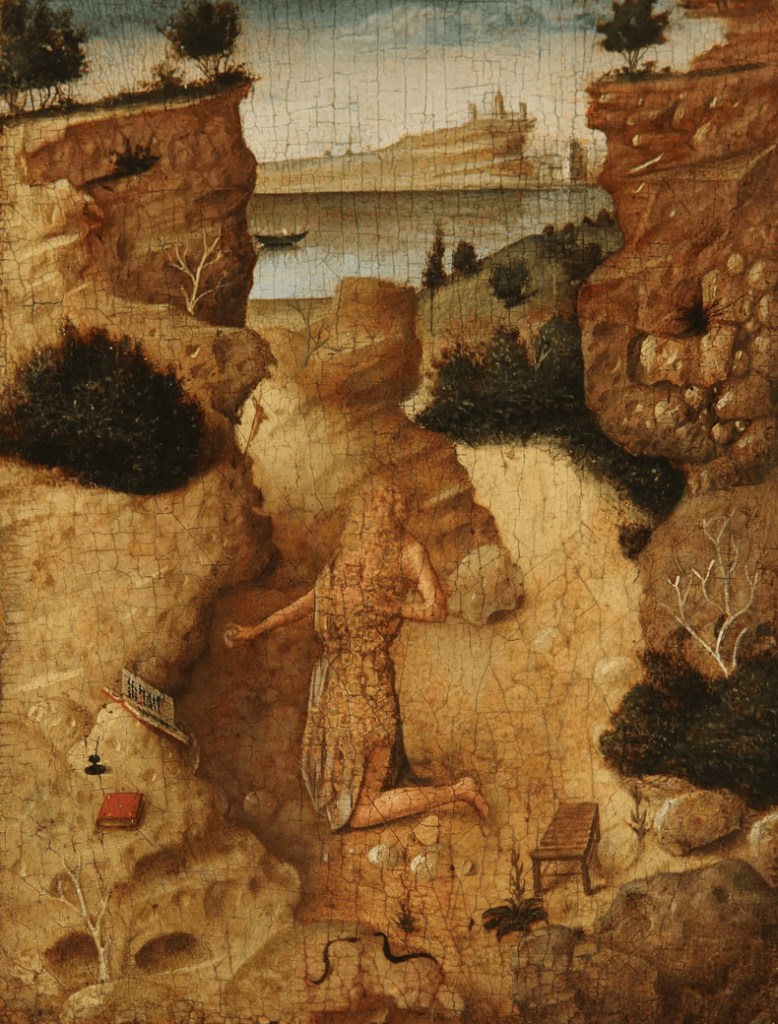

The Italian government paid handsomely for not one but two paintings last month: Caravaggio’s Portrait of Monsignor Maffeo Barberini (c. 1598–99), which it acquired for €30m, and Antonello da Messina’s Ecce Homo (c. 1470), on which it spent €12.6m. But Rakewell’s eye was drawn not so much to the recto side of the latter, with its forlorn-looking Christ, as to the verso, in which Saint Jerome, kneeling in a rocky landscape, beholds a book. At least, it looks like that’s what he’s doing. It’s hard to tell, because a previous owner’s repeated kissing of the painting has worn Saint Jerome’s face clean away.
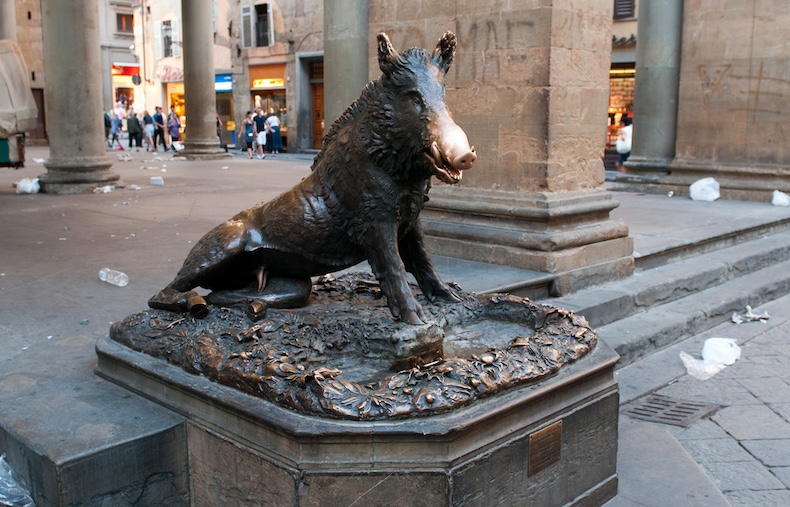
Your roving correspondent is aware that the modern approach to art – in which we inspect it from a safe distance, often separated from it by a pane of glass – is relatively new. Portrait miniatures, for example, used to be carried about the person. But Messina’s painting has prompted Rakewell to consider other instances of art that has been loved not wisely but too well. Statues, mainly. Earlier this week it was reported that two of the five pins fixing the statue of Molly Malone in Dublin to its plinth have, according to experts, been destroyed from ‘the abuse’ that the work has been receiving ‘on a daily basis’. Indeed, there is an entire Wikipedia page devoted to ‘statue rubbing’, from which Rakewell learned (and later verified) that tourists fondle the cojones of Arturo Di Modica’s bronze statue Charging Bull near Wall Street for good luck. Your correspondent would be remiss not to also mention Pietro Tacca’s porcine sculpture Porcellino (c. 1634), whose snout has been rubbed over the centuries to a fine gold sheen.
There are paintings that have suffered a similar treatment. In 1997, at a party in the Warhol Museum in Pittsburgh, a reveller kissed the artist’s Bathtub (1961), leaving a lipstick trace that proved so stubborn that NASA scientists had to spend eight hours removing it with an experimental atomic oxygen beam. Ten years later, the artist Rindy Sam was fined after kissing a work by Cy Twombly – an entirely white canvas until she made her mark on it – at the Lambert Collection in France. (Sam said in court that she had been ‘overcome by passion’, and among the fines she had to pay was a symbolic €1 to Twombly, which strikes Rakewell as the financial equivalent of a bisou.)
We might look to Ovid’s Metamorphoses for an insight into such behaviour. In Book 10 of the poem the sculptor Pygmalion carves his ideal woman out of ivory, and Venus grants his prayer that it comes to life. These days, by contrast, getting up close and personal with an artwork gets you strange looks at best and a brush with the justice system at worst. Then again, it was Warhol who said that ‘Art is what you can get away with’. Since the devotee who kissed Saint Jerome’s face into oblivion remains unnamed (as does the guest who kissed Bathtub), perhaps they were more of an artist than they thought they were.