From the March 2026 issue of Apollo.
Michael Armitage has been thinking about time. About two weeks before I meet the painter at his studio in Bali, in the forested slopes north of the town of Ubud, the oldest cave art to be found so far has been discovered on the Indonesian island of Sulawesi. Faintly visible behind some slightly more recent paintings of a hunting scene are small, pale handprints surrounded by dusty red, thought to have been made some 68,000 years ago. ‘There’s something chilling about being able to put your hand in the exact same place where 70,000 years ago, somebody did the exact same thing and then blew ochre over their hand to leave an imprint,’ Armitage says.
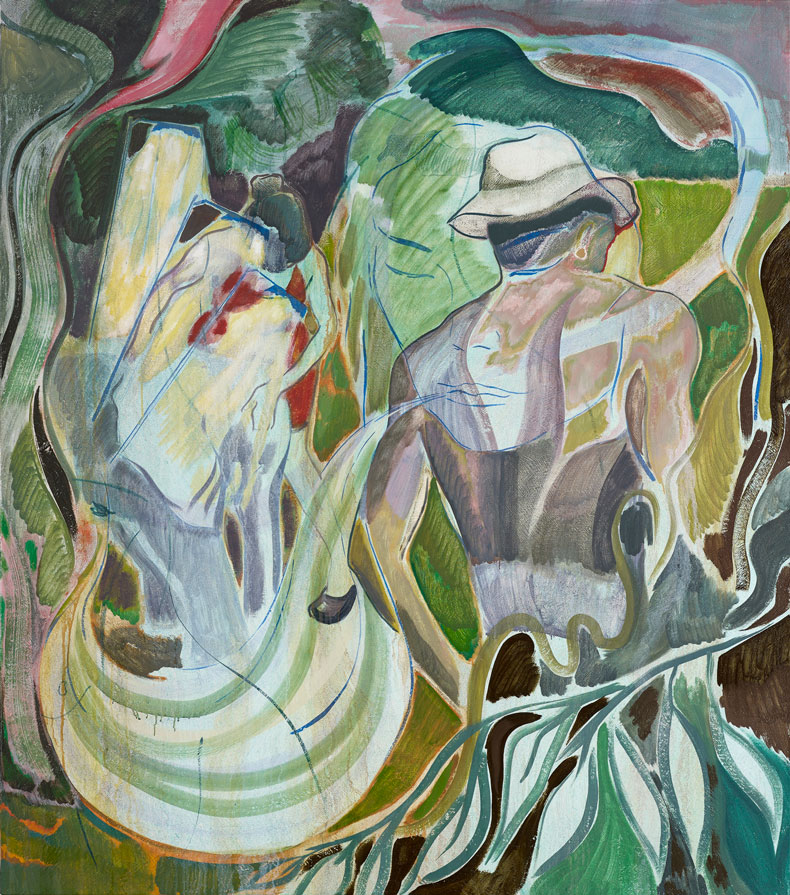
Armitage’s preoccupation with deep time, which pre-dates the discovery of the handprints, will shape ‘the next couple of years of work’, but at the moment he is also preparing for a retrospective at the Palazzo Grassi, one of the Pinault Collection’s two exhibition sites in Venice. Ever since a director at White Cube came across his work in a book of promising painters a little over a decade ago, Armitage’s star has been rising. After solo shows in museums and galleries around the world, including Berkeley Art Museum and the South London Gallery, the painter achieved a new level of prominence with ‘Paradise Edict’, his first major museum show, which opened at the Haus der Kunst in Munich in 2020 before moving to the Royal Academy of Arts in London the following year. His work was also catching the eye of private collectors: in 2019 Conservationists (2015), an elegant half-figurative study of two figures, enlivened by earthy swirls of green and blue, sold for more than $1m, a personal record that has since been comfortably surpassed by two other works.
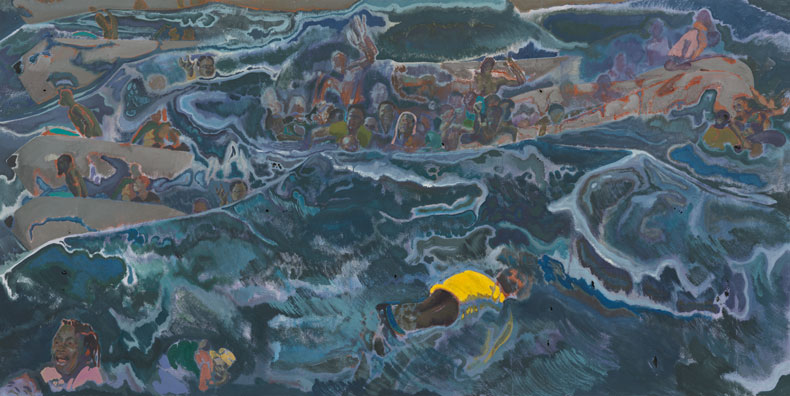
The Palazzo Grassi show, ‘The Promise of Change’, is Armitage’s largest exhibition yet and, though it’s organised by theme rather than chronologically, it makes clear how his painting has evolved over the last 12 years; the title is as much a nod to his open-minded approach to paint and subject matter as it is an acknowledgement of the optimism that glimmers in almost all of his work. (Armitage sees the retrospective more prosaically: ‘It’s a bit like being weighed and measured.’) If he has lately become interested in humanity at a species level, most of his work so far has been more culturally specific. Last year at David Zwirner in New York he presented ‘Crucible’, which included paintings of migrants risking or losing their lives to cross the Mediterranean; usually an Armitage exhibition will include a range of colour palettes, but most of these paintings were enveloped in ultramarine. ‘Paradise Edict’ included works inspired by the violence, corruption, demagogues and political hustlers Armitage saw at an election rally in Kenya in 2017; the title painting was the strongest demonstration yet of how Armitage’s fluid brushwork collapses multiple realms – heaven and hell, real and imaginary, timeless idyll and modern clamour – into a truly disconcerting whole.
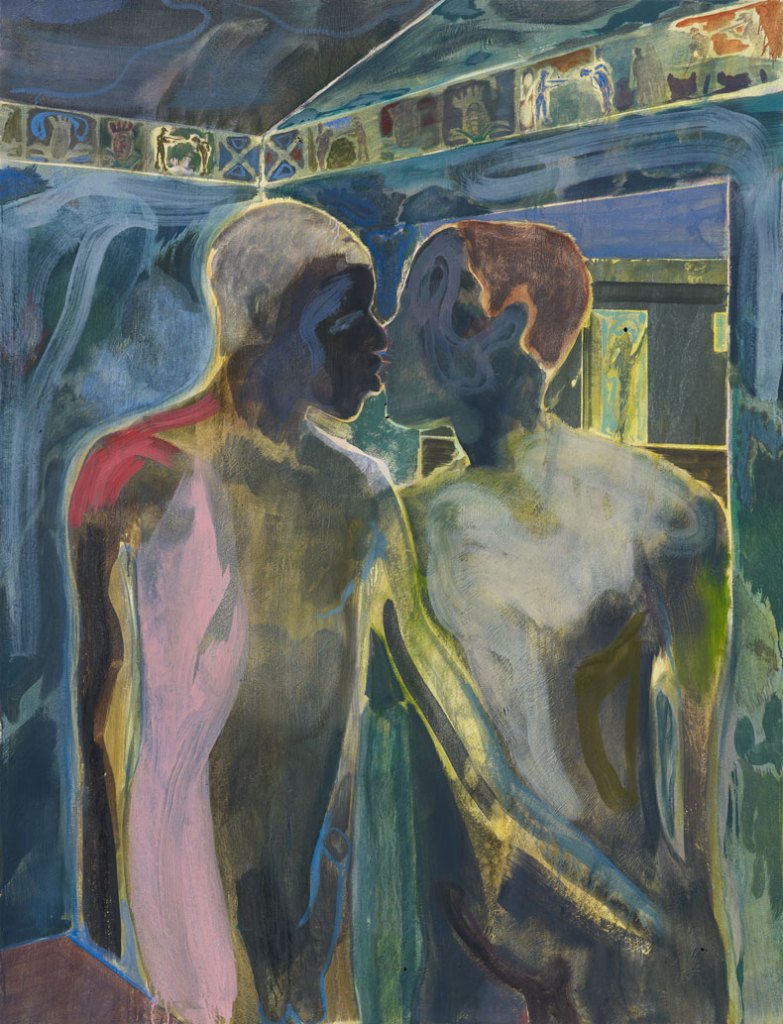
One constant in Armitage’s career has been his riffing on European art history in depictions of contemporary scenes from East Africa. Take Kampala Suburb (2014), at first glance a tender painting of two men kissing in what might be a bar or nightclub in the Ugandan capital. Study the frieze above their heads and you’ll notice variations on a composition lifted from Goya’s The Third of May 1808 (1814), in which a desperate resistance fighter is about to be shot by firing squad. Armitage painted the work not long after the Ugandan government imposed a penalty of life imprisonment for anyone found to be gay; the original bill had stipulated the death penalty. The artist’s rich, velvety colours are what draw you in, but devils lurk in the details.
Born in 1984 to a Kenyan mother and an English father, Armitage spent the first 16 years of his life in Nairobi, surrounded by coffee plantations, on the fringes of Karura Forest – now considered fairly central to the city but then on the outskirts. ‘I feel like I had a very fortunate childhood,’ he says – barring the single term he spent at Stonyhurst, a boarding school in Lancashire, where he would place his mattress over one of the old Victorian pipes in the floor to try to get warm. After the sixth form at Bryanston, a more arts-friendly school in Dorset where Armitage ‘lived in the art room’, he enrolled at the Slade School of Fine Art in London, where he studied under tutors including Phyllida Barlow. After graduating he spent a further three years at the Royal Academy Schools. ‘There was a less generous spirit in the kinds of criticism that were circulating than at the Slade,’ he says. ‘I wanted to break down my practice and rebuild, which is a very uncomfortable thing to do. […] I really wanted to understand all the decisions I was making: the subjects I was painting, whether I could find other ways of making that would satisfy me, whether I wanted to paint at all.’
Part of this self-questioning involved a three-year dalliance with abstraction and, although he eventually abandoned this path, vestiges of that period remain. Conservationists is one example: on the right-hand side it’s clear that you’re looking at a man’s back, but the figures on the left are obscured by, or composed of, cubist rectangles. ‘The things I was thinking about when making abstract paintings were kind of the same as what I’m thinking about now,’ Armitage explains. ‘You still have the same compositional problems. You still have the issue of a mark, the history of a mark. Abstract paintings – certainly the way I was making them – still had a narrative.’
The surface on which those marks are made also tell a story. In 2014, Armitage began painting on lubugo, a material made from the inner bark of a fig tree, which is lightly burned, cleaned, soaked in water and beaten for several days with wooden mallets to flatten it out. (The mallets are ridged, so the mark-making begins before Armitage does.) The painter first saw the material being sold at a market in Kenya as a tablemat made from a Kenyan textile, but it is in fact traditionally produced by the Baganda people of Uganda – primarily to make burial shrouds, but also for painting on.
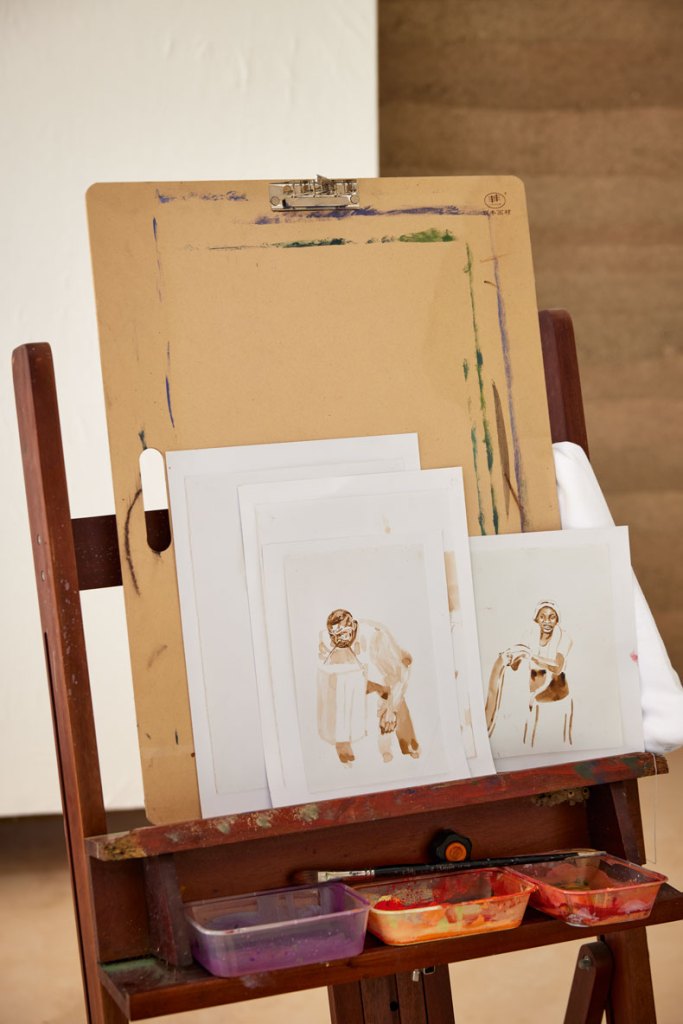
However, moving to Indonesia – he divides his time between Jakarta and Bali – has made him realise that bark cloth is not as specific to East Africa as he thought. Indonesians, for example, also use it for shrouds. ‘Two things have shocked me about the material,’ he says. ‘I felt like I was doing something original and new with it, but that wasn’t the case at all. I was just ignorant of how much it had been used in art-making, particularly in Uganda, for decades before I started doing it. But also, just how ubiquitous the material is across all the tropics. All of the areas around here [Indonesia], everyone’s been using it for thousands of years.’ Lately Armitage has been using Sumatran bark cloth, which has a texture largely similar to lubugo. It takes six months to source one roll that, though many metres long, is never more than a metre wide.
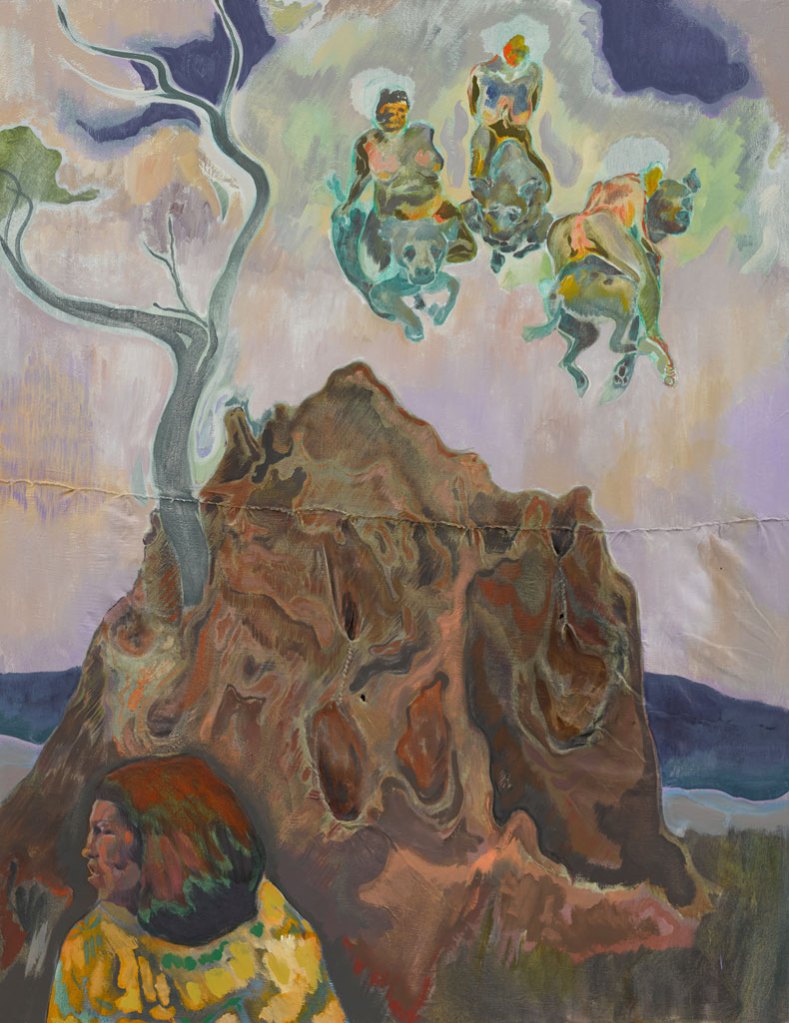
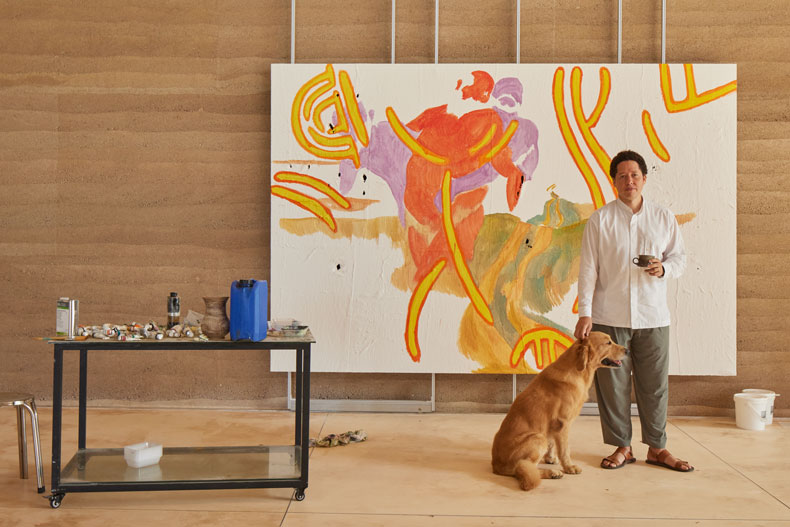
When I visit Armitage’s purpose-built studio on a cool February morning, there is only one painting on display – a work in progress that nods to the cave paintings on Sulawesi. The paintings that would otherwise have been here are on their way to Venice. We are surrounded instead by blank lubugo canvases bathed in sunlight from a glass gable wall. Normally the lack of work might be a disappointment, but it’s a thrill to see these sheets unpainted: they are covered with fine striations, seams zipping across the canvas, the occasional gaping hole like an unwitting homage to Lucio Fontana. As a result, I better appreciate the wit of Anthill (2017), in which Armitage lets these irregularities guide his depiction of the pocks, scars and canyons of an ants’ citadel.
Lubugo is not the only material Armitage has been working with of late. The ‘Crucible’ show included his first sculptures: four stations of the cross cast in black bronze from teak carvings. ‘One of the amazing things in Bali in particular is the tradition of carving and sculpting,’ he says. ‘Everybody here can carve; people grow up carving. So it’s been an amazing place to start doing that, and to be able to ask questions. It was very strange for me how similar I found carving to drawing. Painting is a very cerebral exercise, but there’s something much more physical about sculpting, when you’re bringing something into form […] It felt like a very direct way of making something.’
Armitage moved to Bali in late 2022; his wife is Indonesian. ‘Nobody calls me before 3pm here, because everyone’s asleep on that side of the world. The single biggest thing I’ve had from the move has been quiet.’ The word that comes to mind when I explore the area around Ubud is ‘profusion’: of vegetation, of sculpture, of tropical critters. This is also the case for much Balinese art of the 20th century, as a visit to the Neka Art Museum makes clear: the large wood sculptures and oil paintings are feverishly detailed and bursting with overlaps of human and animal life. Armitage’s paintings are similarly full of incident or detail and, if his most recent work revels in drawing parallels between palaeolithic art and 21st-century creativity – such as an unprecedented move played by the computer program AlphaGo against a human player in a game of Go – that seems fitting for an island where the weather conditions make statues from the recent past look like antiquities, dappled with damp patches and colonised by moss.
‘The landscape is quite overwhelming, as is the culture,’ Armitage says. ‘There’s a lot of imagery around – the presence of spirits and unseen things that take form in sculpture, drawings, music, performance, even health. That’s what painting is: giving form to an idea, a feeling, an experience. You try to give it a form that hopefully doesn’t exist already.’
An unexpected consonance between Armitage’s new home and his art becomes apparent as I walk down Ubud’s high street. He has spoken before about his fascination with (and wariness of) ‘self-exoticisation’: when a certain people mould themselves to foreign expectations, consciously or unconsciously. Bali has its own version of this phenomenon. The island depends on tourism and the galleries that throng Ubud sell animal paintings, depictions of rice paddies or Hindu and Buddhist iconography, mostly to foreign buyers.
Armitage has done more than his fair share to complicate, challenge or simply ignore stereotypes of East Africa, not only through his painting but also by founding the Nairobi Contemporary Art Institute (NCAI), which he continues to oversee both from afar and in person during the three to four months a year he spends in Kenya. ‘In 2017 I’d asked artists, students and other art practitioners in the region: what are the things we’re lacking in Nairobi?’ he tells me. ‘And everyone said the same things: a different type of higher education and a non-profit art space.’
The NCAI opened in earnest in 2022 and since then it has staged numerous exhibitions, published artists’ books, worked with government and private schools to broaden art education in Kenya, and set its sights on moving into a purpose-built home in the next five years. Armitage has made all this possible, but the dream is for the NCAI to be able to support itself; it is already curatorially independent. Things are going well, he says. ‘The single thing I am most proud of with NCAI is having a very young team, most of whom have no experience in the art world, come and pull off a space that sets a standard in Nairobi and in the wider region.’ Artists such as Ibrahim Mahama and Larry Achiampong have taken part in NCAI events, and exhibitions have been organised in collaboration with institutions including Kunsthaus Bregenz in Austria.
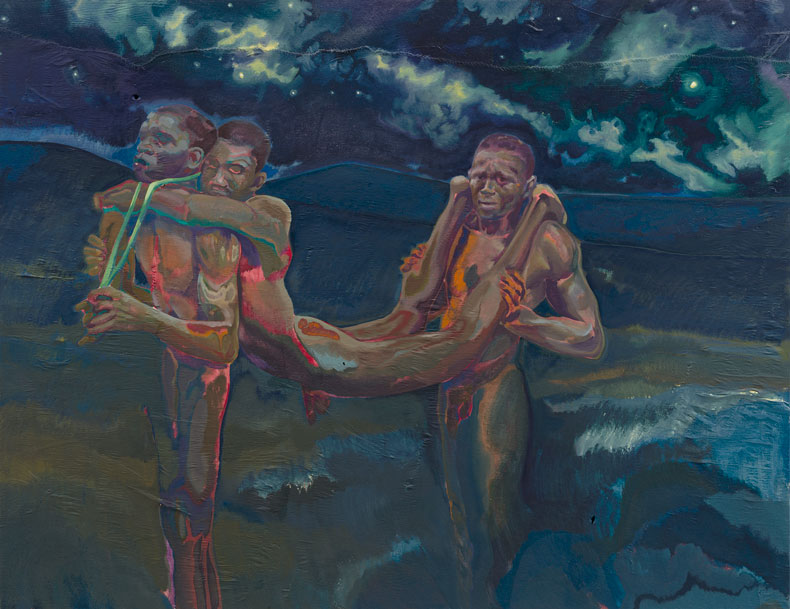
The NCAI has also built up a permanent collection of mostly East African art from the last 60 years. This, as much as anything, will be crucial in helping young talents develop an independent artistic identity. Armitage cites the National Gallery, the Courtauld, the Tate museums and the Prado as essential to his own artistic development, but he might not have become an artist if he hadn’t been exposed at an early age to the private collection of his friend’s mother, the sculptor Chelenge Van Rampelberg. She introduced him to the work of the Kenyan painter Meek Gichugu, an artist to whom Armitage keeps returning. ‘There’s something in the crudity of the mark-making and the images: they’re totally unrepentant things,’ he says.
Armitage becomes animated when talking about Titian and Goya, Jacob Lawrence and the Ugandan painter Peter Mulindwa (the NCAI plans to make a book about Mulindwa). He is also forthcoming when asked about his own work, but does not enjoy being the centre of attention. The difficulty, he says, ‘is going from a position of not having to talk about your work that much, because people aren’t interested, to people telling you that what you’re doing is good, and having to talk about it all the time. Because then things suddenly become more set than they are. You’re suddenly accountable to something you said 10 years ago, and everything has to be explained. For me that’s an uncomfortable pressure.’
Now a little uncomfortable myself, I concentrate on stroking and scratching Sino (pronounced ‘Sinyo’), the family’s golden retriever, a good boy who has spent most of the 90-minute interview at my feet. But Armitage is making a fair point. His art is far more interested in states of flux than in fixed positions. However minatory his paintings can be, with undercurrents of violence, degradation and entrapment, they remind us – through surprises of colour and dissolution of form and line – that there is always a point at which anything is possible.
‘Michael Armitage: The Promise of Change’ is at the Pinault Collection (Palazzo Grassi), Venice, from 29 March–10 January 2027.
From the March 2026 issue of Apollo.