Last month Miguel Falomir, director of the Prado, caused a stir at a press conference when he said, ‘The Prado doesn’t need a single visitor more.’ The success of a museum, he added, ‘can collapse it, like the Louvre, with some rooms becoming oversaturated. The important thing is not to collapse.’
The Louvre, under pressure from constant strikes, infrastructural woes and the fall-out from the heist that took place in October, did not exactly need this extra press – especially because its director, Laurence des Cars, is already aware of the problem. She has been trying to reduce visitor numbers at the Louvre since taking the reins in 2023, with limited success. Last year she wrote, in a memo addressed to the culture minister Rachida Dati but leaked to the press, that overcrowding made visiting the Louvre ‘a physical ordeal’.
But how many visitors is too many? For the Louvre, the answer to the first question is well below 8.7 million, which is how many people streamed through its doors in 2024. Overcrowding is one of the principal reasons for the staff strikes that have long been afflicting it. ‘The working conditions and the infrastructure have seriously worsened in the past four years,’ Elise Muller, general secretary of the culture branch of Union Sud, said last summer. ‘The understaffing has become monstrous in all the areas in charge of visitors.’

Emilie Gordenker, director of the Van Gogh Museum in Amsterdam, has said that one of the accomplishments of which she is most proud is thinning the crowds: between 2017 and 2025, the number of visitors to the museum fell from 2.3 million to less than 1.9 million. ‘The visitor experience was a bit unpleasant,’ she told the Times last year. ‘What we decided to do would be to privilege quality over quantity. So we really thought about the visitor experience.’
At the press conference, Falomir said something similar: ‘You can’t judge a museum on visitor numbers. The quantity isn’t as important as the quality.’ But how to define ‘quality’? Falomir seems to define it as ‘a diverse and inclusive range of visitors’. Gordenker puts user experience front and centre when thinking about visitor numbers: over email she emphasises ‘visitor satisfaction ratings’ and ‘reputation score: how the Van Gogh Museum is perceived in the Netherlands’. British Museum director Nicholas Cullinan seems to think less quantitatively: alongside visitor figures, he explains, the research the institution carries out, ‘the extent to which the public […] engage with and respond to the principle and purpose of the encyclopaedic museum’ and ‘the amount of positive difference we make in society’ are how the museum measures success.
Visitor numbers still matter to museums, though. When Maria Balshaw announced in December that she was stepping down as director of the Tate, it was widely noted that museum attendance had fallen by 27 per cent since 2019. (She assumed the post in 2017.) The Association of Leading Visitor Attractions (ALVA) compiles a list each year of the top 100 museums in the UK by visitor number; the Art Newspaper does the same for museums around the world. Judging by the stream of press releases from institutions announcing their visitor numbers each year (and trumpeting attendance figures for individual exhibitions, which can’t hurt when sponsors are involved), the number of people who visit museums is a core part of signalling success to the media.
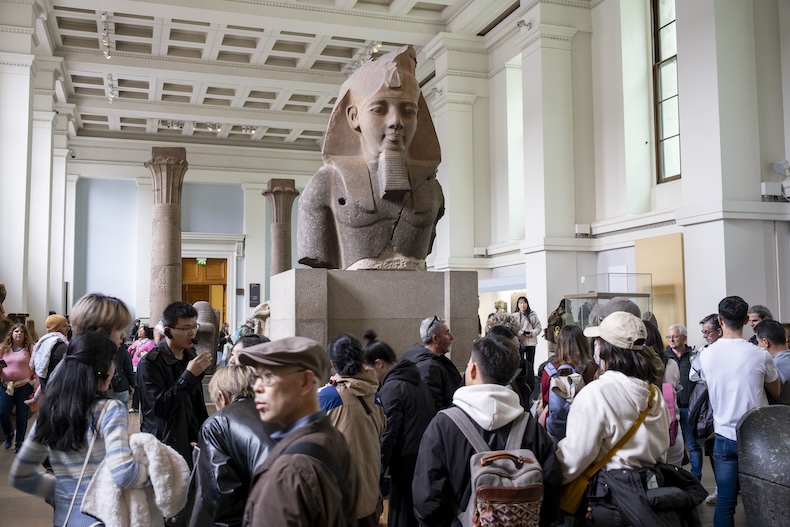
Visitor numbers are also how museums think about their own success when talking to their stakeholders. In his foreword to the British Museum’s annual report and accounts for 2024–25, the very first thing museum chair George Osborne mentions is the 6.5 million visitors who came through the museum’s doors that year. Max Hollein, CEO and director of the Metropolitan Museum of Art in New York, does much the same in that institution’s annual report, referring to the Met’s 5.7 million visitors that fiscal year – a five per cent increase on the previous year. (This doesn’t seem to be too many visitors for Hollein: in the calendar year 2025, the Met had 6.3 million visitors.)
In any case these numbers should be seen in context. The Louvre’s pole position is especially impressive – or dismaying, depending on your point of view – when considering that, unlike the British Museum, the Rijksmuseum or the Prado, it’s closed one day a week. There’s also the fact that certain parts of some museums will be extraordinarily crowded while others are deserted. Fixing such imbalances are easier said than done: earlier this month union organisers cited the Louvre’s redevelopment plans, which would involve the Mona Lisa getting its own gallery to ease overcrowding, as another reason for their strike. In their view, des Cars should focus on ‘technical work’ – repairs to the fabric of the building and improved security measures – instead.
For Hollein, the more important metrics are ‘the duration of stay, the percentage of repeat visitors, and general audience satisfaction with the visit’. He points out that ‘the median length of stay for a Met visitor is two hours and 43 minutes, longer than the average length of a movie.’ After all, as anyone who has been absorbed by a work of art knows, it’s not the numbers in which we turn up that matters, but what we encounter when we do.