From the October 2026 issue of Apollo.
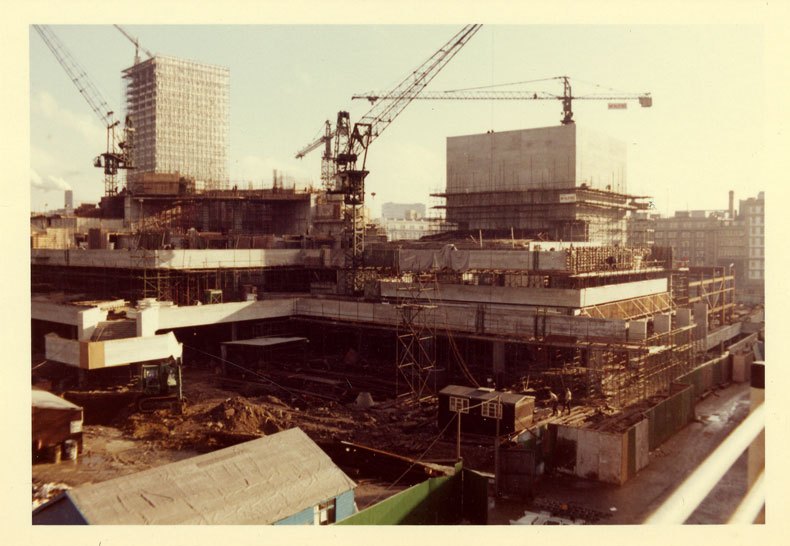
Had things worked out differently, we might be celebrating a centenary and not a 50th anniversary. But then we would merely have a national theatre, and not the National Theatre. The director and playwright Harley Granville-Barker advanced the first serious proposal for a home for British drama in 1907; an architectural competition was held in 1924. The pursuit of a national theatre was already a long-running affair when the first plans were laid during the Second World War for a cultural complex on the South Bank of the Thames. Not until 1976 was Denys Lasdun’s building finally completed.
Lasdun’s National Theatre (NT) still has the power to provoke and surprise, though today it is not the shock of the new but the continual rediscovery of a building that might have become familiar. The strong horizontal layers of Lasdun’s structure – he called it a building ‘without facades’ – were intended as a dialogue with the Thames, but today that dialogue is rather muffled as the theatre can be only half-seen from the far side of the river, thanks to the mature trees that have grown up in front of it. The electronic sign, which adds a touch of West End pizzazz, is fortunately still visible. To admire the architecture, the southern end of Waterloo Bridge is still the best seat in the house. The projecting terraces are balanced by the monumental vertical blocks of the fly towers of the two largest stages, the Olivier and the Lyttleton. But the skeleton key to the whole composition is the cluster of passenger lift towers around the foyer, which are set at 45 degrees to the rest of the plan. This simple twist, and their chamfered corners, make them almost delicate, and essential. The way they frame the entrance is classical in sensibility, but the execution is exquisitely modern.
The National Theatre’s reputation for architectural austerity stems from the use of board-formed concrete both inside and out. In fact it is a warm and luxurious building. It is grand, but without empty grandeur. The wood-grain markings in the concrete invite the hand; Lasdun wanted it to evoke ‘warm stones, ancient ruins, the non-slick and the permanent’. In places including the stairs that take visitors to their seats, it creates some of the intimate atmosphere of older theatres. The building is always successfully concealing its own enormous size, before revealing it right on cue. Climbing up to the Olivier – the largest of the NT’s three theatres – it is still a delightful surprise to find oneself suddenly at eye level with Waterloo Bridge, watching the buses go by, feeling in the heart of the city. Lasdun called this relationship between building, people and the rest of London ‘the fourth theatre’.
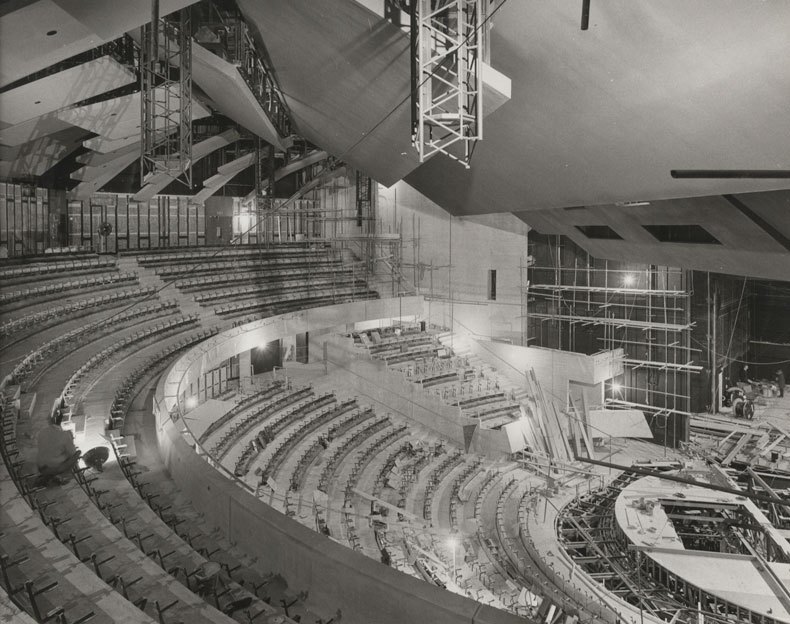
The NT’s half-century has a worthy monument in Richard Pilbrow’s book A Sense of Theatre (2024). This thumping account of the theatre’s design, construction and use is also a monument to Pilbrow, who had been intimately involved in the technical aspects of the project and who died in 2023. It is, necessarily, a warts-and-all telling. Such an ambitious and unprecedented building – Lasdun had never designed a theatre before – inevitably had pitfalls and shortcomings. In his foreword to Pilbrow’s book, Richard Eyre (director of the NT from 1988–97) recalls telling the actor Albert Finney about a comparison the director Peter Brook made between a theatre and a violin. Like a violin, Eyre said, a theatre’s tone came from its period and age. ‘Yes,’ Finney replied, ‘and who’d build a violin out of fucking concrete?’
It has, however, been resolutely popular with its users, on stage and in the audience. ‘Above all it was an actors’ theatre,’ the director William Gaskill remembers in his memoir of 1988. A little-known feature of the building is the lightwell sandwiched between the stages, around which the dressing rooms are organised, looking on to each other and contributing to a sense of community in the company. Really, though, it is the public areas that cement the triumph of the NT – Lasdun’s ‘fourth theatre’. It is an open and welcoming place throughout the day and a refuge from the busy South Bank, a remarkable consummation of Lasdun’s enthusiasm for a democratic landmark.
This everyday use has been a far better defence of the building than a hundred architectural essays. A renovation plan in the 1990s proposed demolishing one of the terraces and the elevated walkway connecting the theatre to Waterloo Bridge, but fortunately this was not carried out – and we can somewhat forgive Eyre for the suggestion if we remember what a mistreated and forbidding place the South Bank could be in the late 1980s and early ’90s. The pedestrianisation of Theatre Square has been a tremendous success – as with most places where motor vehicles have been banished, it is now hard to remember or believe they were ever allowed – although the honky-tonk food trucks that are often parked outside are maybe a little too democratic. An extension to the south by Haworth Tompkins, completed in 2015, is appropriately humble in the presence of greatness. The dramatic diagonal buttresses supporting the projecting office floors, made glorious by a vaulted soffit, have been spared prettification by coloured paint, as elsewhere on the South Bank. The NT’s neighbour to the east, a building for IBM designed by Lasdun as a companion to his theatre, has weathered threats and has been intelligently renovated by AHMM.
What remains is to reunite the National Theatre with the rest of London. The full-grown trees along the river front provide a priceless amenity to the South Bank promenade but do obscure the view from the north. It is sacrilege to suggest felling full-grown and healthy London planes, charismatic megaflora that they are. But the removal of just two (or maybe four) of these beauties to give a glimpse of the foyer from across the river might be an improvement and would also give a better view of the river from the theatre’s Weston Terrace. To avoid scandal it is probably best to let natural causes do the work; planes can live for 300 years, so this is a proposal for the tercentenary in 2276, when I hope that the National Theatre will be a monument as indelible as the Tower.
From the October 2026 issue of Apollo.