From the March 2026 issue of Apollo.
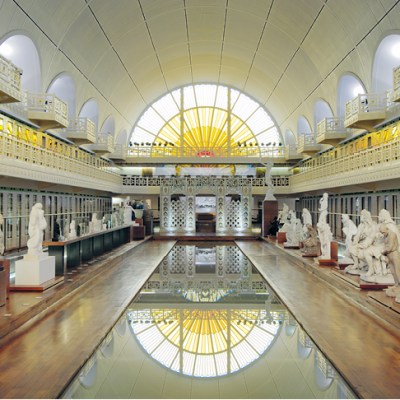
Recently reopened after a major restoration, the Yrjönkatu Swimming Hall in Helsinki was Finland’s first indoor pool. It was designed by Väinö Vähäkallio in 1928 and a century on continues to offer separate swimming sessions for men and women, either with or without swimming costume. But its real significance is as an example of Nordic classical architecture – that brief but extremely rich movement which dominated the architecture of the region between 1910 and 1930.
Long ignored, or indeed dismissed by many architectural historians, Nordic classicism was seen as something of an embarrassing interlude in the development of modernism – a backward look within the progressive narrative. Modernism was regarded as having emerged from the rejection of 19th-century historical styles, via the morality, honesty and restraint of the Arts and Crafts movement (or National Romantic movement in the case of Scandinavia), eventually evolving into the functionalist architecture of the late 1920s. That the Scandinavian countries (so long regarded, later, as one of the most fertile grounds for modern design) should have engaged in a brief classical revival during this period was almost incomprehensible. The reality was, however, that the Nordic classicists were engaged in something much more radical and relevant to their times than simply reproducing what had gone before.
As has so often been the case, this new generation of artists reacted against their elders – in this case, the National Romantics, who, inspired by a growing nationalism, looked backwards and inwards to the Norse myths of the region. The Nordic classicists wished to reconnect with Europe and the great European tradition of classicism, and thus to evolve a new style of architecture for their now fast-expanding cities as they underwent their late industrialisation. Their principal sources lay in Italy and their leading proponents – including Gunnar Asplund, Sigurd Lewerentz and Hilding Ekelund – carried out extensive visits to the country, studying both the classical and vernacular architecture of the region and at the same time witnessing a highly attractive urban lifestyle, which they saw as a model for the urbanisation of their own countries (despite their hugely contrasting climates). These ideas then became interwoven with their own ascetic Protestant culture, the local architectural precedent of C.F. Hansen’s ultra-restrained early 19th-century classicism in Copenhagen and the distinct thread of the visionary neoclassicism of Claude-Nicolas Ledoux and Étienne-Louis Boullée. Sweden, the region’s economic powerhouse, provided the opportunities, and so it was in Stockholm that these themes first coalesced into a new style.
Led by Asplund (though strongly supported by Ivar Tengbom), these architects produced a series of outstanding buildings throughout the 1920s. They included Tengbom’s Stockholm Concert Hall of 1926, with its attenuated colonnade and shocking pale-blue render (the style described by the English architectural critic Philip Morton Shand as ‘Swedish Grace’); Asplund’s brilliant burnt-sienna Stockholm Public Library of 1928, with its outstanding entrance sequence, which rises from street level through darkness into the enlightenment of the vast circular top-lit reading room; and also his remarkable Bio Skandia cinema of 1923, in which he sought to recreate an Italian piazza indoors, with its stone-paved floor below an electric star-studded Mediterranean blue ceiling. Meanwhile in Copenhagen, Hack Kampmann produced his Police Headquarters of 1924 (still in use), with their entirely unexpected circular central courtyard, and Edvard Thomsen his equally elegant Øregård Gymnasium of the same year.
In Finland, the most significant Nordic classicists were Erik Bryggman and Hilding and Eva Ekelund. The couple toured Italy together in 1920 before writing their hugely influential article in Arkkitehti – ‘Italia la bella’ (1923). They regularly competed for public commissions in the ’20s with Pauli and Märta Blomstedt and Alvar and Aino Aalto, who would go on to establish themselves among the most famous modernist architects of the 20th century (and who would also regularly suppress the publication of their earlier classical work). These were contemporaries of Vähäkallio, the architect of the swimming pool, who, while never a leader of the movement even in Finland, was a very successful Helsinki architect, completing numerous buildings during the 1920s, including the massive red-brick apartment and office building Simonlinna in 1925 and the equally large head office of the Elanto Consumers’ Cooperative in 1928. Both adopt typical Nordic classical details, borrowing Asplund’s tomb-like triple-height entrance doorway from the Stockholm Public Library, and the Simonlinna building also displays the same tall, attenuated arches as the Yrjönkatu Swimming Hall. Asplund was then the young Alvar Aalto’s guiding star – almost all Aalto’s early classical designs from this period contained poorly disguised elements of Asplund’s completed buildings, with the great circular drum of Asplund’s Lister District Courthouse of 1921 appearing in both his Jyväskylä Worker’s Club of 1924 and his Seinäjoki Defence Corps building of 1926.
It was a profound shock to his contemporaries when, in 1930, Asplund took Scandinavian architecture off in a completely new direction with his contributions to the Stockholm Exhibition, which introduced modernist architecture to the region, at the same time sounding the death knell for Nordic classicism. He continued to lead the development of modernism through the first few years of the 1930s, until Alvar Aalto emerged from his shadow with the completion of his Paimio Sanatorium in 1933. Vähäkallio also abandoned the classicism of his swimming pool design, making the shift to modernism in the early ’30s and continuing his successful practice throughout the next few decades, during which he produced numerous public buildings, including the waterfront headquarters of the national alcohol monopoly Alko in 1940 (since 2004 the Helsinki Court House); and his final building, the Helsinki Finnish Club of 1958.
Like Vähäkallio’s swimming pool, most of the significant buildings of the Nordic classical movement have survived and either are being or have been fully restored as they reach their centenary. They continue to be held in great affection by their communities and to evoke and support the civilised society to which their architects aspired.
From the March 2026 issue of Apollo.