From the January 2026 issue of Apollo. Preview and subscribe here.
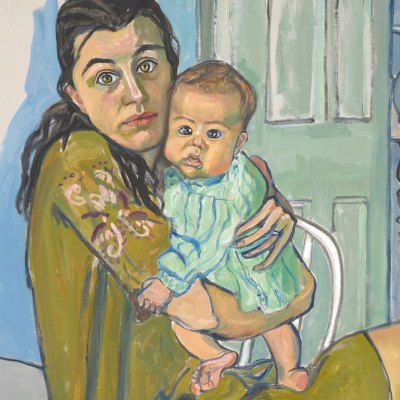
During the run of the Alice Neel exhibition at Barbican in 2023, I tried to inspire an older female relative to accompany me to the show. I told her about Neel’s political activism, her maternal grief, her zingy New York portraits. All was going well until I described the exhibition’s opening display: a nude self-portrait painted by the artist when she was 80 years old. My relative – circling 80 herself – was horrified: ‘Nobody wants to see that!’
A couple of months ago, I repeated this story to Joan Semmel. We were sitting in her apartment in New York’s SoHo, surrounded by paintings from across her long career. Semmel had just turned 93 and her studio walls were busy with works in progress – paintings of nude female bodies, for which she had used herself as the model. They showed the body monumental, crammed tightly into the space of the picture so that limbs, torso and breasts framed apertures to the darkness beyond. Semmel’s colours are bright, acerbic – hot red and purple light carves its way across painted skin – betraying a joy in intense pigment that dates back to her days as an Abstract Expressionist. The liquidity of her paint gives the flesh a melting quality: this is soft stuff, gravity bound. Semmel works from photographs of herself but doesn’t consider most of these paintings self-portraits – she instead describes the figures as female icons, power images for women.
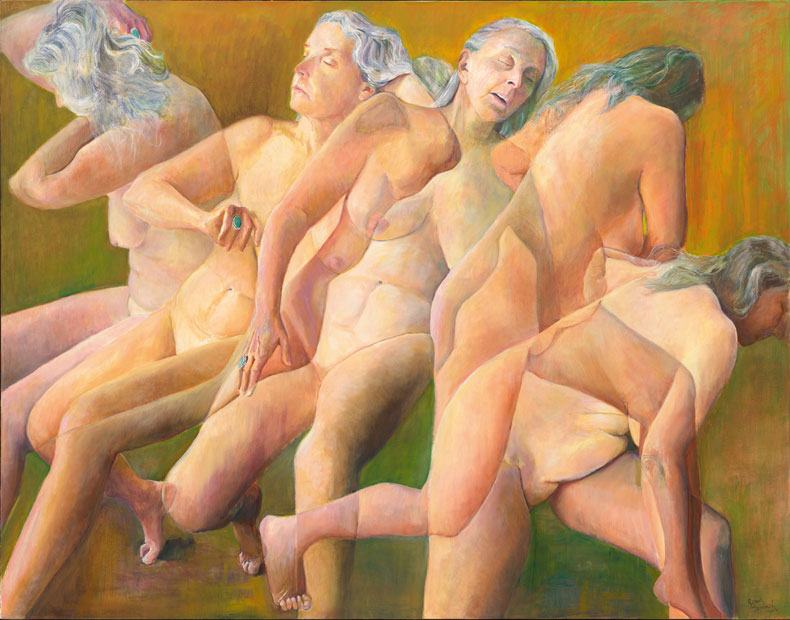
Semmel has been through a lifetime of ‘Nobody wants to see that!’ with her work. As an expat artist in Spain, she had early success as an abstract painter, but on moving back to New York at the turn of the 1970s her attention turned to figuration and to the naked body in particular. For a few years, working from life, she made explicit paintings of sexual intimacy. She moved on to portray the female body from a user’s perspective: a mountainous terrain that filled the field of vision. The sex paintings received some support in the feminist press, but no commercial gallery would show them. In the decades since, the female body has remained her primary subject. She has painted scenes in the women’s locker room at the gym, studies of discarded mannequins picked up in the street and arrangements of mirrors and cameras which give the viewer an uncanny sense of being looked at and objectified by naked women.
The thing about having an ageing body is that it is ageing all of your life. When Semmel first started working from her body, 35 was considered old, she tells me, and she was already a few years north of that. I wonder if she found this freeing? No, not at all – she felt inhibited. She was aware of her fluctuating weight, her less than perky breasts, her failure to conform to the classical ideal. She may have been committed to painting from her body, but she was still part of a culture in which women are taught from girlhood to police their physical appearance. That was over half a century ago. Semmel jokes that when people today tell her it’s wonderful that she’s painting older women, she replies, merrily, ‘Oh, am I?’
The window during which a female body conforms to what it’s ‘meant’ to look like is short – perhaps 10 or 15 years. Many women – be they taller or shorter, skinnier or heavier – may never conform at all. So, what do these women look like, if they don’t look like women? (This is not merely a question about beauty standards – the idea that a standard female body is that of a slim-yet-curvaceous white 20-year-old also has serious medical implications.)

We admire aged rocks and trees, so why not aged human bodies, Caroline Coon asks me. In Coon’s Self with Delphinium age 70 (2016) she paints herself naked, standing as strong and upright as the branch she grasps. Spear in hand, she is positioned like the archangel Michael – a supernatural being beyond gender. Sitting in her London flat, Coon explains that flowers carry both male and female aspects, reflecting feelings that she has carried throughout her life. Which is not to say she is uncomfortable with her body; she studied as a ballet dancer, knows her body well and respects it. She grew up with great admiration for the powerful bodies of the older dancers who trained her. To Coon, ‘Nobody wants to see that!’ is part of the expansive tradition of punishing women – shaming them for their bodies, their behaviour, their willingness to speak out – whether they’re Ariana Grande or Christine Keeler.
We are attentive to age in the art world. Apollo is not alone in listing an artist’s birth date immediately after their name. Some artists I have worked with fear this convention places them at a disadvantage, that they might be overlooked – might not be seen – on account of their age.
‘Nobody wants to see that!’ is rarely a straightforward response to art. Consideration of the work itself gets tangled up with feelings about one’s own body and the judgements we have internalised about ageing and beauty. Semmel and Coon’s nude paintings of their own bodies threaten to reflect something of ourselves back at us. They disturb cultural conventions about which bodies are allowed to be visible in public. Not just visible in Hollywood movies, or fashion advertising, but properly ‘seen’ – respected, afforded attention, culturally visible.
‘Joan Semmel: In the Flesh’ is at the Jewish Museum, New York, until 31 May 2026.
From the January 2026 issue of Apollo. Preview and subscribe here.