An early work in ‘I dreamt of you in colours’ feels unlike anything else by Otobong Nkanga in the exhibition. It appears to be a blurred photograph of a young woman, the artist, in an inky blue light, occupying a space roughly the size of a full-length mirror. Her head is bowed and she is wearing a white lace dress with a crinoline skirt. The image, Fattening Room (1999), depicts Nkanga’s attempt to reimagine a ritual of the same name practised by the Ibibio people of southern Nigeria. During this rite of passage (which has significantly waned in recent decades), young women and girls undergo a protracted initiation into marriage and are placed in a room for up to six months in order to be fed – both physically and metaphorically. The goal of the ritual is not only for a young bride to gain weight, but also to acquire knowledge of the family she will marry into and the social and economic environment she will inhabit.
Nkanga’s personal ‘fattening room’, however, was conceived thousands of miles away from her family’s Ibibio origins while she was studying at the École des Beaux-Arts in Paris. The artist never experienced the traditional ritual herself, but sought to create her own version in her studio. In an interview about the process included in the exhibition catalogue, she describes stealing soil from the university’s garden each day to construct the skirt from compacted earth mixed with white clay, building its rings around her body over the course of a month. Nkanga later worked with a fashion designer to create a European-style wedding dress, before hiring a photographer to take a series of images that she then cut up and recomposed to form the final image.
One of the earliest pieces featured in the exhibition, the artist’s first solo presentation in a French museum (travelling to Lausanne in April), Fattening Room is an unexpected but fitting introduction to her work. Spanning a 30-year career, the exhibition includes drawings, tapestries, installations and a handful of performance pieces that capture Nkanga’s enduring concerns with the structures that shape and disrupt our connection with the natural world and the layers of history that link one part of the world to another.
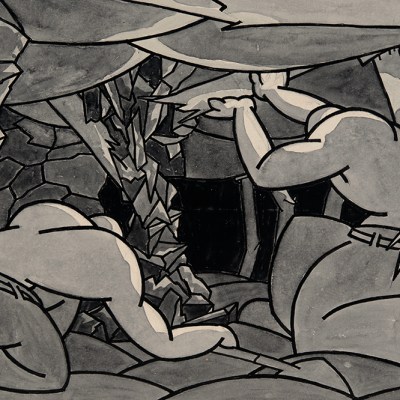
Although the exhibition is not arranged chronologically, a number of early works present the visual motifs to which Nkanga keeps returning. For instance, Awaiting Pleasures – On Fragile Grounds I (2003) depicts a feminine figure with its torso removed, mechanically tiptoeing across a raised grid, its dismembered arms raised while holding two rings aloft, as though it is rehearsing for some kind of performance. The drawing appears to be a study of a body moving through space, a mechanistic exploration of limbs as elements of a machine. But its significance is unexplained, leaving us to consider it as part of a wider series under the same title, including an installation called Awaiting Pleasures – The Workstation (2003). Featuring a wooden loom, oversized sewing needles, Post-it notes and various types of rope and thread, this is a seemingly prosaic glimpse behind the scenes of Nkanga’s tools – the instruments she will use to bring the ideas on paper into three-dimensional life. Around the corner, the severed roots of an orange tree appear to burst through a wall like a foot kicking through plaster, violently pierced with large needles (Contained Measures of Land – The Operation, 2008). The combination of wood and stainless steel is reminiscent of the workstation on display, an unsettling reminder of the potential of human tools to be used for art, industry or violence, for both creation and destruction.
The motif of sharp lines piercing, holding and suspending things in place runs through the exhibition, be it in works on canvas, monumental tapestries or floor-based installations. Similarly, traces of her drawings continue to appear in later works that are more ambitious in scale. The glimmering tapestry series Unearthed (2021) depicts undersea worlds that are simultaneously enchanting and unsettling. Transformed by the triangular slave trade, mining exploitation and climate change, the aquatic world becomes a punctured and entangled space in Nkanga’s imaginary, a deep-sea burial ground where mechanised human limbs sink and fuse with plant matter.

These limbs sometimes belong to humanoid figures that resemble artists’ mannequins; at other times they are entirely dismembered and depersonalised, as in The Weight of Scars (2015), Nkanga’s first large-scale tapestry. Created after a visit to abandoned mining sites in northern Namibia, the tapestry incorporates documentary images of the scarred landscape that float like orbs against the woven fabric. Although these photographs are held together in a constellation of sorts, they are also pulled apart by phantom limbs in a tug-of-war posture; their gesture points to the history of mineral extraction that decimated the landscape and underlines the use of certain bodies as mere instruments of labour.
The beauty of Nkanga’s work lies in its refusal to romanticise violent histories while offering glimpses of the potential for repair and renewal. In her series Social Consequences (2009–ongoing), the mechanical limbs reappear in further depictions of exploitative labour, but also in sensual colour images such as Earthing (2021) and Underneath the Shade (2022). Still, despite hinting at the possibility of metamorphosis, these surreal images hark back to the limbs piled at the bottom of the ocean as the figurines’ arms are punctured by the large black dots that accumulate in Nkanga’s imagery. The presence of these dots is ambiguous: do they represent holes or pins? Wounds, or joints?
In his writings on the contradictory sense of dislocation and connection that shapes diasporic experiences, the literary theorist Brent Hayes Edwards uses the metaphor of a joint to describe this paradox. For Edwards, ‘the joint is a curious place […] it is both the point of separation – the forearm from the upper arm, for example – and the point of linkage’ (The Practice of Diaspora, 2003). Although written to analyse Black diasporic literature of the 1920s, his words offer a useful frame for interpreting the black dots that punctuate Nkanga’s monumental body of work a century later. Throughout ‘I dreamt of you in colours’, the artist’s ecological questions acknowledge the horrors of environmental destruction while searching for signs of hope. In this light, the black dots pinned to Nkanga’s figurines feel like points of separation and linkage, injury and connection, as though she is asking: is this a puncture, or a space for a thread to be woven through?
‘Otobong Nkanga: I dreamt of you in colours’ is at the Musée d’Art moderne de Paris until 22 February 2026.