In May, the ‘giga-week’ sales of modern and contemporary art kick off in New York. Those auctions can suck the oxygen out of market at the top end, but not every seller wants to consign their works into that vast milieu. This is especially true of European, and specifically French, works, which often do better in their home market.
This month, most market activity is in Europe and right now is Paris’s moment. ‘There is clearly a deep-rooted passion among the local audience for the French Impressionist and Modern masters,’ says Arianne Piper of the art advisory Piper Ganay Partners. ‘New York still holds its position as the home for high-octane contemporary “trophy” lots, but I think Paris has really solidified itself as a primary hub for European modernism. The pull of Art Basel Paris is obvious, but the addition of Sotheby’s new space on rue du Faubourg Saint-Honoré, which opened in October 2024, has added a fresh layer of momentum.’
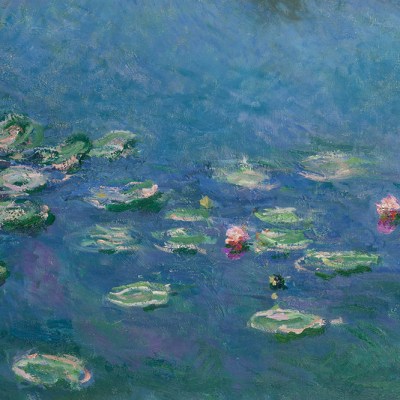
It was in that new saleroom that, on Thursday night, the highest-value sales of the week were made, for two rediscovered Monet paintings: Les Îles de Port-Villez (1883) for €6.4m (estimate €3m to €5m) and Vétheuil, effet du matin (1901) for €10.2m (estimate €6m to €8m). Overall, the sale at Sotheby’s totalled €35m, an 84 per cent increase on the equivalent sale last year.
Painted 18 years apart and 18km apart, the two Monet paintings had been hidden in two different collections in France for decades. ‘Until recently, we knew one only through a black-and-white photograph and the other through a printed plate published in 1985,’ says Aurélie Vandevoorde, head of Impressionist and modern art at Sotheby’s Paris.
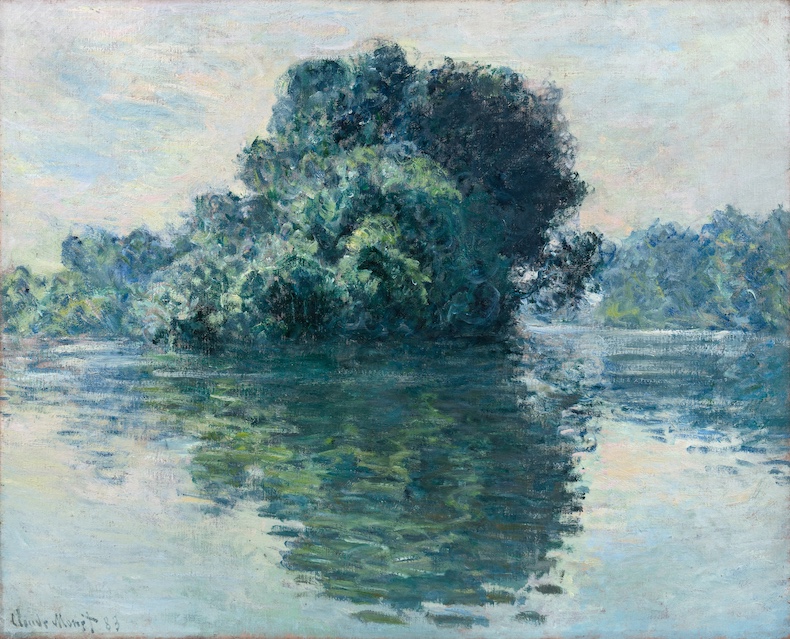
Les Îles de Port-Villez, painted shortly after Monet moved to Giverny, depicts a stretch of the river Seine that he would return to time and again. The work was bought by Monet’s dealer Paul Durand-Ruel shortly after it was completed. Vétheuil, effet du matin, last seen in public in 1928, depicts a different section of the Seine and was sold soon after it was painted to Bernheim-Jeune, the gallery once located in the same building as Sotheby’s on rue du Faubourg Saint-Honoré. It had been in the same French family collection since 1972. ‘It’s exactly these kinds of finds that highlight the central role France plays in sourcing major works and keeping the market for European modernism so vibrant,’ Piper says of the Monets.
The market for Monet has certainly become more selective in recent years and the conservative estimates on these two works reflects a broader caution across the auction houses in a softer global market. Thomas Bompard, a specialist in the Impressionist and modern department at Sotheby’s Paris, says that last night’s results ‘emphatically proved’ that demand for good Monets is still strong: ‘Vétheuil, effet du matin ignited an electric, 10‑minute bidding battle, setting a new auction record for Monet in France, while Les Îles de Port‑Villez attracted equally strong international interest.’ Bidding came ‘from Europe and beyond’, Bompard says, ‘reaffirming Paris’s position as a leading stage for major masterpieces’.
Ever since Christie’s sale of the collection of Yves Saint Laurent and Pierre Bergé in 2009 set new records for the designs of the husband-and-wife duo François-Xavier and Claude Lalanne, their work has been perennially in demand – particularly in Paris. Christie’s evening sale on Wednesday night included eight works by Les Lalanne, the highlights being three by Claude, including the playful Pomme de New York (2008), a giant bronze apple which sold for €6m, and a pair of bronze gates made for the Les Lalanne retrospective at the Musée des Arts Décoratifs in 2010 sold for €1.1m, more than five times the lower estimate.
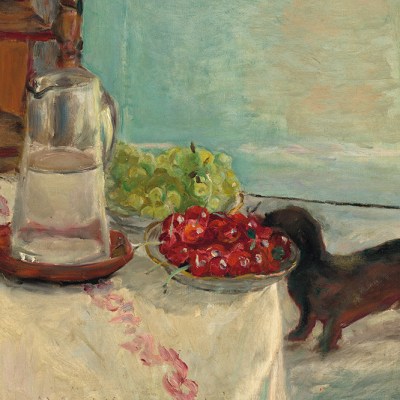
On Tuesday, Christie’s offered a group of fresh works by Pierre Bonnard from the collection of Claude Terrasse (1925–2008), the artist’s great-nephew and godson (and the grandson of the famous composer of the same name, who was Bonnard’s brother-in-law, friend and collaborator). The single-owner sale included 60 paintings, gouaches, drawings, illustrations and lithographs, estimated from just €100 to €600,000. All sold, for a total of €3.3m, above pre-sale expectations of €1.9m–€2.9m. The top lot, as anticipated, was the vibrant Midi au jardin (1946), a humming view of Bonnard’s garden at Le Bosquet near Cannes, painted just a year before his death. It sold for €762,000.
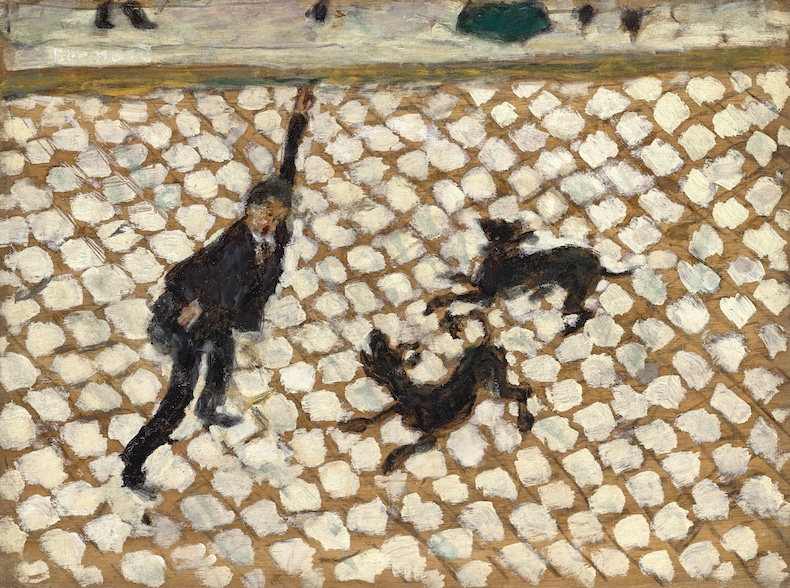
An unusual work from Bonnard’s Nabis period, La Rue; Homme aux prises avec deux chiens (1895), painted 50 years earlier in 1895, sold within estimate, for €330,200. Meanwhile, La Grand-mère ou La Grand-mère aux poules (1890), an oil portrait of his maternal grandmother painted at Le Clos, the family home near Grenoble, sold for €406,400, roughly double the estimate.
Valérie Didier, Christie’s head of sale at the Impressionist and modern art department, and co-head of 20th and 21st-century art evening sales, says that bidding came from the United States, France, Switzerland, Germany, Belgium and Asia, and that the Bibliothèque nationale de France pre-empted several lots. Midi au jardin drew most attention, Didier says, ‘because it is the most representative of Bonnard with its very abstract composition, full of colour and light, [and the] South of France subject, which equals very commercial’. This is in line with demand more broadly for Bonnard’s work, Didier says: ‘The market for bright, colourful, South of France compositions is the strongest, but also for Nabis works by the artist, which is the most sought-after period.’
The London-based dealer Stephen Ongpin says that the sale offered many interesting works at reasonable estimates: ‘The fact that the provenance came directly from the artist’s studio, via his nephew Claude Terrasse, meant that everything was fresh to the market, and for the most part in splendid condition.’ Ongpin adds that another branch of the Terrasse family has sold drawings and paintings by Bonnard before, in a large sale at Osenat auction house in Fontainebleau in 2015, which made €5.4m. That auction coincided with the major Bonnard exhibition at the Musée d’Orsay in Paris, which provided a helpful tailwind.
‘The Christie’s selection was smaller and more focused [than Osenat], with an emphasis on the Nabis period works, which are somewhat rarer, and also on his graphic work,’ Ongpin says. ‘I particularly liked the way in which the sale included several different studies for the same final work, like the four studies for Andrée and her Dog, which allowed one to see the process behind the artist’s development of the composition.’
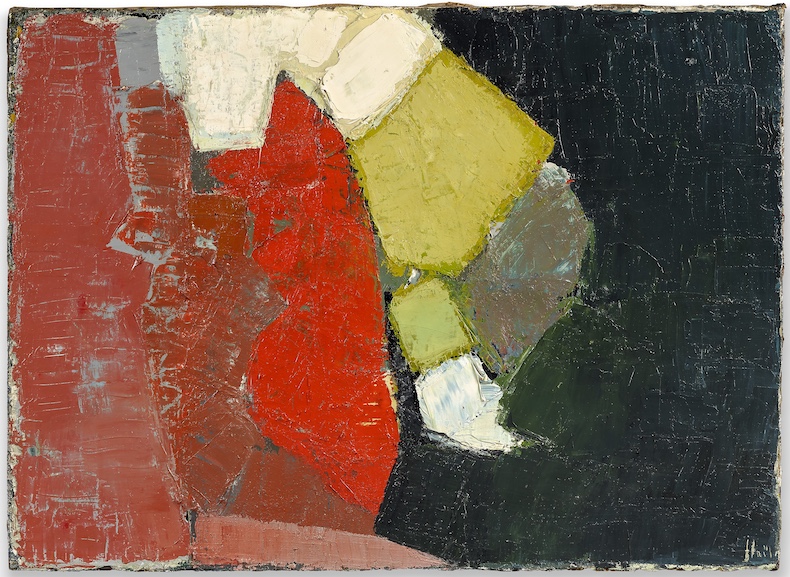
Artcurial held its evening sale of modern and contemporary art on Thursday. While a pastel by Paul Gauguin, Eve Bretonne (II) from 1889, failed to sell against an estimate of €550,000–€750,000, Isaure de Viel Castel, vice-president of Artcurial and head of its 20th-century department, said that the auction house was ‘delighted’ with the €1m paid for the top lot, Composition (1949) by Nicolas de Staël. Among other highlights were a rediscovered silver table centrepiece depicting a group of marabou storks by Rembrandt Bugatti (modelled in c. 1904 and cast 30 years later), which sold for €794,000, well above the €200,000– €300,000 estimate. ‘Tracy Emin’s blue neon set a record for a work by the artist sold in France at €161,000,’ de Viel Castel adds.
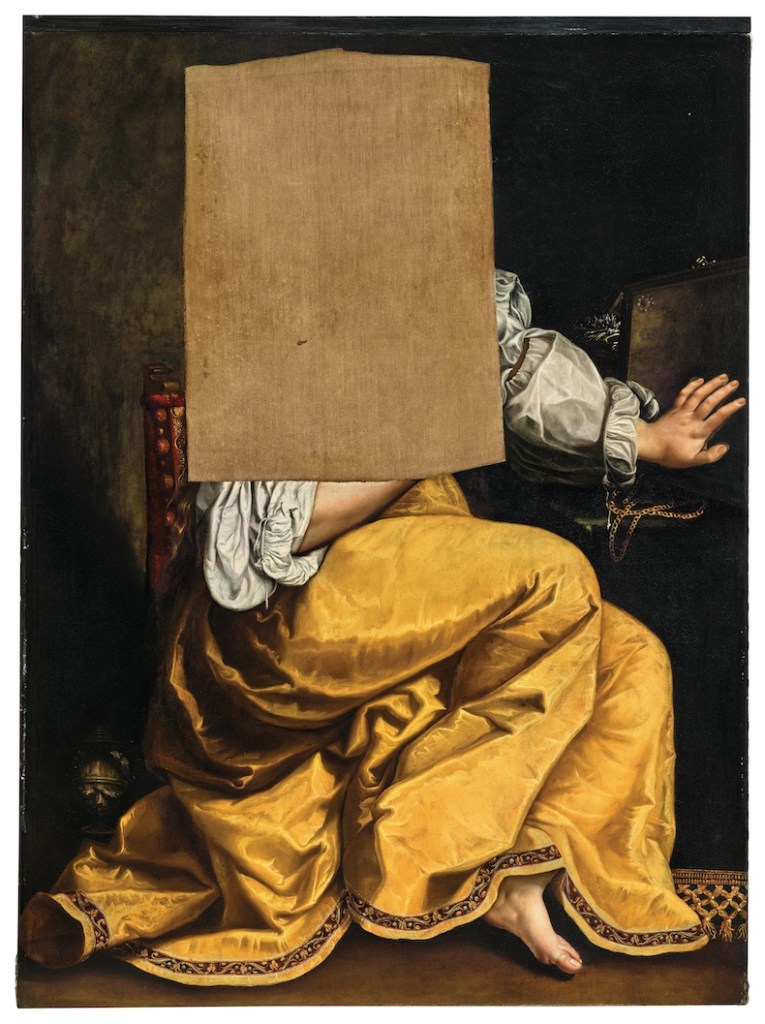
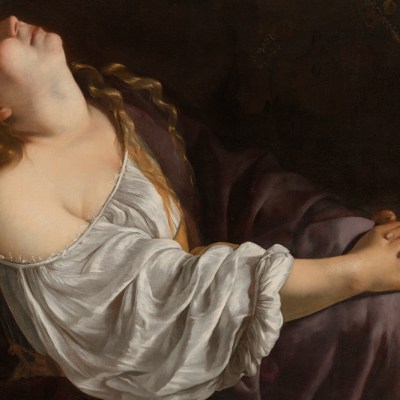
Looking ahead, on 28 April Dorotheum in Vienna will offer for sale a curious painting of Mary Magdalen by Artemesia Gentileschi (c. 1615–18). The only problem: Mary is missing her face, hence the cautious estimate of €100,000–€150,000. Dorotheum says that, for many years, the painting was rolled up in a cellar in Germany. It is not known how or when the head was cut out of the canvas, but the auction house suggests that it was ‘most probably linked to the chaos and looting of post-war Berlin’. The painting was first identified in 2011 by the Italian art historian and Gentileschi expert Roberto Contini, who says that it is an autograph replica of the painting of the same subject by the artist in the Palazzo Pitti in Florence.
Dorotheum is trying to spin the loss into a positive, drawing parallels with the concepts of negative space explored by Rachel Whiteread and Edmund de Waal. ‘The gaps and silence in the work of these artists turn loss into space in which emptiness speaks as powerfully as form,’ the catalogue intones. Whether that will wash remains to be seen.