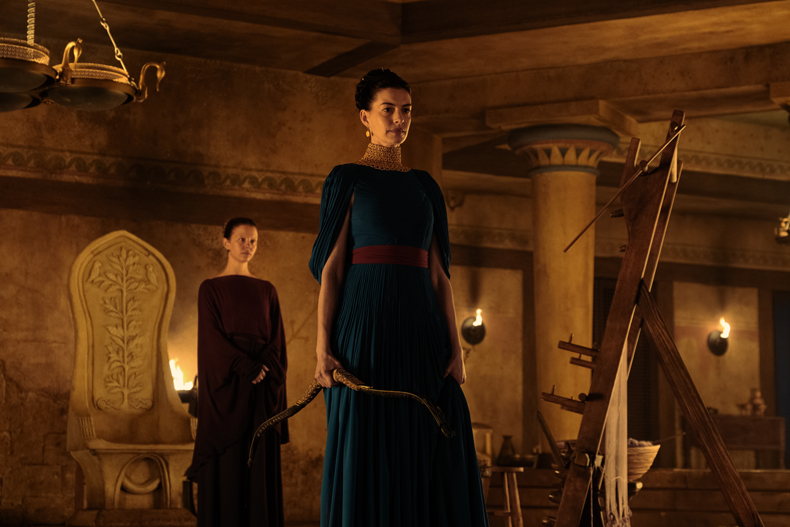
It’s hard for a 21st-century woman to get on board with Penelope. Unless, that is, you’re the kind of woman who gets up at dawn, dewy-skinned and gingham-garbed, to bake the day’s bread while your seven infants sleep rosy-cheeked in sheets you’ve hand-spun yourself, all the while posting perfectly lit photos of this wholesome existence on social media. Then Penelope, who has faithfully waited 20 years for her husband Odysseus’s return, weaving all the while, might be considered your OG. But for the rest of us she is something of an enigma. It takes an actress of Juliette Binoche’s calibre to imbue Penelope with a fierceness that is hard to glean in the original text, as she did in Uberto Pasolini’s The Return (2024). I’ll be interested to see how much agency Anne Hathaway brings to the role in Christopher Nolan’s much-anticipated new version of the epic (as it happens Hathaway has bought the film rights to, and will star in, Caro Claire Burke’s recently published tradwife novel Yesteryear).
For the ghost of Agamemnon in book 24 – as for the whole poem – Penelope is only virtuous, principled and intelligent insofar as these qualities relate to her husband (to be fair, Agamemnon has been murdered by his own wife’s lover). ‘Lucky you, / cunning Odysseus,’ the dead warrior says (in Emily Wilson’s translation of 2017), ‘you got yourself / a wife of virtue – great Penelope. / How principled she was, that she remembered / her husband all those years! Her fame will live / forever, and the deathless gods will make / a poem to delight all those on earth / about intelligent Penelope.’
Those on earth would have to wait nearly three millennia for poems or other texts that really were about Penelope: cue Carol Ann Duffy’s revisionist poem in her collection The World’s Wife (1999), or Margaret Atwood’s Penelopiad (2005), which retells the Odyssey from Penelope’s perspective and gives her the kind of lines that hit as zingingly as one of her husband’s expertly aimed arrows. Atwood spins one of the many ambiguities of Penelope’s story – whether or not she has already recognised the disguised Odysseus before he reveals his true identity in the archery challenge – into a piece of marital shrewdness: ‘Also, if a man takes pride in his disguise skills, it would be a foolish wife who would claim to recognise him: it’s always an imprudence to step between a man and the reflection of his own cleverness.’
The central symbol of Penelope’s fidelity in the Odyssey is, of course, her loom. Depictions of Penelope from ancient vases to Pinturicchio and beyond nearly always show her at her loom, or holding a ball of thread. The Romans ran with this signifier of a woman’s virtue – see Livy’s account of Lucretia, paragon of wifely loyalty, who was weaving at home when other wives were out making merry; or the emperor Augustus, whose push to clean up Roman morals in the early first century included making the female members of his family spin and weave his clothes.
Yet in the Odyssey it can’t be the fact of her weaving in itself that indicates Penelope’s dutiful fidelity. Odysseus and his men encounter the sorceress Circe as she is singing at her loom; even the nymph Calypso, who keeps Odysseus on her island for seven years as her sex slave (or so he portrays the situation), is up to a bit of weaving – albeit with a shuttle made of gold. Back in Sparta, post Troy, Menelaus and Helen seem to be living in well-oiled domestic harmony, in spite of the fact that her famously beautiful face has caused all this trouble (‘Look what you made me do!’ says many a man in Homer). How is this possible? Not just, surely, because Helen emerges ‘from her high-ceilinged, fragrant bedroom’ with her spindle and wool waiting. If Penelope is the Homeric version of the wholesome tradwife, Helen, in her lavishly decorated suburban pad, is the hot wife dispensing ‘medicine’ to her guests, her dealer another mum she knows: ‘Helen decided she would mix the wine / with drugs to take all pain and rage away […] Helen had these powerful magic drugs / from Polydamna, wife of Thon, from Egypt.’ As for so many modern couples, for Helen and Menelaus, microdosing – not weaving – seems to be the key to relational intimacy.
The real evidence of Penelope’s loyalty to her husband lies in what she does at night, in secret: unpicking her work so that the textile is never done; for she has told the 100 or so boorish ‘suitors’ occupying her house that she will only marry one of them once the shroud she is weaving for her father-in-law, Laertes, is finished. For several years she has managed to stall them in this way, ever hopeful of Odysseus’s return.
You can see why the Pre-Raphaelites took to Penelope. Her skill in weaving was an ideal subject for a group that, with William Morris et al, revived and celebrated craftsmanship. She was also, in the absence of her long-lost husband, a suitably tragic figure. Edward Burne-Jones, John Roddam Spencer Stanhope, John William Waterhouse – they all added Odysseus’s wife to their litany of mournful-looking women subjects.
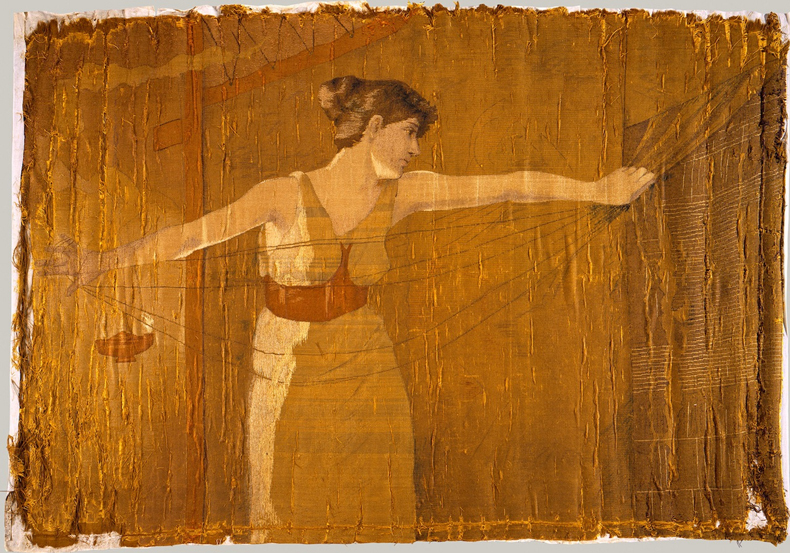
For all the richly coloured detail of those works, their renderings of Penelope and her predicament, to this viewer at least, feel flat. One of the most affecting images of Penelope I’ve come across recently is simple by comparison. It is, appropriately, a textile: a silk wall hanging embroidered with silk thread showing Penelope with her arms stretched out, tearing at the tapestry on the loom with her left hand; her right hand pulls the threads – real threads – away, winding them round her fingers. Penelope Unraveling Her Work at Night, now in the Met’s collection, was made in 1886 to a design by the American artist Dora Wheeler. Her mother, Candace Wheeler, seems to be something of an unsung doyenne of interior design – arguably the very first (move over, Elsie de Wolfe). She set up an interior design firm with Louis Comfort Tiffany before founding her own company, Associated Artists, which was entirely staffed by women and produced both handmade and machine-made textiles (the likes of Morris and Walter Crane were both influences on her work). Having moved away from commissions made for wealthy clients such as the Vanderbilts, Wheeler, like Morris, wanted to produce beautiful fabrics that middle-class households could afford. She did this in part by inventing new weaving and printing techniques.
The Penelope embroidery is probably the last remaining example of one of these techniques (patented in 1882) – what Wheeler called ‘needlewoven tapestry’, where stitches are passed in and out of a loosely woven silk canvas to give the appearance of a traditionally woven tapestry. The fact that this textile is worn, and particularly damaged on the right-hand side, where Penelope is tearing at her own tapestry, feels like a happy accident, only adding to the sense that we are witnessing the Homeric unravelling in real time. Tradwife or not, Penelope’s pain here is palpable.