From the January 2026 issue of Apollo. Preview and subscribe here.
The pomegranate – the striking, scarlet-hued fruit of the Punica granatum tree – has long been appreciated for its looks. One finds its distinctive rounded shape, topped with its small calyx ‘crown’, adorning Bronze Age necklaces, Renaissance textiles and colourful Iznik tiles on the walls of mosques. Among William Morris’s first wallpaper designs was ‘Fruit’, which featured stylised pomegranates, oranges, lemons and peaches.
Indigenous to an area reaching from north-west Turkey to Afghanistan, the pomegranate has long been cultivated in many parts of the world, including China, India and the Mediterranean region. It is remarkably rich in symbolic associations across various cultures. One recurrent association is fertility. The reason for this is clear when one cuts through the tough, leathery skin of a pomegranate to reveal the multiple seeds crammed inside. Its classical Latin name, malum granatum, means ‘seeded apple’: just one pomegranate contains 600-800 seeds. The Chinese character for ‘seed’ is the same as that for ‘offspring’ and in China, as elsewhere, the multi-seeded pomegranate is a symbol of fertility and abundance.
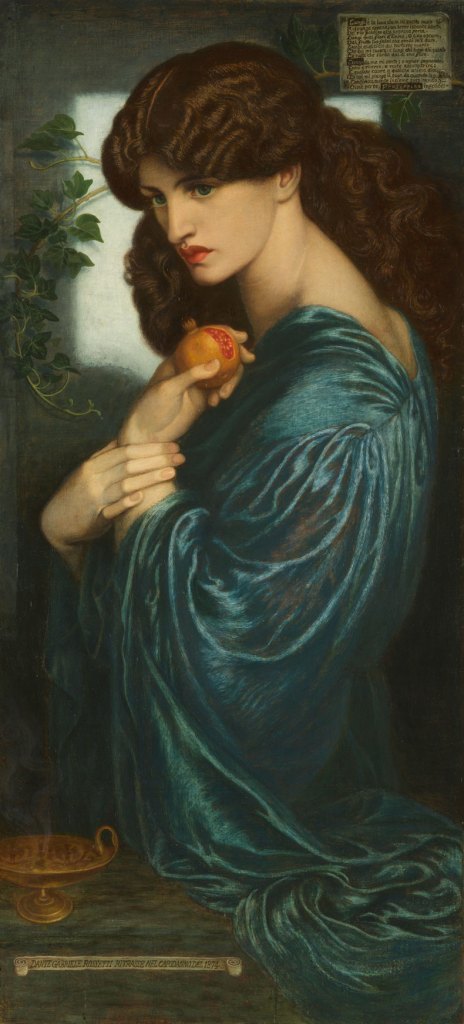
In Greek and Roman mythology, the pomegranate plays a decisive role in the story of Proserpine (Persephone), the beautiful young daughter of Ceres, goddess of agriculture, fertility and motherhood, and Jupiter, king of the gods. In Metamorphoses, Ovid tells how Proserpine is forcefully abducted by Pluto, the king of the underworld. Ceres pleads with Jupiter for her return, which he grants on the condition that no food has touched her lips while she has been in the underworld. Proserpine has, it turns out, eaten seven seeds from a pomegranate from Pluto’s orchard, an act that condemns her to spend half the year in Pluto’s gloomy kingdom – during which time the Earth endures winter as Ceres mourns – and half the year in heaven with her mother, when the Earth enjoys spring and summer. This myth inspired the Pre-Raphaelite artist Dante Gabriel Rossetti in 1874 to paint his lover Jane Morris, the wife of William Morris, in the guise of Proserpine. In the work, which is in Tate Britain’s collection, she is depicted as a graceful, disconsolate figure, clad in blue drapery, looking sorrowful and thoughtful. In her left hand she clutches the fruit that has condemned her to this melancholy existence: a pomegranate, slit open to reveal the seeds inside. In the corner of the painting is a sonnet by Rossetti, in which he ventriloquises Proserpine, who describes the pomegranate as a ‘drear / Dire fruit, which, tasted once, must thrall me here’.
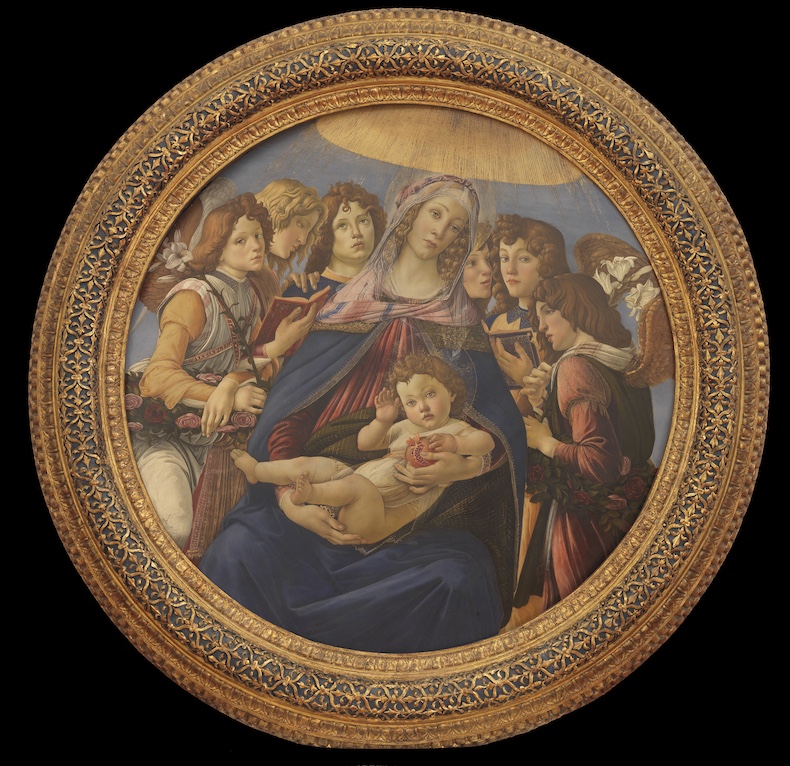
In Christian art the fruit represents Christ’s passion, with the juicy, bright red seeds akin to drops of blood. Botticelli’s Madonna of the Pomegranate (c. 1487) depicts the Virgin Mary holding the infant Jesus, surrounded by six angels. Though the composition is characteristically harmonious, there is a wistful quality to the expressions of Mary and the angels, while the baby cradled in his mother’s arms looks thoughtful. His chubby fingers clutch a pomegranate that his mother is holding in her left hand. A slash in the fruit reveals the crimson seeds inside – an omen of Christ’s fate.
Fertility, prosperity, blood, rebirth – the pomegranate is a fruit resonant of both life and death. In Greece it is a New Year’s Day custom to smash a pomegranate on the doorstep to welcome prosperity and good fortune to the home, while in the Eastern Orthodox tradition pomegranate seeds are used in koliva, a memorial food for the deceased. In Armenia the pomegranate is particularly full of meaning. The visually mesmerising film The Colour of Pomegranates by the Georgian-born Armenian film director Sergei Parajanov – made in 1969, when Armenia was part of the Soviet Union – features a scene in which the juice from three pomegranates seeps into a white cloth to form a shape resembling the ancient kingdom of Armenia.
In the UK today the pomegranate is promoted as a superfood. And in an age of social media, its striking form and colour adds to its appeal. Nigella Lawson – who has fond childhood memories of finding a pomegranate in her Christmas stocking – scatters the ruby seeds on dishes from cakes to salads, as does Yotam Ottolenghi. Today, those small, juicy, gem-like seeds – which doomed Proserpine to months of darkness – are sold pre-picked and packaged in supermarkets for use as a decorative garnish.
From the January 2026 issue of Apollo. Preview and subscribe here.