From the September 2026 issue of Apollo.
This exhibition about art and furnishings in Renaissance Siena opens with a full-length portrait of Scipio Africanus, the Roman general famed for his conquests on the battlefield and continence off it. With long, crimped blond hair and a bronze cuirass embossed with putti, Scipio stands on a plinth in camp contrapposto, one hand holding a billowing cloak to his hip and the other resting on a sword.
The painting is one of eight spalliera panels – painted works affixed to furniture – now scattered across collections in Italy, elsewhere in Europe and in the United States, depicting Virtuous Men and Women of classical and biblical traditions. Dating from the early 1490s, the panels formed a cycle running around the walls of a chamber, likely above a day bed (lettuccio), in one of the Sienese palaces of the powerful Piccolomini family. Scipio was probably the first figure in the series and the only one painted by its designer, the Sienese polymath Francesco di Giorgio Martini.
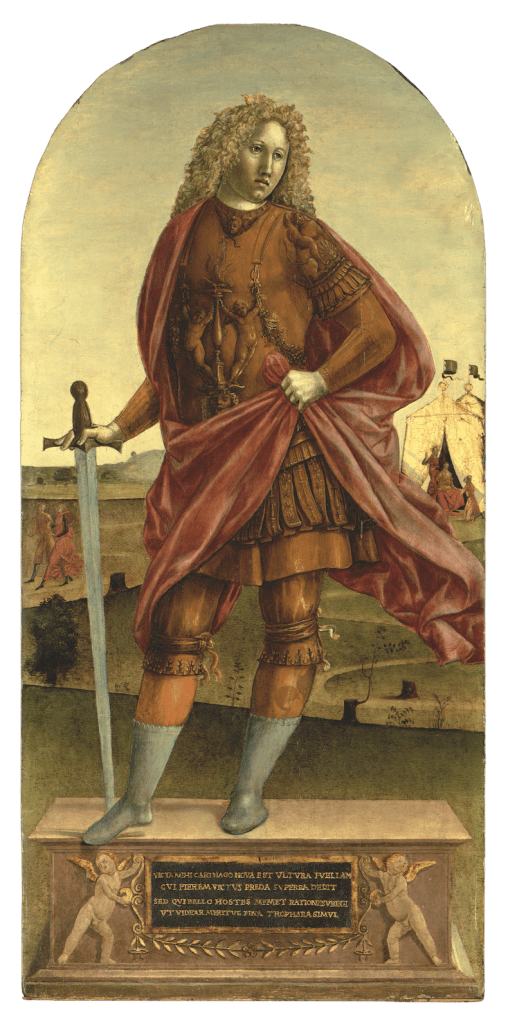
This opening work establishes the themes and priorities of the exhibition, which focuses on narratives and figures from mythology and scripture – intended as moral exempla – in objects made for elite domestic interiors. However, it also alerts the visitor to one of the exhibition’s key constraints: with limited loans, it struggles to convey the breadth and quality of Sienese production. The Scipio panel is the only original on display, while large-scale reproductions stand in for the rest.
Reopened as a cultural hub under new management in 2024, the Palazzo delle Papesse has until now staged only post-war and contemporary exhibitions, so a show of the type of art that originally furnished its spaces is welcome. The building was commissioned in 1460 by Pope Pius II for his newly widowed sister Caterina Piccolomini, who took an active role in overseeing its construction at a time when female patronage on such a scale was rare. While the exhibition galleries retain almost none of their 15th-century fabric, the palace’s remarkable courtyard is largely intact. For this show, festoons of foliage and fruit have been strung between its octagonal brick columns – as they would have been for festivities in the Renaissance.
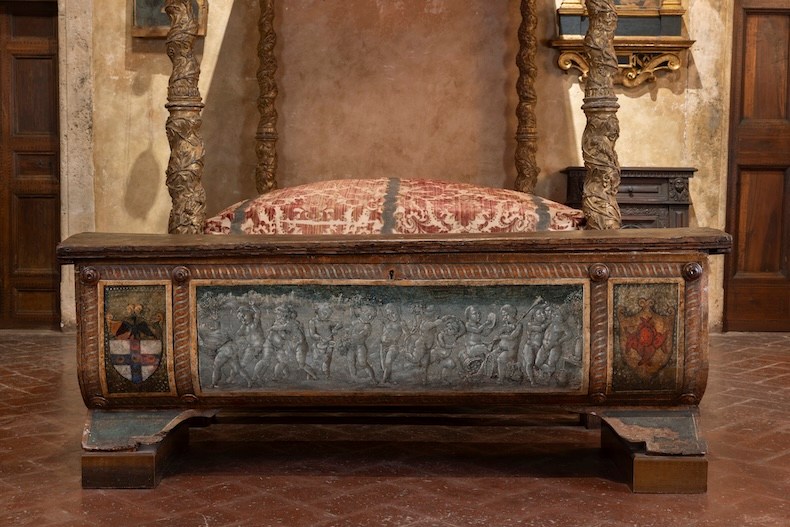
Like the palace, many of the artworks in the exhibition have been transformed over the centuries. As private collectors and emerging museums developed a taste for ‘old Italian’ art in the early 19th century, decorated furnishings were dismembered to create more portable and saleable objects. Almost every painting here is actually a fragment: individual narrative scenes stripped from marriage chests; a bedhead dismantled and reconfigured into a series of closely cropped portraits; and a circular desco da parto (birthing tray) cut down into rectangular form and mounted in a gilt frame. Particularly fascinating, and less commonly found in exhibitions, are the fragments of sbacchere, long wooden strips that were slotted between ceiling beams and painted with writhing vegetation, nude figures and sometimes whole allegorical scenes.
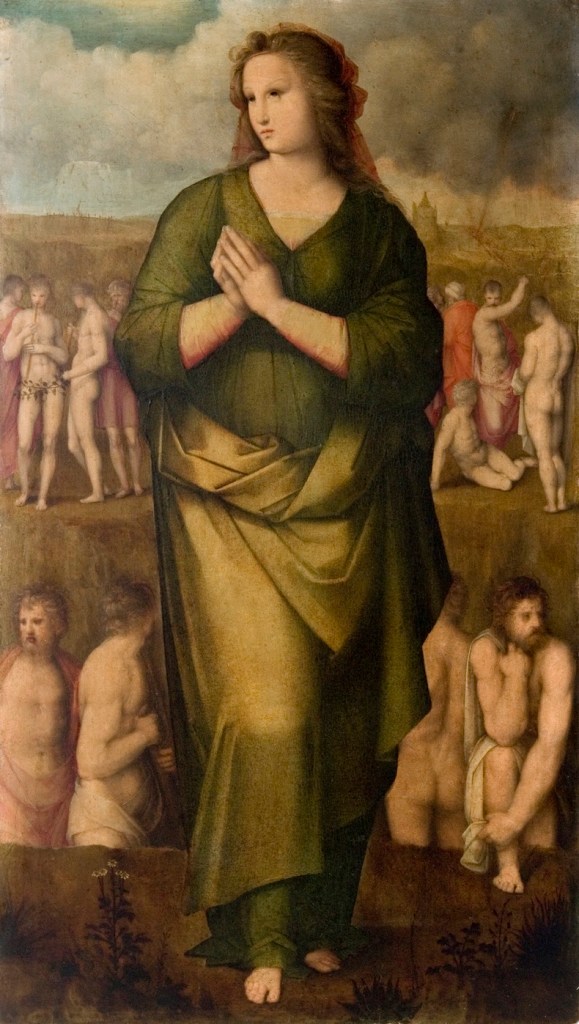
It is extraordinary to think that whole ceilings were adorned with sbacchere; indeed, it is difficult to visualise. The curators are clearly aware of the challenge decontextualised artworks pose to modern-day viewers and, in places, have tried to restore something of their lost settings. Andrea del Brescianino’s three Virtues (1517–18), for example, are displayed above a modern fibreboard bench, recalling the position they occupied as spalliere above a lettuccio. While this schematic representation of the furniture jars somewhat, it is preferable to attempting a more realistic rendering of a day bed, given how little is known about what they actually looked like.
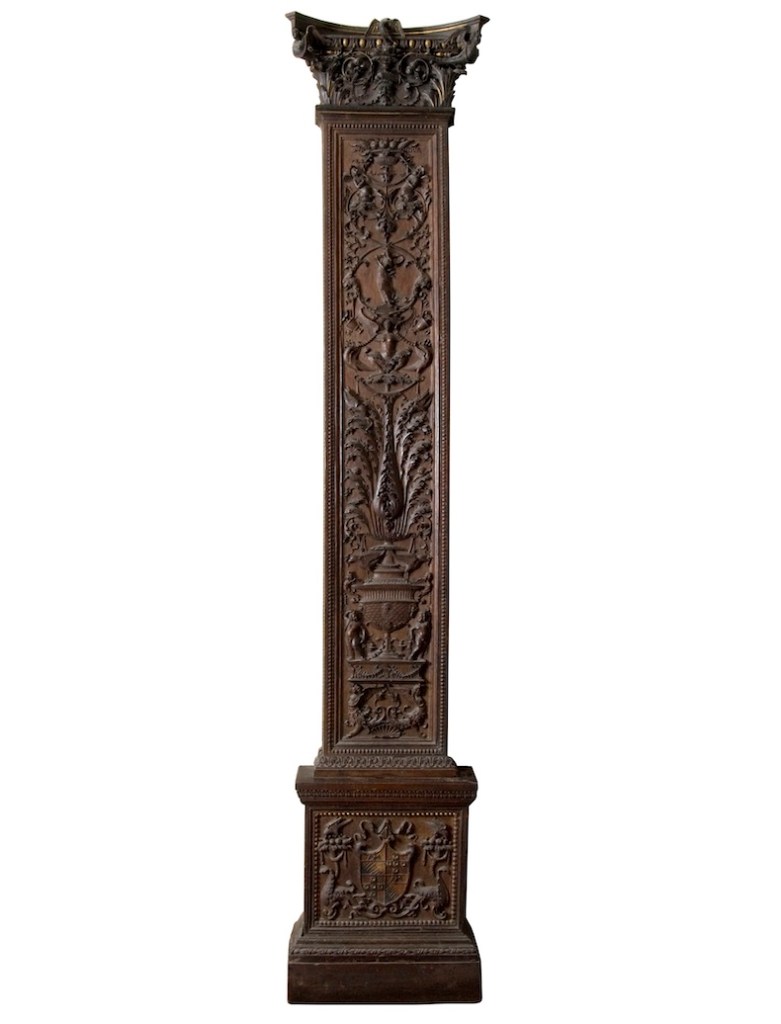
However, it is the woodwork – a relatively rare survival – rather than the associated paintings that is in the spotlight later in the show. On display are two pilasters depicting figures of Faith and Hope interwoven with grottesche, carved by local artist Antonio Barili and originally installed in the Camera Bella of the palace built by Sienese lord Pandolfo Petrucci in the first decade of the 16th century. These pilasters served to divide the scenes of the room’s fresco cycle, based on Petrarch’s Triumph of Chastity and painted by Pinturicchio, Luca Signorelli and Girolamo Genga (several of which are now in the National Gallery in London). Though it is a shame that these painters, so important for Sienese art of the period, are not represented in the exhibition, drawing attention to the beauty of the woodwork itself is valuable.
The Camera Bella was decorated in this sumptuous fashion to celebrate the marriage of Pandolfo Petrucci’s son Borghese to Vittoria Piccolomini in 1509. In fact, many of the works on display were commissioned to mark weddings, with marital virtues as their favoured subjects. Desirable qualities in a wife – fertility, fidelity, chastity – were particularly popular; destined to spend their days inside the palace’s rooms, it was women who were often the principal audience of these objects. No figure recurs more insistently than Lucretia, the Roman noblewoman who, in Livy’s account, commits suicide after being raped – a tragedy reframed as an edifying example of chastity. A cassone panel on loan from the Musée du Petit Palais in Avignon sets Lucretia’s final moments in a doll’s-house interior of dizzying perspective and zig-zagging crenellations, while a brilliant oil sketch by Domenico Beccafumi captures in lurid tones the instant before her dagger strikes.
Pinacoteca Nazionale, Siena
One of the exhibition’s greatest strengths is the erudition with which the curators trace the influence of classical texts on the artworks. Not content merely to identify a painting’s subject or its origins in Virgil, Ovid or Plutarch, they seek to determine the specific text that may have inspired it, examining the wording of vernacular inscriptions or subtle details of the imagery. In the process, a distinctly Sienese sensibility emerges, with the writings of humanists such as Francesco Patrizi and Giovanni Antonio Campano informing the iconography of the city’s art. This modest but intelligent show, and its wide-ranging and lavishly produced catalogue, is a promising indication of what the Palazzo delle Papesse has to offer the cultural landscape of Siena today.
Living the Renaissance: domestic furnishings in Siena from the 15th century to the age of Mannerism is at the Palazzo delle Papesse, Siena, until 1 November.
From the September 2026 issue of Apollo.