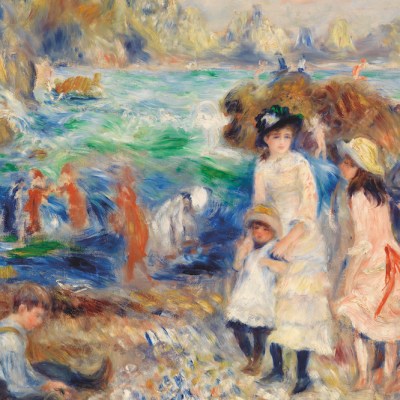
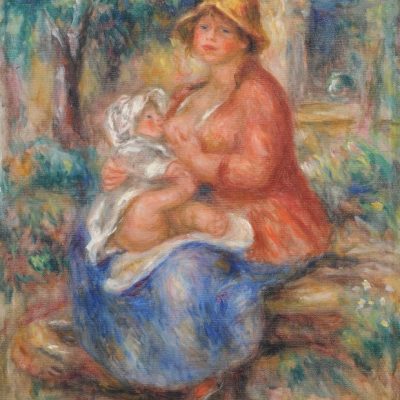
Last month thieves broke into the Musée Renoir in Cagnes-sur-Mer and stole four of the artist’s paintings. In their rush to escape, they abandoned two. The work of Pierre-Auguste Renoir might be worth stealing, but perhaps not doing time for. Some would have it that he was a reactionary anti-Dreyfusard who slavered over young women, turning out lazily prettified scenes of Parisian life during the first half of his career and ridiculous female nudes during the second: ‘monotonously compact, rounded breasts and thunderous thighs’, as Peter Schjeldahl put it in the New Yorker in 2019. Among Renoir’s collectors, or would-be collectors, is Donald Trump, who owns what appears to be a replica of Two Sisters (On the Terrace) (1881), which he insists is an original.
‘Renoir and Love’endeavours to make Renoir great again. Having done excellent business at the Musée d’Orsay earlier this year, it is mounted in collaboration with both the d’Orsay and the Museum of Fine Arts in Boston, where it will move in February 2027. Over five rooms and 45 pictures – selected from the first two decades of his career, in which he produced his best work – the curators come as close as anyone to rehabilitating Renoir as a great artist.
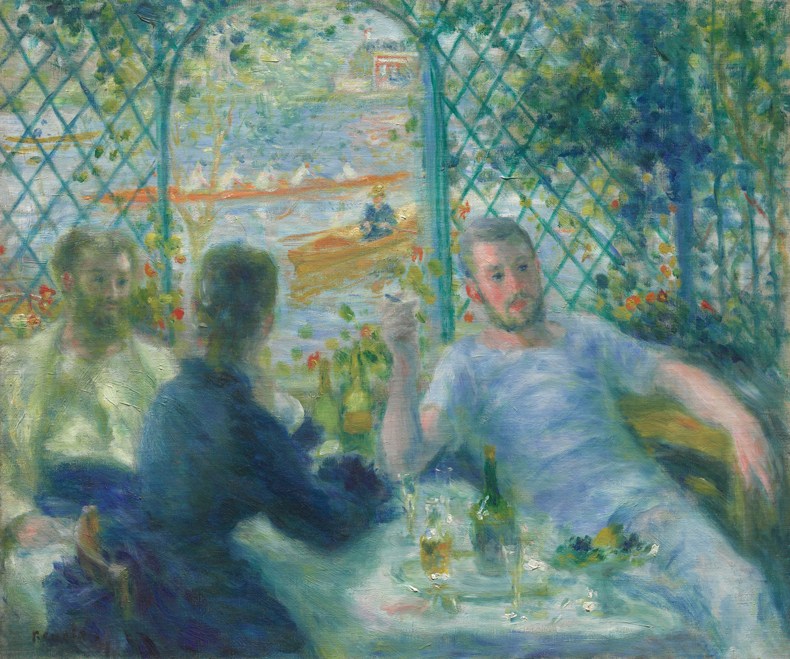
His innovation was to apply Impressionist techniques to depictions of ‘human connection’ as well as nature. In doing so, he better captured how we might perceive and share the fleeting joys of these moments. Several examples stand out beautifully. There are the man’s lips hovering above his dance partner’s cheek as he closes his eyes in Dance in the Country (1883). They could be ready to bestow a kiss, murmur endearments or show how caught up he is in the whirl of their dance, his straw hat having already fallen to the floor. Then there is the languid drag a rower takes on his post-prandial cigarette in Lunch at the Restaurant Fournaise (1875). Relaxed strokes of white and blue on his top echo the Seine flowing in the background; the occasional smear of green reflects nasturtium foliage, which scrambles across the trellis that frames the river and is interspersed with hot daubs of red and orange flowers.
Renoir suffered more than many of his peers from the advent of modernity. When he was a boy, his family were forced to move when their home in the rue d’Argenteuil in central Paris was demolished as part of Baron Haussmann’s modernisation of the city. Before becoming an artist he was an apprentice in a porcelain factory, leaving when machinism rendered his skill unnecessary. He was also nearly executed during the Paris Commune: some National Guardsmen thought he was a spy mapping fortifications when he set up his easel by the Seine. Little wonder he is reported to have said that a picture should be cheerful because ‘there are too many unpleasant things in life as it is’.
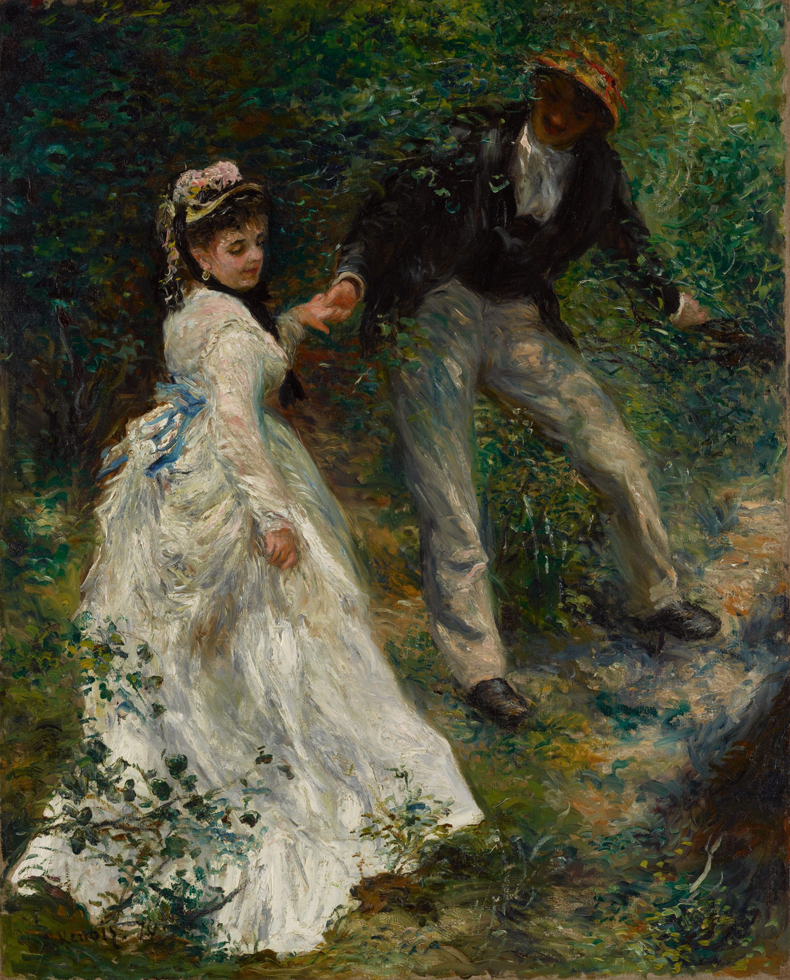
‘Love’ is construed broadly here, then, as the consolations for modern life. There is romantic love, of course, as in La Promenade (1870), where another straw-hatted gallant leans back into the swirling, sharp flecked leaves of the Fontainebleau forest as he helps his companion up the path. And there is love of family and of friends, such as At Renoir’s Home, rue St-Georges (1876), a group portrait that includes Camille Pissarro (whom he later refused to exhibit alongside on the grounds that ‘to stick with the Israelite Pissarro means revolution’).
Best of all, there is love of a good time. Near an uncharacteristically taut and spiky self-portrait (1875) in the first room is Mother Antony’s Tavern (1866), showing Alfred Sisley chewing the fat with another couple of bohemians in a favourite Impressionist haunt. In the next room we find the Musée d’Orsay’s monumental Dance at the Moulin de la Galette (1876), displayed in the UK for the first time. Parisians waltz amid the glow of light filtered through acacia trees, dappled in fuzzy splodges across their outfits.
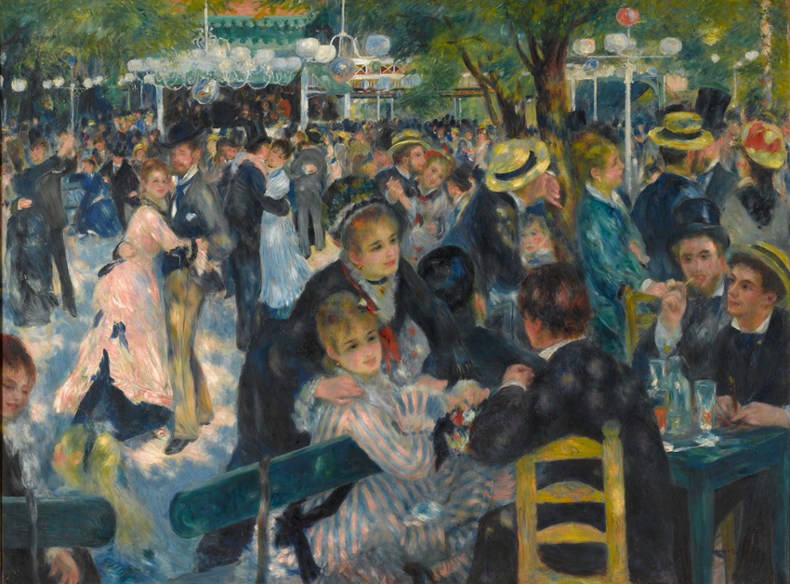
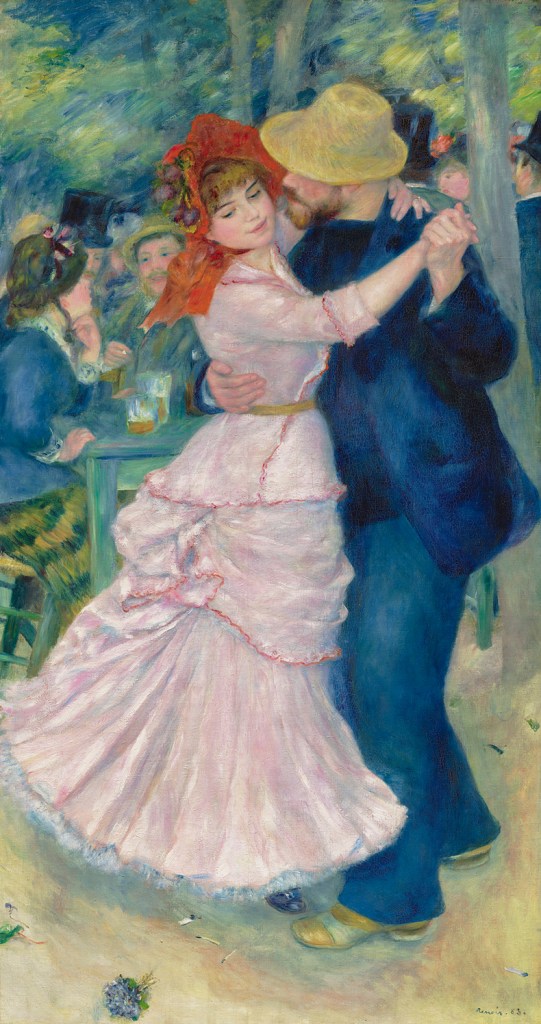
This lovely touch highlights one of Renoir’s limitations. Even in this early period his faces, especially the girls’ and women’s, are often just as fuzzy as his light effects. There is the woman sitting in the foreground of the dance in the Moulin Galette, staring vacantly to her right. You see something similar in the exhibition’s other stand-out loan, Dance at Bougival (1883), from the MFA Boston. The porcelain-doll insipidness of the central woman’s face contrasts with the liveliness and ambiguity playing on her dance partner’s, even if his expression is mostly obscured by another straw hat. This anticipates the blankness of the meaty classical nudes that characterised his later work, represented here by The Great Bathers (1883), in which the titular figures seem to be both chatting and moaning with pleasure. Renoir was right that joy has a place in great art; capturing it requires more imaginative sympathy than he was always capable of.
‘Renoir and Love’ is at the National Gallery, London, until 31 January 2027.