From the September 2026 issue of Apollo.
On 17 March 1861 the Kingdom of Italy was proclaimed by parliamentary decree under King Vittorio Emanuele II of the House of Savoy. The shape of the new nation would remain uncertain until July 1871, when Rome, under papal rule until the previous year, was declared the new nation’s capital. But in September 1861, Vittorio Emanuele sealed the achievement by opening the first Esposizione nazionale italiana in Florence, then Italy’s capital. Modelled on London’s Great Exhibition of 1851 and Paris’s Exposition Universelle of 1855, it was intended to foster an optimistic, modern idea of national unity. Art was a significant feature, underlining the deep cultural roots of Il Risorgimento (literally, ‘resurgence’). For more than 40 years novelists, poets, sculptors and painters had been exploring images and ideas drawn from Italy’s glorious past to project a new independent future. This exhibition was the first time that the many emergent strands of painting in different regions were shown together, from the high Romanticism of the Milanese artist Francesco Hayez (1791–1882) to the radical realism and proto-Impressionism of the Florentine group known as the Macchiaioli.
Many artists had been political activists and had fought in the revolutionary wars. It was the heady combination of political fervour and military action that inspired some to switch from a colourful and dramatic historicism, heavily influenced by Sir Walter Scott and inculcated by the Florentine painter and teacher Giuseppe Bezzuoli (1784–1855), to the pursuit of contemporary images exemplified by Giovanni Fattori, Silvestro Lega and Telemaco Signorini. Their work was characterised by sketchy immediacy and strongly contrasting patches of dark and light; it was these patches, macchie, that gave the Macchiaioli their name, though it also contained echoes of the macchia (‘scrubland’) of the Maremma in Tuscany, from which came the phrase vivere alla macchia (‘to live as an outlaw’). For the next 30 years their politically engaged art set them apart from Impressionism as it took hold in Paris from the 1870s, giving rise to a distinct Tuscan school of landscape painting and, later in the century, to the Divisionismo of Giuseppe Pellizza da Volpedo and Plinio Nomellini.
Outside Italy, these artists are little known – France dominates the narrative of 19th-century Western art. But according to Claude Piening, senior international specialist in 19th-century European paintings at Sotheby’s London, there is a market for certain key artists, especially Hayez – ‘A striking painter, in the lineage of Ingres, he is a household name in Italy but also sought after internationally.’ Il bacio (The Kiss), though set in the Middle Ages, alludes to the Risorgimento through a plumed hat and cloak as well as red tights – Garibaldi’s volunteers wore red shirts – to illustrate the scenario of the young idealist leaving his lover to go to war. The first of four versions was shown in Florence in 1859 and instantly became famous. Piening sold a second version, from 1861, at Sotheby’s London in November 2008 for £780,450, against an estimate of £400,000–£600,000. A version from 1867, with redder tights and the female lover in blue rather than white, sold at Christie’s New York in 2016 for $1.9m, almost double the upper estimate and a record price for the artist. In 2024 Hayez’s much earlier Ingres-influenced painting Bathsheba (1827) sold at Christie’s London for £1.5m against an estimate of £600,00–£800,000. Laura Mathis, head of sale, 19th-century European art at Christie’s New York, says that while interest in other mid-century Italian painters has dipped significantly since 2008, ‘Hayez has been the key outlier, and has not seen his prices decrease in the same way at all.’ She adds: ‘Direct Risorgimento themes have the greatest resonance within Italy, which makes sense. But Hayez’s quality as an artist holds broad appeal within the wider market as well.’
There are other exceptions. In 2003 Signorini’s striking picture L’Alzaia (The Towpath) (c. 1865), which won awards at the Vienna World Fair in 1873, was chased to a world record auction price of £2.8m at Sotheby’s London. Piening says that ‘the painting is an incredible expression of human strength, but shows the divisions that still existed in Italian society by placing the dandy apart from the hauling men. We priced it at £180,000!’ In 2023 at Sotheby’s London, another painting juxtaposing the rising bourgeoisie and the working class, Vincenzo Cabianca’s enigmatic Ai bagni di Viareggio (At the baths of Viareggio) of 1866, achieved £956,000, well above the low estimate of £800,000.‘There is still an appetite for great Macchiaioli work,’ Piening says, and he notes ‘a strong swing in the market away from abstract towards figurative art’, with many collectors finding good value in the 19th century.
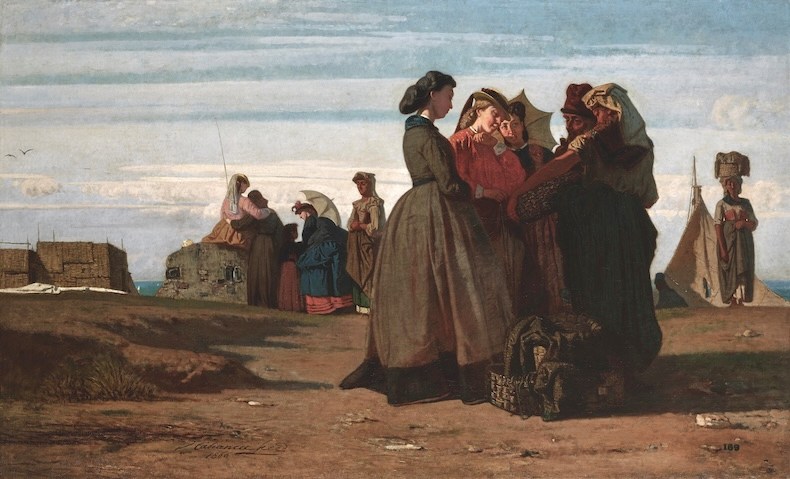
One major hindrance to wider appreciation of the Macchiaioli’s work is the difficulty of securing export licences from Italy for works considered to be of national significance. At the baths of Viareggio is one of only six pictures by Cabianca to have appeared at auction internationally in the last ten years. It is being shown by Marco Voena at the International Biennale of Antiques (BIAF) in Florence (26 September–4 October). Unusually, it was acquired by an American in Turin the year it was painted.
Although Hayez has long been collected by foreigners and is well-represented in museums internationally, in the late 19th and early 20th centuries most American collectors went to France. Indeed it is the Italian painters who went to Paris around that time – Giuseppe De Nittis, Giovanni Boldini and Federico Zandomeneghi among them – who are now seeing strong international interest. At the baths of Viareggio is the first picture by a Macchiaioli artist that di Robilant has handled, but he does sometimes encounter works by the much-travelled Carlo Bossoli, originally from Lugano, Switzerland, who between 1859 and 1861 produced a famous series of gouaches of the battles for Italian independence.
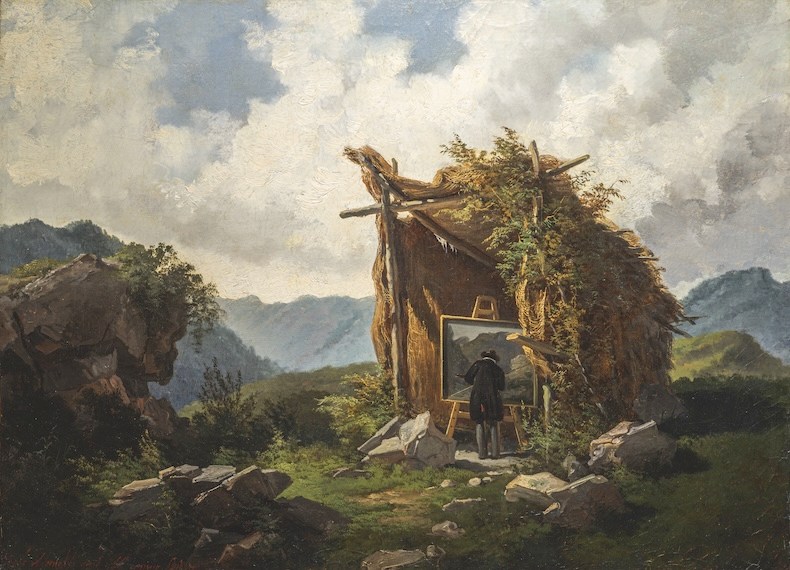
Enzo Savoia, of specialist 19th- and early 20th-century dealership Bottegantica in Bologna, sees a decline in interest in Macchiaioli painting among private collectors internationally. Institutions are interested but finding a good picture in good condition that is already abroad is difficult. He does have ‘a very nice Signorini’ and works by Fattori. Another BIAF exhibitor, Alessandro Marletta of Galleria Antiquaria Marletta, is more optimistic. He suggests that a recent exhibition devoted to Giuseppe Bezzuoli at the Palazzo Pitti in Florence and this year’s focus on the Macchiaioli at Milan’s Palazzo Reale, timed to coincide with the Winter Olympics, have helped raise the international profile of these nationally revered artists. Research undertaken by his gallery has shed light on many lesser-known figures, including Luigi and Carlo Ademollo. He will exhibit Carlo Ademollo’s Self-portrait en plein air (1855) – an important artistic statement.
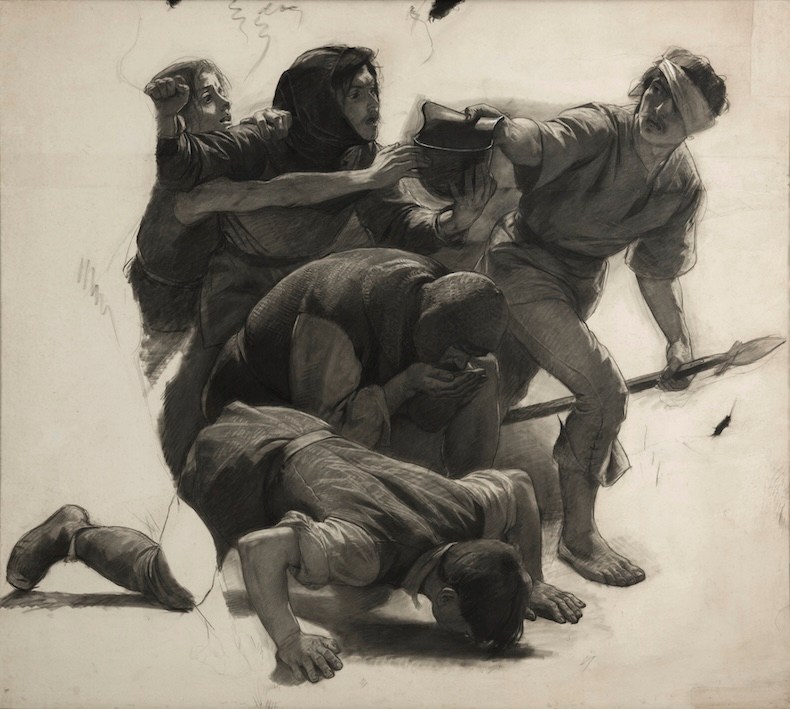
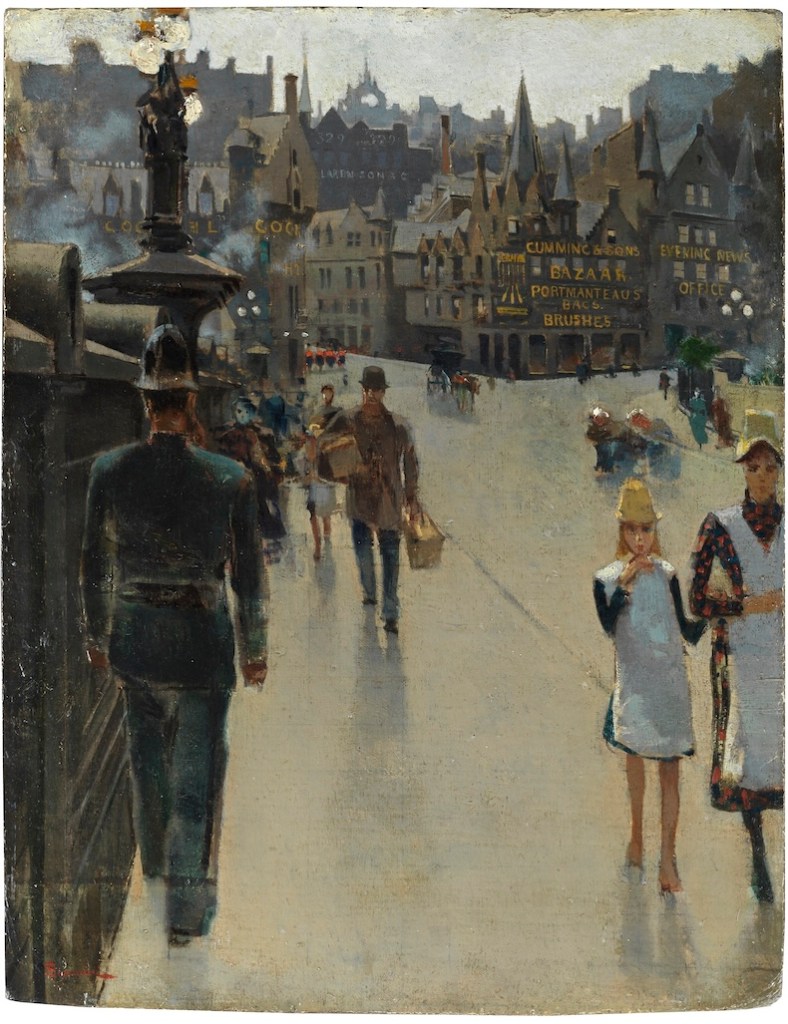
Andreas Pampoulides, of London-based dealership Lullo Pampoulides – also present at BIAF – has recently had some success in exporting significant Risorgimento works from Italy. In 2018 the National Gallery of Art in Washington, D.C., acquired from the gallery an impressive large-scale charcoal drawing by the Turin-born artist Andrea Gastaldi (1826–89), depicting a group of life-size figures – a rare study for Gastaldi’s major painting La Costanza dei Tortonesi (also known as The Thirst of the People of Tortona, 1866–67). ‘The museum understood the value of the picture,’ Pampoulides says. He notes that, although interest is slowly growing in this field, ‘in reality, it is a local market. With non-Italian collectors and museums you have to do much more to explain the importance.’ In 2022, however, the National Galleries of Scotland were happy to acquire from him, for a six-figure sum, a vibrant painting from 1881 by Signorini of Waverley Bridge in Edinburgh, with the distorted perspective of passers-by and buildings that distinguishes his work. Pampoulides says that ‘Besides its subject matter, central to its appeal was that it was not French.’
From the September 2026 issue of Apollo.