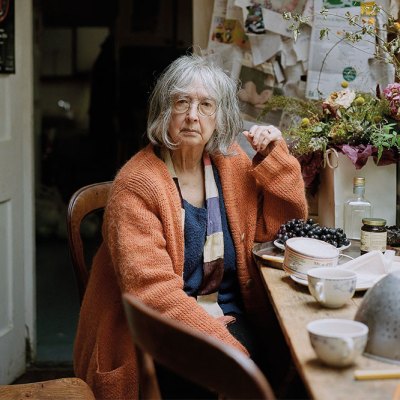
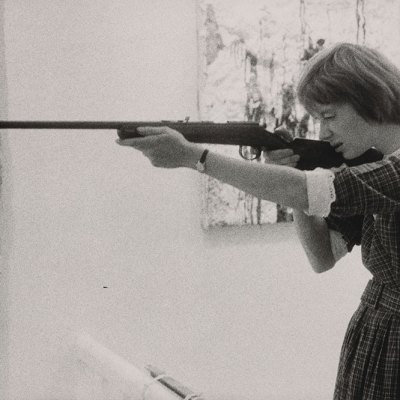
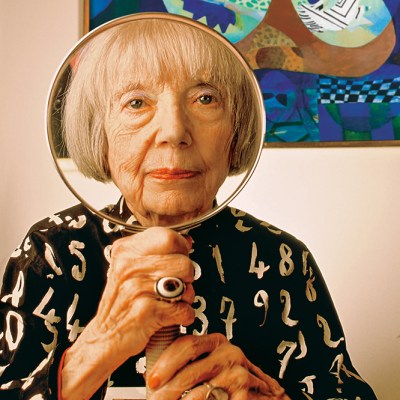
An omelette, a figure skater, a doodlebug; a daffodil, a rat, Nicole Kidman’s back. Try to find a link between these words and you’d be sure to come up short, but in an exhibition of Rose Wylie’s work at the Royal Academy in London, such disparate references sit side-by-side in harmony. ‘The Picture Comes First’ is Wylie’s largest exhibition to date and its title is both a nod to their making and an imperative – if Wylie likes the look of something, be it yesterday’s breakfast, a newspaper clipping or a scene from her favourite film, she’ll put it down on paper or in paint.
It was this unpretentious approach to artmaking that made Wylie’s name when she was in her seventies – although she had studied at Folkestone and Dover School of Art in the 1950s, she took several decades off while raising her children. Now 91, she has gained a reputation as an unassuming rebel, drawing and painting in a graphic and playful style that forgoes technical perfection. ‘In painting, I don’t like too much pernickety, precious fiddling about,’ Wylie said in 2023. ‘Perhaps you’ve noticed.’
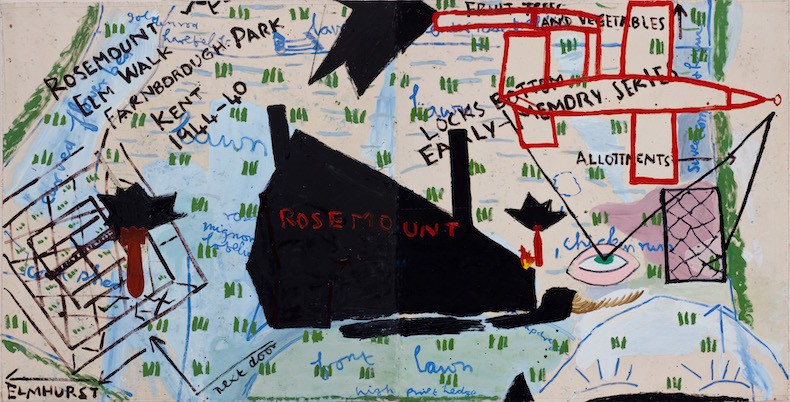
Loosely divided into sections based on her inspirations, processes or opinions about making art, the exhibition opens with paintings that draw on Wylie’s childhood memories of the Blitz. Doodlebugs are rendered as imposing globs of black in works such as Black Doodlebug (2022), while in Park Dogs and Air Raid (2017), planes are in combat above while dogs and ducks wander in a park below. Casting aside the conventions of perspective, Wylie’s dogs and doodlebugs are almost the same size, echoing the attentions of a child who might have been equally transfixed by both. Rosemount (Coloured) (1999) sets out the scene of a bomb landing on her family home in Bromley, Kent, and sits somewhere between an aerial image and a map, plotting out different parts of the home in cursive text (‘front lawn’, ‘chicken run’). Mingling symbols of war with childhood memories – family pets, the neighbour’s house, trips to the park – the works display Wylie’s indiscriminate appetite for images.
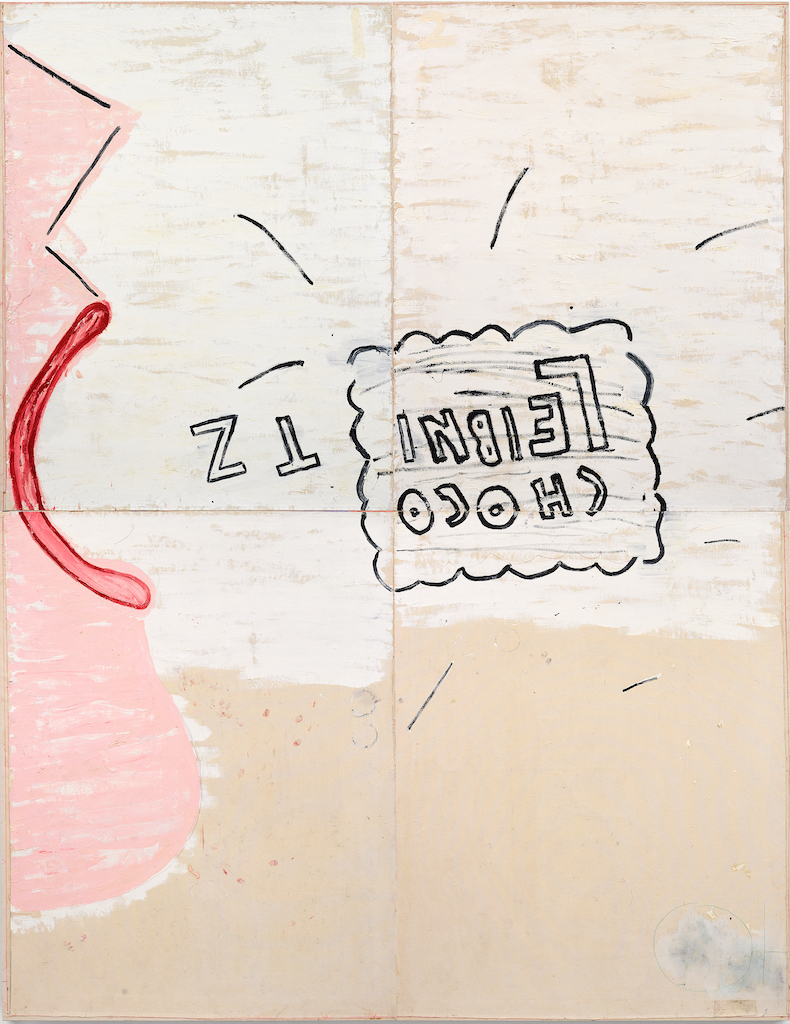
Though Wylie is intentionally unfussy in her work – creating large, deceptively simple works, applying paint in thick streaks, even with her hands – this doesn’t mean her compositions lack consideration; she often redraws the same image several times before committing it to canvas and will patch things over when she’s unsatisfied. In Choco Leibnitz (Self-Portrait) (2006) Wylie has sketched her face in profile as she pops said biscuit into her mouth; another work, also titled Choco Leibnitz (2006) and presented in a later section of the exhibition, mirrors that composition, with little altered apart from a few added colours and a massive increase in size.
Given the emphasis the wall texts place on Wylie as a prolific sketcher, there are surprisingly few sketches here; nevertheless, there is plenty to charm in what has been included. Roy Oxlade (2014) is a spare but striking caricature of Wylie’s late husband, all spectacles and hard-set mouth, while the title of Doesn’t Do You Justice (2022) suits the rough treatment of its subject. The drawings demonstrate Wylie’s appeal: the work is fun, showing an artist enjoying the process of creation as much as the result. Homage to Jimmy Lee Sudduth’s Statue of Liberty (2020) is sketched on to a page of Wylie’s diary, tucked next to reminders for upcoming events. The small drawing was inspired by a painting by Sudduth, likely seen by Wylie some years earlier. Conjured from memory, there’s something delightfully relatable about it: who hasn’t doodled in their notebook to pass the time?
Further into the exhibition, Wylie’s love of pop culture and film, and her fascination with images drawn from other forms of media – newspapers, books, the internet – come into focus. She’s clearly a Tarantino fan: there are paintings of threatening figures of Inglourious Basterds (2009) in khaki coats and a gory scene from Kill Bill (2003) is repeated across two connected canvases. Celebrities make an appearance and sport wiggles its way in too, capturing how Wylie’s attention flits from one thing to another. In Pink Skater (Will I Win, Will I Win) (2015), a woman jumps across the canvas, her face a picture of concentration, her costume pink and puffy like a wad of chewed bubble-gum. A green outline pokes out behind the figure, hinting at earlier attempts to nail down her shape and red stars burst out around her.
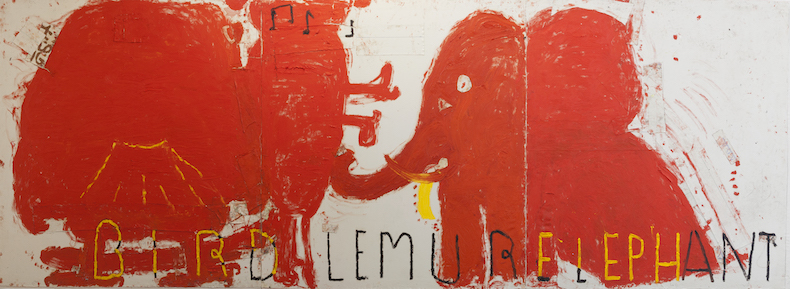
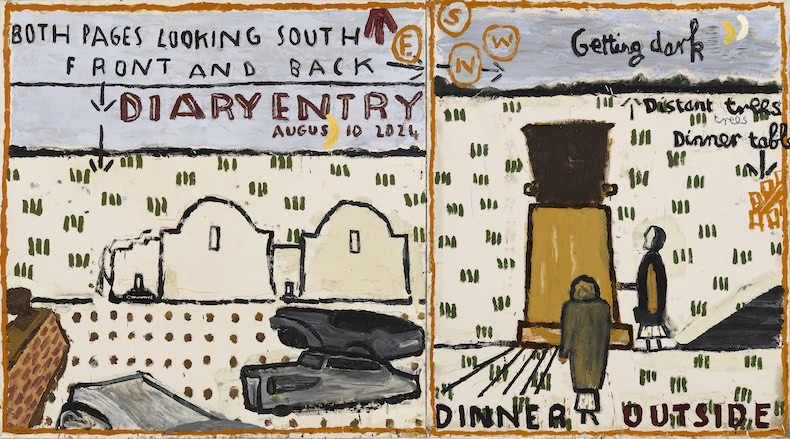
There are even signs of rebellion against her own technique, in works where Wylie turns away from the clear-cut references that populate so many of her paintings. Between 2015 and 2016 she made a series of massive monochromatic paintings of animals: elephants, horses, frogs, birds, cats and more. Painted in cadmium red, blue, black and a warm brown, mainly with her hands, they teeter on abstraction, as one form blends into another. Appealing as these paintings are, it’s those hanging nearby that record Wylie’s quiet life in her Kent cottage that are the most endearing. Operating as a kind of visual diary, they capture the simple pleasures of each day; Dinner Outside (2024), for example, recalls a twilit summer night, with Wylie preserving a night spent with friends. The Well-Cooked Omelette (1989) – the earliest painting included here – shows just that, a pile of eggs served on a blue and white bowl, rendered in loose strokes of yellow and brown. Such simplicity might not be to the taste of every critic, but as an artist committed to capturing whatever takes her fancy, it’s hard to imagine Wylie minding all that much.
‘Rose Wylie: The Picture Comes First’ is at the Royal Academy of Arts, London until 19 April.